Festival Fodder
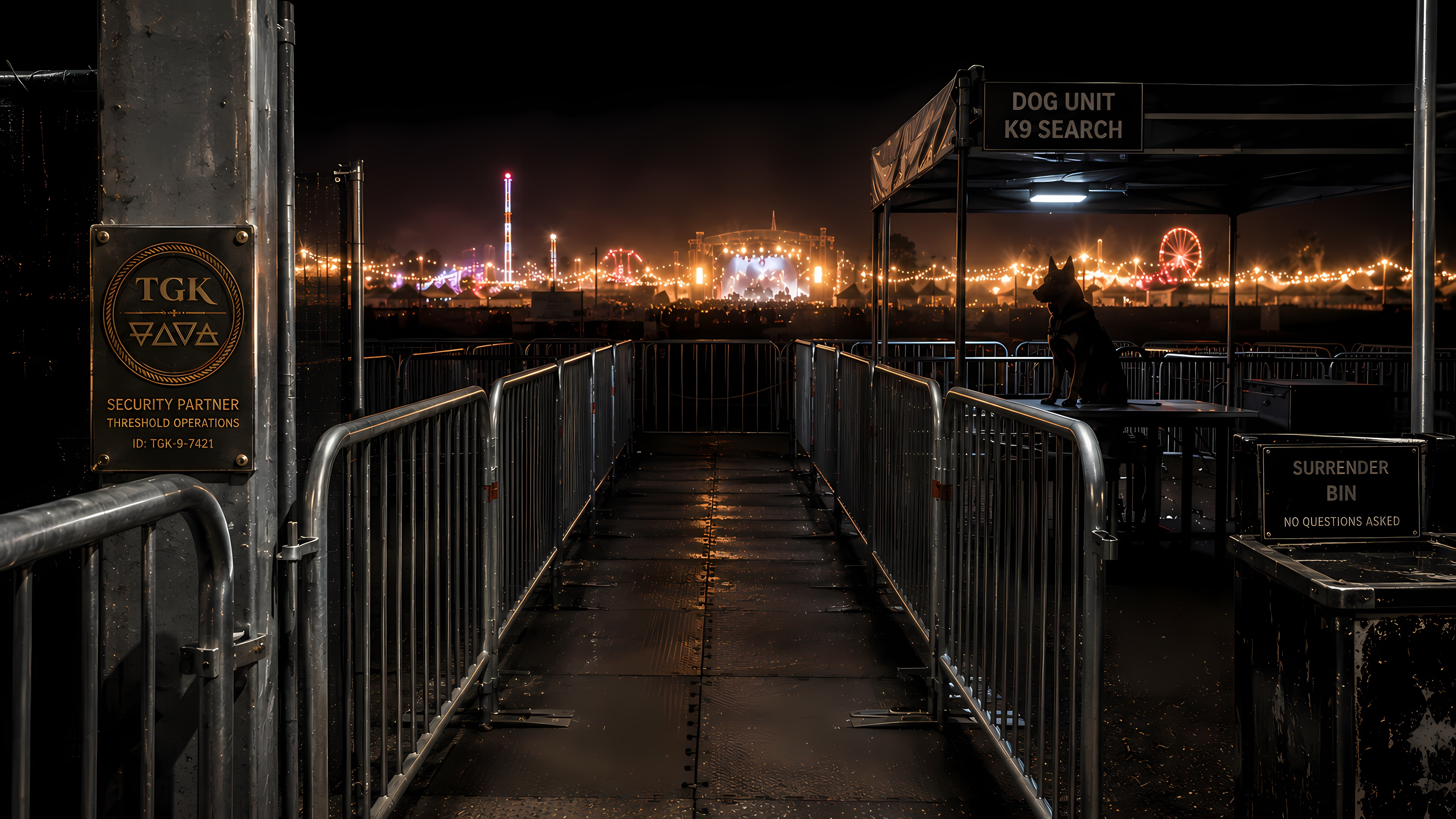
The machine appears in fluorescent form at the mass leisure event. Search lanes, dogs, amnesty bins, private security, licensing conditions, police visibility, body checks, and rapid disposals converge inside spaces marketed as release, pleasure, music, and youth freedom. [3] [4] [5]
That is what makes the pattern so revealing. The festival is sold as temporary escape from ordinary life, yet it often functions as an intensified training ground for ordinary submission. The attendee is often asked to consent in advance to surveillance conditions they would resent elsewhere. Search becomes normal. Queue discipline becomes moral. Presence itself becomes conditional on accepting a legal and security architecture designed to sort bodies quickly under the sign of public safety. [3] [4] [5]
Drugs law is central to this inversion. Through the Misuse of Drugs Act 1971 and related enforcement structures, entire youth populations can be rendered pre-suspect in environments already coded as risky [1][2]. The result is not just occasional prosecution. It is a whole climate: one in which experimentation, subculture, altered-state exploration, and crowd energy are folded into an intake system that makes compliance cheap and contest expensive.
Festival Fodder names this harvest logic. The crowd is invited as consumer spectacle and then processed as a field of possible infractions. Joy is not abolished. It is instrumentalised. The event becomes both entertainment product and policing opportunity, a place where the state and its private auxiliaries can rehearse suspicion on a population taught to interpret this as the price of entry.
A note on method
This episode stays with legislation, festival guidance, policing powers, and reported event-enforcement patterns. The claim is not that drug harm is imaginary or that every search is abusive. It is that high-discretion event environments can turn minor suspicion into fast compliance, record creation, and low-visibility intake.
TL;DR
- Festival policing turns celebration into intake. Search lanes, licensing conditions, body checks, and rapid disposals convert a leisure space into a high-discretion enforcement environment.
- Consent is front-loaded. Attendees are asked to accept surveillance and suspicion as the price of entry before any specific wrongdoing is established.
- Drugs law widens the net. Entire youth populations can be rendered pre-suspect in spaces already coded as risky, making compliance cheap and contest expensive.
- The setting lowers resistance. Distance from home, fatigue, excitement, cost exposure, and limited legal clarity make fast submission more likely.
- The issue is not only individual searches. It is the broader inversion by which joy, subculture, and altered-state gathering are reorganised into manageable populations for suspicion and record creation.
Continue reading
This episode continues inside TGK
Unlock the full text, downloadable PDF edition, and the wider archive by signing in or becoming a member.