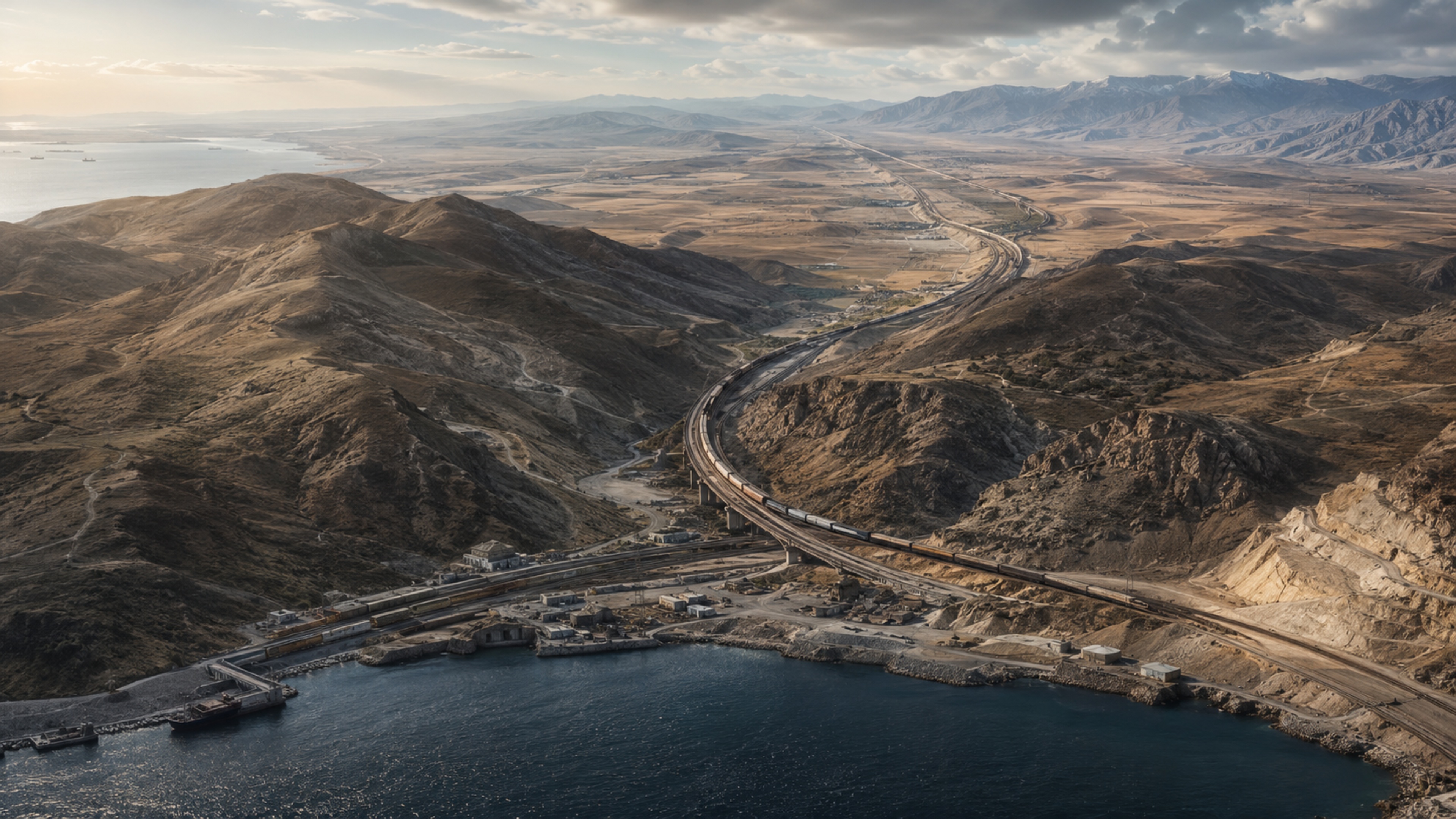
Railroad, Not Just Rhetoric
Published: 2 March 2026. Last major update: 1 August 2026. This page uses dated editorial notes for substantive post-publication developments. The original argument below is preserved unless a factual correction is explicitly marked.
Corridor Lens Summary
- INSTC hinge: Iran is the middle section joining Indian Ocean access to Russian and Eurasian overland movement.
- Rasht-Astara timing: the missing western rail link turns corridor timing from background context into a pressure variable.
- Mirror retaliation: the 2 March 2026 Strait of Hormuz closure hit the maritime chokepoint the corridor is designed to reduce dependence on.
- Live companion: the Fortress of Fear dossier tracks the running chronology and the broader signal map.
This is a rapid-response investigation, not a numbered Empire Codes episode. It sits alongside the live dossier and extends the corridor argument already visible in Episode I and Episode III.
The narrow claim is simple: Iran is not only a nuclear headline or a permanent enemy image. It is also a transport junction inside an emerging land-corridor system, including the INSTC, that reduces dependence on Western-controlled maritime routes, insurance choke points, and dollar-centred services gates.
If that is true, then pressure on Iran is also pressure on infrastructure. Not the whole story. But a part of the story too large to ignore.
Editorial Updates
This page is updated by addition, not by silent rewriting. Substantive new developments are logged as dated notes so the original publication remains legible.
- Silent edits allowed: typos, formatting cleanup, broken links, and minor wording repairs that do not change the argument.
- Correction rule: if an original factual statement is wrong, mark the correction with a date and state what changed.
- Update rule: if later events extend or strengthen the argument, add them as dated notes instead of rewriting the original body as if it always included them.
Update note: 1 August 2026
The Hormuz administration question has moved from proposal to veto. Reuters reporting carried on 28 July said Oman had delivered a regional-management proposal for the Strait of Hormuz, with voluntary shipping contributions funding navigation, environmental protection, search and rescue, and related services. Reuters reporting carried on 29 July then said Tehran had ruled out that model. A senior Iranian official told Reuters the Omani proposal had no chance of success, while Deputy Foreign Minister Kazem Gharibabadi said Iran had offered a temporary arrangement putting one direction of shipping traffic entirely through Iranian waters and part of the opposite route under Iranian control.
That turn matters because the corridor question is no longer only whether Hormuz reopens, or whether users pay for services. It is whether the recognised traffic scheme, de-mining authority, route assignment, and safety-service funding sit under a regional mechanism, an Omani lane, an Iranian lane, or a contested hybrid. The evidence does not establish why the original strikes happened. It does support the narrower claim that pressure on Iran is now also pressure over who administers the maritime gate that land corridors are meant to make less decisive.
Update note: 29 July 2026
Three developments in late July sharpen the argument in different directions. First, the corridor is now being designed as an institution rather than contested as a battlefield. Reporting attributed to The Wall Street Journal and Reuters, carried by the Jerusalem Post, says Oman sent a delegation to Tehran on the night strikes were halted and has kept Washington informed of a back-channel proposal for joint Omani and Iranian oversight of maritime security and search and rescue in the strait, funded voluntarily by regional states and by the shipping and oil industries. Iran is reported to be engaging while still insisting on control and on fees for safe passage. If that arrangement forms, the users of the chokepoint pay for the authority that governs it.
Second, the constraint on Western enforcement became visible. Al Jazeera reported that the United States and Iran paused strikes from 25 July, and that President Trump had halted escalation plans over the depletion of Pentagon missile-interceptor stocks in the region, while the blockade continued and both navies went on stopping and redirecting vessels. An Iranian ballistic missile attack on American forces ended the pause on 28 July. Corridor enforcement, on this evidence, has a magazine depth.
Third, corridor conditions have started reaching back into sanctions architecture. When the Council of the European Union adopted its 21st sanctions package against Russia on 23 July, legal analysis of the package records that the oil price cap adjustment mechanism was suspended until 14 July 2027 because of Strait of Hormuz conditions, and that a temporary exemption was granted to the Russian LNG purchase and transfer prohibition until 25 July 2027 for third-country transfers under pre-2022 long-term contracts. A chokepoint crisis in the Gulf is now visibly bending the terms of an energy sanctions regime aimed at Russia. That is corridor logic operating on the sanctioning side of the ledger.
On the land-corridor side, the University of Queensland published half-year Belt and Road figures on 27 July recording US$49.8 billion of investment and US$76.5 billion of construction contracts in the first half of 2026, including US$21.8 billion in metals and mining and, for the first time, more than half of total engagement in green projects. The alternative architecture is being financed at scale while the maritime route is being rationed.
Status note on the rail claim: no verified new Rasht-Astara construction or completion milestone was found in this scan window. The timing claim in the original argument therefore stands unchanged and unconfirmed, and should not be read as having advanced.
No substantive paragraphs in the original argument sections below were silently rewritten for this update. New developments were appended here and added to the live dossier.
Update note: 23 July 2026
The framework held for roughly a month and then failed on precisely the clause this page would predict. Associated Press reported that the provision directing Iran and Oman to negotiate the future administration and maritime services of the strait had become the central point in the memorandum's collapse. Washington restored its blockade and asserted control over passage, floated a 20% safe-passage toll, then replaced the fee proposal with Gulf trade and investment commitments. The Guardian separately reported that European governments were weighing a non-compulsory navigation-fee proposal subject to International Maritime Organization backing, while Oman pushed a cooperative safety model and warned against mandatory tolls.
The second development in this window is the more important one for the corridor thesis. AP reported that the Houthis declared a maritime embargo against Saudi-linked shipping at Bab el-Mandeb and attacked two Saudi oil tankers, on a route that was carrying greater Saudi export weight precisely because Hormuz remained disrupted. Traffic displaced from one chokepoint arrived at a second chokepoint and met a second permission gate. That is the maritime-dependency problem stated in its clearest available form, and it is the problem land corridors exist to answer.
Update note: 17 June 2026
The corridor question moved from battlefield to paperwork. At the Palace of Versailles during the G7 summit, President Trump and Iranian President Masoud Pezeshkian signed a 14-point memorandum of understanding providing for a cessation of military operations, the lifting of US sanctions on Iranian ports and oil sales, the release of frozen Iranian funds, and free commercial passage through the Strait of Hormuz for 60 days pending a longer-term framework to be negotiated with Oman and Gulf states. The detail that matters for this page is the structure rather than the signature. Passage was granted as a time-limited concession that expires into a negotiated administration regime, which is a different thing from a reopened waterway.
Update note: 9 April 2026
Developments from 3 to 9 April sharpened the same corridor argument into a more explicit permission system. Reuters reported that Omani-operated tankers, a French-owned CMA CGM container ship, and a Japanese-linked gas carrier crossed Hormuz under the narrowed conditions Tehran was imposing for vessels it deemed non-hostile. On 7 April, Associated Press reported that Russia and China vetoed a watered-down UN Security Council resolution that would have backed defensive measures to reopen the strait. That matters because the chokepoint was no longer only physically constrained. It was also being politically protected from multilateral override.
The next layer made the same pattern more overt rather than less. AP reported that Iran accepted a two-week ceasefire window while saying passage through Hormuz would be allowed for that same period under Iranian military management, not as a return to neutral commercial transit. AP then reported that Israel treated the ceasefire as inapplicable to Lebanon, carried out mass strikes there, and Iran responded by again halting tanker movement. By 9 April, AP reported that semiofficial Iranian outlets had published a chart suggesting sea mines were laid over the traffic-separation route while ships were being shown a path further north near Iran's mainland. The narrow significance for this page is clear: Hormuz is functioning less like an ordinary reopened waterway and more like a filtered corridor administered through alignment, routing, and residual coercive control.
Update note: 2 April 2026
Associated Press then reported that Britain convened 41 countries in a virtual summit on reopening the Strait of Hormuz, with Foreign Secretary Yvette Cooper saying participants discussed coordinated diplomatic pressure on Iran, tighter economic measures to stop Tehran profiting from control of the strait, cooperation with the International Maritime Organization to free trapped ships and seafarers, and a follow-on meeting of military planners to examine mine-clearing and shipping reassurance options. That matters because the chokepoint was no longer being treated only as a bilateral US-Iran confrontation. It was being absorbed into a wider coalition management architecture, turning corridor access into a multistate diplomatic and security problem.
Update note: 29 March 2026
A narrower UK layer now belongs beside the corridor argument. On 24 June 2025, the government's China audit said direct engagement with China was essential. On 27 January 2026, Starmer arrived in Beijing promising a "consistent, pragmatic partnership", and the government later published trade and investment outcomes from the visit. Then, on 2 March 2026, Starmer told Parliament that the United Kingdom "was not involved in the initial US and Israeli strikes on Iran", described that decision as deliberate, and said Trump had disagreed.
This does not prove that Britain has rerouted its supply chains through the INSTC or exited dollar-centred alignment. It does place a core US ally on record pursuing a China-facing economic reset while declining full entry into the opening anti-Iran action. For this page, the significance is narrow but important: pressure on Iran now sits beside visible allied hedging over how far to join the campaign around that junction state.
Update note: 19 March 2026
Reporting on 18 and 19 March pushed the same argument one layer further into energy-node warfare. Associated Press reporting said Israel struck facilities tied to South Pars, the Iranian side of the world's largest gas field and the main source of Iran's domestic gas supply. AP then reported that Iran retaliated by hitting Qatar's Ras Laffan LNG facility and the Habshan gas facility and Bab field in the United Arab Emirates, widening the pressure sequence across neighboring production and export infrastructure.
At the same time, AP reported that at least 89 ships still crossed the Strait of Hormuz between March 1 and 15, with more than one-fifth believed to be Iran-affiliated and other non-Iranian passages continuing through a reduced, selectively tolerated flow. That sharpens rather than weakens the corridor claim: the chokepoint is not simply open or shut. Passage is being filtered while pressure on the junction state spreads outward into adjacent Gulf energy nodes.
Update note: 10 March 2026
Reporting from 5 to 7 March widened the same corridor-pressure frame in two directions. First, Tehran made diplomatic closure explicit: Foreign Minister Abbas Araghchi said Iran was not seeking a ceasefire and saw no reason to negotiate with Washington after talks had twice been interrupted by attack. At the same time, Trump publicly moved the war language beyond a narrow strike rationale by demanding Iran's unconditional surrender and a leadership outcome acceptable to Washington.
Second, the western-flank ground dimension became more overt. Al Jazeera reported that the leader of an Iranian Kurdish faction in Iraq said a cross-border operation into Iran was highly likely and that U.S. contacts had taken place through indirect channels. That does not prove a single master plan. It does show the pressure sequence widening: air campaign, maritime disruption, diplomatic closure, leadership conditioning, and possible frontier-ground activation now converge on the same junction state.
Update note: 3 March 2026
Developments since publication have strengthened the corridor-pressure frame rather than displaced it. The Strait of Hormuz was reported closed and Hapag-Lloyd suspended transits through the waterway; QatarEnergy halted LNG and associated product output after attacks on its facilities; and Hezbollah reopened the Lebanon front. Most significantly for the corridor argument, the maritime chokepoint that land routes are designed to circumvent was itself disrupted as the conflict widened. These developments widen the conflict from a strike event into a broader corridor, energy, and alliance disruption sequence.
TL;DR
- Iran is a junction: the INSTC depends on Iran as the middle section connecting Indian Ocean access to Russian and Eurasian overland routes.
- The timing matters: the Rasht-Astara segment is the missing link, with a completion horizon inside the same 2028 pressure window already visible across Empire Codes.
- This is bigger than ships: land routes, rail freight, and alternative payment rails reduce dependence on Suez, maritime insurers, and dollar chokepoints.
- The strike sequence fits the pressure frame: diplomacy, allied basing access, and military action appeared inside the same corridor-compression moment.
- The Hormuz closure confirms the frame: Iran's first major retaliatory instrument was the maritime chokepoint, showing the same infrastructure under pressure in this piece becoming the instrument of response.
- The claim is constrained: this does not prove a single motive. It argues that infrastructure pressure is a missing variable in the public explanation.
The Railroad
The International North-South Transport Corridor is not a slogan. It is a functioning transport design linking India, Iran, Russia, and onward Eurasian markets through sea, rail, and road. The strategic significance is not that it replaces every maritime route tomorrow. It is that it makes Western maritime dominance less exclusive over time.
The critical point is the western rail gap. The Rasht-Astara segment has long been treated as the missing link that would make the route materially more continuous and more attractive for freight. Once that segment is completed, Iran's role changes from sanctioned problem-state to infrastructure hinge.
The completion target sits inside the same 2026 to 2028 pressure window already visible across Empire Codes, which is why the timing claim matters rather than functioning as background context.
That matters because empires built on naval reach and maritime choke points do not only fear military rivals. They also fear routes that make their gatekeeping less necessary. A corridor that is faster, cheaper, and less exposed to Suez or insurance bottlenecks is not just a logistics improvement. It is a redistribution of leverage.
In that frame, Iran is not peripheral. It is the join between systems: Indian Ocean access, Caspian movement, Russian trade, and wider Eurasian routing. Remove the junction, and the corridor degrades. Keep it functional, and the alternatives keep growing.
Why Now
The public story around Iran defaults to familiar language: nuclear risk, deterrence, regional security, retaliation. None of that disappears here. But it is not enough on its own to explain why the Iran file keeps resurfacing with urgency precisely as land-corridor and payment alternatives become more practical.
By early March 2026, several layers sat on top of one another: Tehran was hit directly; the UK publicly confirmed a narrower defensive basis for allowing use of British bases; and the argument inside Empire Codes had already reached the point where tariffs, services gating, and export controls were no longer the whole coercion picture. Military action looked less like a separate category and more like the next instrument when prior layers had not stopped the route from advancing.
That is the important distinction. The claim is not "there are no other motives." The claim is that corridor timing and junction geography fit the sequence too closely to be treated as irrelevant background.
The working test is straightforward: if Iran were not central to a route system that reduces reliance on Suez, maritime insurance, and dollar-centred permission corridors, would the pressure cycle look the same? If the answer is no, then infrastructure is not an afterthought. It is part of the target.
What this argument is not saying
This argument does not require pretending nuclear, military, alliance, or regional-security motives do not exist. It says those motives alone do not adequately explain the timing and intensity of pressure if Iran is also functioning as a corridor junction inside an emerging land-route system.
In other words: this is not a single-cause theory. It is a missing-variable argument. Public war language may describe the strike. Infrastructure pressure helps explain why this pressure keeps returning to Iran, and why the route itself belongs inside the analysis.
Live updates remain in the Fortress of Fear dossier. The long-form season context remains in Episode I and Episode III.
Evidence Base
Primary and supporting records used for this rapid-response analysis.
References
-
[1] Reuters (17 May 2023): Russia and Iran sign rail deal for corridor intended to rival Suez
:Rasht-Astara rail agreement described as the missing link in the INSTC.
-
[2] DHL: On the Right Track - China-Europe rail's explosive growth
:Commercial evidence that land-corridor freight is no longer hypothetical.
-
[3] Financial Times: HSBC Hong Kong joins China's alternative to Swift global payments system
:Payment-rail diversification relevant to sanctions and settlement pressure.
-
[4] Reuters (31 Oct 2024): BIS to leave cross-border payments platform Project mBridge
:Shows live contestation around alternative payment architecture.
-
[5] GOV.UK (24 Jun 2025): China audit - Foreign Secretary's statement
:Official UK statement setting out the government's China reset and engagement posture.
-
:Official readout for Starmer's Beijing visit and the government's economic framing of China engagement.
-
[7] GOV.UK (30 Jan 2026): Prime Minister visit to China - trade and investment factsheet
:Government factsheet summarising trade, investment, and market-access outcomes from the China visit.
-
[8] Prime Minister's Oral Statement on Iran: 2 March 2026
:Official UK statement confirming non-participation in the initial strikes and recording Trump's disagreement.
-
[9] GOV.UK: PM Statement on Iran (1 March 2026)
:Official UK statement on British involvement and basing access.
-
[10] Al Jazeera (28 Feb 2026): Explosions in downtown Tehran, smoke seen rising
:Contemporary reporting on the opening phase of the strike sequence.
-
[11] Hapag-Lloyd: Vessel situation in the Middle East
:Carrier advisory used for the Strait of Hormuz closure and transit suspension update.
-
[12] S&P Global (2 Mar 2026): QatarEnergy suspends LNG production after military attacks
:Trade-press reporting on the QatarEnergy halt and related infrastructure strikes.
-
[13] Associated Press (2 Mar 2026): Hezbollah attacks resume and Israel strikes Lebanon
:Wire reporting used for the renewed Lebanon front update.
-
[14] Saudi Press Agency (3 Mar 2026): Drones target the US Embassy in Riyadh
:Official Saudi statement on the Riyadh embassy strike.
-
[15] Al Jazeera (6 Mar 2026): Iran war - What is happening on day seven of US-Israel attacks?
:Used for the diplomatic-closure update, including Araghchi's statement that Tehran saw no reason to negotiate with Washington.
-
[16] Al Jazeera (6 Mar 2026): No deal with Iran except unconditional surrender, Trump says
:Used for the war-aim widening update, including public demands for unconditional surrender and leadership terms.
-
:Used for the western-flank ground-pressure update and reported US contact with Kurdish groups.
-
:Used for the South Pars update, including the field's role as Iran's main domestic gas source and the escalation risk for Gulf energy infrastructure.
-
:Used for the selective-passage update, including the reduced but continuing Hormuz traffic and Iran-affiliated vessel share.
-
[20] Associated Press (19 Mar 2026): Strikes hit world's largest natural gas field in Iran
:Used for the retaliation update, including the Ras Laffan, Habshan, and Bab strikes.
-
[21] Associated Press (2 Apr 2026): Britain convenes 41 countries on reopening the Strait of Hormuz
:Used for the coalition-management update, including diplomatic pressure, economic measures, and follow-on mine-clearing planning around Hormuz reopening.
-
[22] Reuters (3 Apr 2026): Japanese, French and Omani vessels cross the Strait of Hormuz
:Used for the selective-passage update, including friendly-flagged or friendly-owned vessel movements through Hormuz under Iranian filtering.
-
:Used for the UN-veto update, including the blockage of a softened Security Council attempt to reopen Hormuz.
-
:Used for the ceasefire-management update, including the two-week reopening window and Iranian military management of Hormuz passage.
-
:Used for the Lebanon carve-out update, including the renewed mass strikes and Iran's subsequent tanker-halt response in Hormuz.
-
:Used for the mined-lane update, including route displacement and ambiguous clearance during the ceasefire window.
-
:Used for the Versailles memorandum update, including the 60-day free-passage window and the longer-term framework to be negotiated with Oman and Gulf states.
-
[28] RFE/RL (17 Jun 2026): Iran and US sign deal covering Hormuz and the nuclear file
:Corroborating record of the signed memorandum, sanctions relief, and the release of frozen Iranian funds.
-
:Used for the memorandum-collapse update, including the Iran and Oman clause on future administration and maritime services of the strait.
-
:Used for the blockade-restoration update, including the asserted US control of passage, the 20% toll proposal, and its replacement by Gulf trade and investment commitments.
-
:Used for the fee-architecture update, including the non-compulsory European proposal, IMO backing, and Omani opposition to mandatory tolls.
-
:Used for the second-chokepoint update, including the Bab el-Mandeb embargo declaration and tanker attacks on the route absorbing trade displaced from Hormuz.
-
[33] Al Jazeera (26 Jul 2026): US and Iran hit pause on strikes for a second day
:Used for the enforcement-constraint update, including the reported interceptor-stockpile concern, the Omani delegation to Tehran, and continued blockade boardings and redirections.
-
:Used for the end-of-pause update, including the intercepted ballistic missile attack on American forces.
-
[35] The Jerusalem Post (28 Jul 2026): Oman and Iran approach a deal to reopen the Strait of Hormuz
:Used for the corridor-authority update, carrying reporting attributed to The Wall Street Journal and Reuters on the back-channel proposal for joint Omani and Iranian oversight funded voluntarily by regional states and the shipping and oil industries.
-
:Used for the 1 August update note on Oman's proposed regional management mechanism, voluntary fee model, and Malacca-style comparison.
-
:Used for the 1 August update note on Iran's rejection of regional joint management, its alternative routing proposal, its non-recognition of the Traffic Separation Scheme, and its objection to third-country de-mining.
-
:Primary record of the 21st sanctions package adopted on 23 July 2026.
-
[39] Gorrissen Federspiel: EU adopts 21st sanctions package against Russia
:Legal analysis used for the sanctions-architecture update, including the oil price cap adjustment mechanism suspension until 14 July 2027 on Strait of Hormuz grounds and the LNG transfer exemption until 25 July 2027. Analysis rather than primary text.
-
:Used for the alternative-architecture update, including the first-half 2026 investment and construction-contract totals and the metals and mining and green-project shares.
This page was published on 2 March 2026 and updated on 1 August 2026 with dated editorial notes. The core argument has been preserved. Post-publication developments are appended as updates rather than folded silently into the original analysis, and the note section is kept aligned with the page's source list. It does not argue that infrastructure is the only motive in Iran policy. It argues that corridor timing, junction geography, and alternative trade architecture are necessary parts of the explanation.
These sources are provided for verification, study and context. They represent diverse perspectives and are offered as reference points, not as doctrinal positions.
Link unavailable? Paste the URL into web.archive.org to find an archived snapshot. Most sources in our evidence packs are preserved there.
Discussion Prompt: What Was Really Being Pressured?
This piece argues that infrastructure timing matters, not just public war language.
If Iran is treated as a corridor junction rather than a rogue-state abstraction, how does that change the way you read the strike?
- Which mattered more in the public story: the weapons frame, the alliance frame, or the infrastructure frame?
- What would count as enough evidence to distinguish corridor pressure from coincidence?
- Where else do you see maritime systems reacting to land-based alternatives?
Carry the argument carefully: the claim is about strategic timing and infrastructure pressure, not about reducing every motive to a single cause.
Read Alongside
Open Discussion
Every argument in this piece is open to challenge. Bring primary sources, counterexamples or a better interpretation: the Community exists to test this work, not to validate it.
Support The Gnostic Key
The Gnostic Key is independently researched, written, and built. If the work has value to you, you can make a one-off contribution to help keep TGK independent.