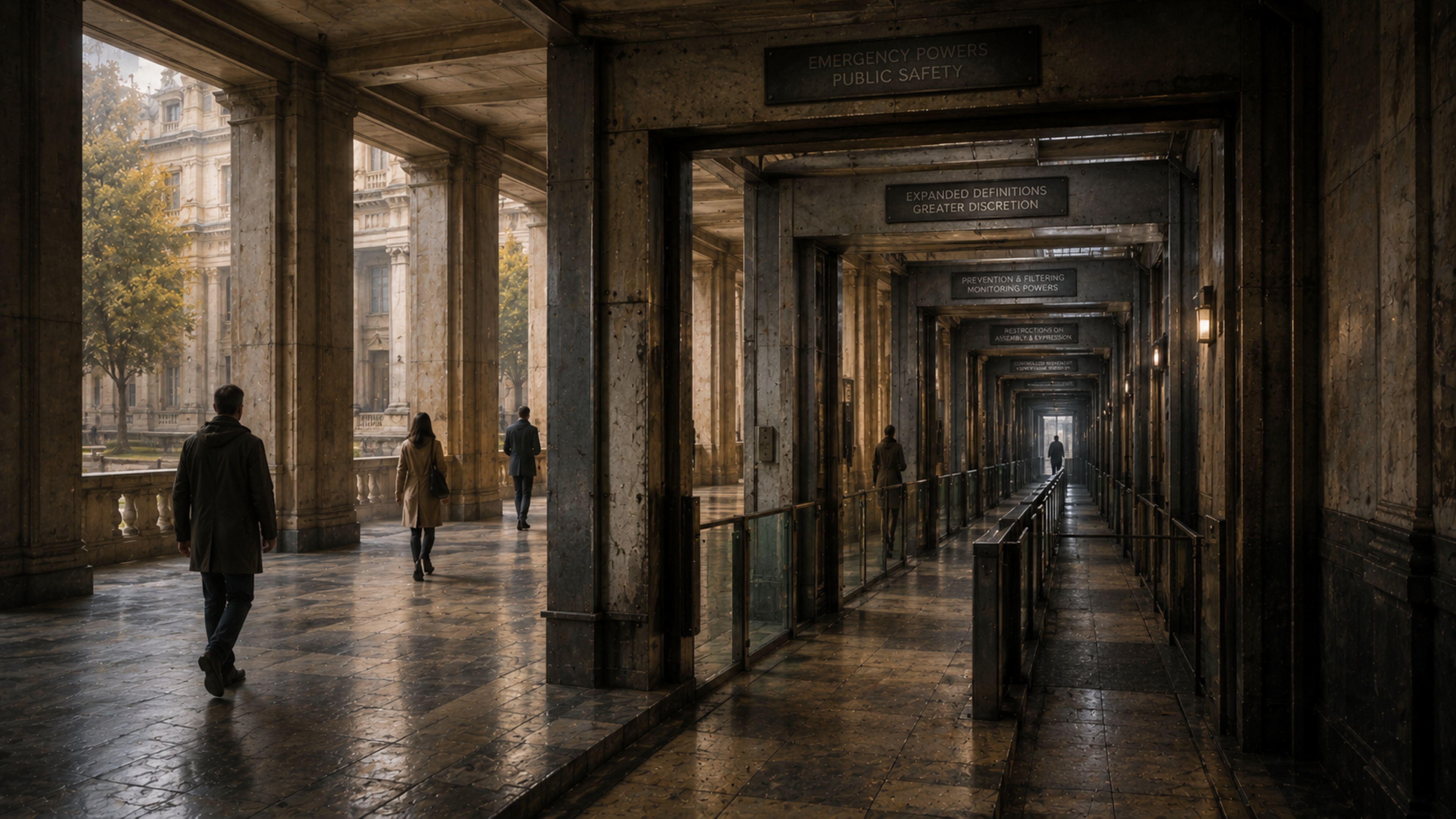
The Erosion Begins
In the United Kingdom, our freedoms and liberties are not granted by the State. People are generally free to act unless the law prohibits or restricts what they are doing, while public authorities require a lawful basis for the powers they exercise. Parliament can make and unmake laws, Ministers and regulators exercise powers available to them under law, and the courts determine whether those powers have been used lawfully.
That is what makes the erosion of those rights harder to identify. A right does not have to be formally abolished for its practical boundary to move. Parliament can create a new offence, a Minister can exercise a delegated power, a regulator can impose a new duty, police guidance can alter how lawful conduct is recorded or investigated, and courts can uphold those changes, limit them, or sometimes send the State back across the line.
Palestine Action provides a contemporary example of that machinery at work when national security, protest and fundamental rights collide. On 20 June 2025, two protesters linked to Palestine Action entered RAF Brize Norton and sprayed red paint on two RAF aircraft. Three days later, the Home Secretary announced her intention to proscribe the organisation, describing the incident as the latest in a longer history of criminal damage attributed to the group. [1]
The legal definition at the centre of that decision is broader than the ordinary meaning many people attach to the word terrorism. Under section 1 of the Terrorism Act 2000, terrorism can include action involving serious damage to property where the other statutory conditions are met, including that the action is designed to influence a government or international governmental organisation, or intimidate the public or a section of the public, and is undertaken for the purpose of advancing a political, religious, racial or ideological cause. [2]
Palestine Action was proscribed in July 2025. The organisation came before Parliament in the same statutory instrument as Maniacs Murder Cult, a transnational white-supremacist neo-Nazi organisation, and the Russian Imperial Movement, a white-supremacist ethno-nationalist organisation with a paramilitary wing. [3] [4] Parliament was asked to approve or reject a single order containing all three organisations rather than vote on each proscription separately. The order was approved by the House of Commons on 2 July 2025 by 385 votes to 26 and subsequently approved by the House of Lords. It came into force at 00:01 on 5 July 2025. [5] [6] The Government maintained that each organisation independently met the statutory threshold for proscription and defended the decision as a lawful and proportionate use of powers Parliament had created. The UN human rights office criticised the use of counter-terrorism law in relation to Palestine Action. [7]
The legal challenge began almost immediately. An application to suspend the proscription while the case was being litigated was refused on 4 July 2025, and the order came into force the following day. On 30 July, Mr Justice Chamberlain granted permission for judicial review on two grounds and refused permission on the others. [8]
The permission judgment matters because it narrowed what remained in dispute. The court refused a ground arguing that the Home Secretary had acted for an improper purpose by using the proscription power against an organisation that did not advocate violence against people. It also refused grounds challenging the conclusion that Palestine Action had committed acts designed to influence the Government and challenging the connection between the relevant acts and the organisation. The litigation therefore proceeded on a basis that allowed serious property damage to fall within the statutory definition of terrorism, while the legality and proportionality of proscribing the organisation as a whole remained open to challenge. [8]
The Government argued that the judicial review should not proceed because the statutory framework already provided another route. Palestine Action could apply to the Home Secretary for deproscription and, if refused, appeal to the Proscribed Organisations Appeal Commission. Mr Justice Chamberlain held that this was not a suitable alternative remedy in the circumstances. The Home Secretary appealed that ruling, and on 17 October 2025 the Court of Appeal dismissed the appeal, allowing the judicial review to proceed. [8] [9]
On 13 February 2026, the Divisional Court held the proscription decision unlawful, finding both that the Home Secretary had acted inconsistently with her own policy and that the decision disproportionately interfered with rights protected by Articles 10 and 11 of the European Convention on Human Rights. [10]
On 15 June 2026, the Court of Appeal reversed that judgment and held that the proscription decision was lawful and proportionate. [11] The litigation is by no means finalised. On 29 July 2026, the Supreme Court granted Huda Ammori permission to appeal in part. The appeal is listed for 4 and 5 November 2026. [12] Further developments will be tracked in the SYSTEMIC | Dossier 0 | Control Stack (Live).
The sequence shows a contest between executive power, Parliamentary authority, statutory definitions, judicial review and the rights available to the person challenging the State. The statutory definition determines what conduct can enter the terrorism framework. Proscription adds another decision about whether an organisation should be placed inside it. Judicial review tests whether that decision was made lawfully and proportionately. Sometimes the power survives that contest, and sometimes it does not.
TL;DR
- Rights do not have to disappear for their boundaries to move. Change can come incrementally through legislation, delegated powers, regulation, guidance and enforcement practice rather than one dramatic constitutional break.
- Crisis can compress political time. Terrorism, national security, emergency, public order, disruption, safety and harm can create pressure for faster intervention and wider preventative powers.
- Passing a law is only the beginning. Powers created in legislation acquire their practical reach through regulations, regulatory decisions, guidance, policing, technical systems and enforcement.
- The staircase does not move in only one direction. Courts can constrain unlawful exercises of power, Parliament can repeal legislation, and governments and public bodies can reform systems that have gone too far. Those brakes are part of the architecture too.
- Rights do not have a political tribe. The same constitutional questions can arise when the person challenging the State is a protest activist, a gender-critical speaker or someone resisting deportation. The facts and legal rules may be very different, but the recurring question is what power the State has and where the law requires it to stop.
- The consequences are lived, not abstract. People encounter this architecture through arrest, charge, surveillance, restrictions on protest, administrative records and the deterrent pressure created when the boundaries of lawful behaviour become difficult to judge.
What Protects a Right in Britain?
Britain has no single codified constitution containing one definitive list of rights that Parliament cannot touch. Our freedoms are protected through a mixture of common law, Acts of Parliament, constitutional principles, international obligations and the courts. That makes the system flexible, but it also makes it more difficult to see exactly where a right begins, where it ends and who has the power to move the boundary.
At the centre of that system sits Parliamentary sovereignty. Parliament is the supreme law-making authority in the United Kingdom. It can make a law, amend it or repeal it altogether. Generally, the courts cannot strike down an Act of Parliament simply because they consider it unjust, disproportionate or incompatible with a fundamental right. [13]
The common law also protects fundamental rights through the principle of legality. Where Parliament uses broad or ambiguous language, the courts presume that it did not intend to override fundamental rights unless it has made that intention sufficiently clear. Parliament can cross the line, but it must confront what it is doing in the legislation rather than rely on vague wording to get there. [14]
The European Convention on Human Rights, or ECHR, is an international human rights treaty created through the Council of Europe. The Council of Europe is separate from the European Union. The United Kingdom was involved in drafting the Convention and ratified it in 1951, more than two decades before joining the European Economic Community in 1973. [15]
The Human Rights Act 1998 gave most of the rights contained in the ECHR practical effect within UK law. Before it came into force, the United Kingdom was already bound by the Convention internationally, but Convention rights were not generally directly enforceable as such in UK courts. A person seeking a Convention remedy generally had to exhaust the available domestic remedies before taking the claim to the European Court of Human Rights in Strasbourg. The Human Rights Act allowed those rights to be relied upon directly in domestic courts when challenging public authorities, bringing much of that protection into the UK legal system. [16] [15]
The Human Rights Act also shapes the relationship between individual rights, the courts and Parliament. Public authorities are generally required to act compatibly with Convention rights, and courts must interpret legislation compatibly with those rights so far as it is possible to do so. But the Act does not place the courts above Parliament. If primary legislation cannot be interpreted compatibly, a court cannot simply strike it down or remove it from the statute book. Certain senior courts can instead issue a declaration of incompatibility, formally identifying the conflict while leaving the legislation in force and the Government and Parliament to decide whether, and how, to respond. [16] [15]
Judicial review allows the courts to examine whether a Minister, police force, regulator or other public authority has acted lawfully and stayed within the powers Parliament gave them. It can also be used to challenge rules made by Ministers under powers delegated to them by Parliament. What the courts generally cannot do is use judicial review simply to overturn an Act of Parliament itself.
The 2025 Liberty case shows how that safeguard works. The Home Secretary used powers delegated by Parliament to redefine the level of disruption required for certain protest restrictions. Liberty challenged the regulations, and the Court of Appeal held that Parliament had not given the Home Secretary the power to make that change. The regulations were unlawful. [17]
Parliament had given the Minister power to make regulations. It had not given her power to move the boundary wherever she chose. The court did not overturn an Act of Parliament. It enforced the limit Parliament had already placed on executive power.
Convention rights are not all structured in the same way. Some provide very strong protection against State interference. Others are qualified rights, meaning the Convention itself allows them to be restricted in certain circumstances. Freedom of expression under Article 10 and freedom of assembly and association under Article 11 are qualified rights. The State can therefore interfere with them, but only where the restriction is prescribed by law, pursues a legitimate aim recognised by the relevant Article and is necessary and proportionate. [15]
This is where the boundaries become contested. The law may protect the right in principle, while the argument shifts to the meaning of the words used to restrict it. What counts as serious disruption? What counts as necessity? When does prevention become disproportionate interference? How far can public safety justify restricting conduct that would otherwise be lawful?
A right is tested at its boundary. The question is how far the State can move that boundary before the law tells it to stop.
Seed Question
Where should the boundary sit between Parliamentary sovereignty and protection of fundamental rights? Is the current UK model strong enough, or should some rights be harder for Parliament to change?
Rights Do Not Have a Political Tribe
A constitutional protection cannot depend on whether we approve of the person using it. If freedom of expression, privacy, family life, protest or due process only matter when they protect people we agree with, they are no longer functioning as universal rights. The difficult cases are usually the ones that reveal whether the protection means anything in practice.
In Miller v College of Policing, that person was Harry Miller, a former police officer who had expressed gender-critical views on Twitter. His speech was lawful, but a complaint led to it being recorded under police guidance as a non-crime hate incident. The Court of Appeal concluded in 2021 that the relevant guidance interfered with his freedom of expression under Article 10 of the European Convention on Human Rights, a right given effect in UK law through the Human Rights Act 1998. The court also found that recording lawful speech in this way was capable of creating a serious chilling effect on public debate. [18]
Whether the reader agrees with Miller's views is irrelevant to the constitutional point. The police had entered the territory of lawful political and social expression without the threshold of a criminal offence being crossed. The court examined that intervention against Article 10 and concluded that the system, as it then operated, went too far. As a Court of Appeal judgment, Miller also established legal principles that bind lower courts in England and Wales when later disputes raise the same questions, although different facts can still produce different outcomes.
The institutional response later changed. In March 2026, following a review with the National Police Chiefs' Council, the College of Policing announced major reforms to the recording of non-crime hate incidents. It said lawful free speech was not a police matter and acknowledged that disproportionate use of the process had eroded public trust. Under the proposed replacement approach, personal information would only be recorded where there was a clear policing purpose, with further guidance and training still to be developed. [19]
Deportation cases expose the same constitutional architecture from another direction. Parliament has expressly stated that the deportation of foreign criminals is in the public interest and, through section 117C of the Nationality, Immigration and Asylum Act 2002, has set statutory tests governing when Article 8 family and private-life considerations can outweigh that public interest. [20]
In HA (Iraq), RA (Iraq) and AA (Nigeria) v Secretary of State for the Home Department, heard together by the Supreme Court in 2022, the issue was how those statutory tests should be applied. HA and RA were Iraqi nationals in settled relationships with British women and had British children. AA was a Nigerian national who relied on the effect that deportation would have on his partner and children. All three had committed criminal offences and were subject to deportation decisions. [20]
The legislation required the courts to consider tests including whether the effect of deportation on a qualifying partner or child would be unduly harsh, and, in more serious cases, whether very compelling circumstances outweighed the public interest in deportation. The Supreme Court dismissed the Home Secretary's appeals. These were questions about the interpretation and application of a balance Parliament had already written into domestic law, with Article 8 operating through that statutory structure. [20]
Palestine Action puts the same constitutional question into a very different legal setting. Its activities, the allegations against its members and the powers used against the organisation are materially different from the lawful speech at issue in Miller or the statutory deportation tests considered in HA (Iraq). What connects them is the exercise of State power and the legal protections available to the person or organisation challenging it. [11]
In Miller, the dispute concerned police recording of lawful expression. In the deportation cases, it concerned Parliament's rules for balancing deportation against private and family life. In the Palestine Action litigation, it concerns proscription, executive power and the qualified rights to expression and association. The facts, politics and legal tests are different. The constitutional question underneath them is the same: what power does the State have, and where does the law require it to stop?
That rights architecture is now itself politically contested. Reform UK has committed to withdrawing the United Kingdom from the ECHR, repealing the Human Rights Act and replacing the existing framework with a British Bill of Rights. Immigration and deportation feature prominently in its case for doing so. [21] The Conservative Party has also adopted withdrawal from the ECHR as party policy. [22] The Labour Government remains within the Convention while pursuing changes to the way Article 8 is applied in immigration and removal cases. [23]
Those approaches change different parts of the architecture. Withdrawal changes the United Kingdom's relationship with the Convention itself. Reform of domestic legislation changes the rules through which rights are balanced and applied while the United Kingdom remains a Convention state. The Human Rights Act currently provides the domestic framework through which Convention rights can be invoked against public authorities in disputes concerning speech, protest, surveillance, policing, family life and other exercises of State power. [16] [15]
Rights do not divide neatly into left-wing rights and right-wing rights. The person relying on a protection today may represent a cause you despise. Tomorrow, the same legal protection may be the mechanism available to someone whose cause you support. The integrity of the right depends on whether we are prepared to recognise it before we know whose hands it will end up in.
The test of a right is not whether it protects a cause you support. It is whether it still applies when the person invoking it irritates you.
Seed Question
Can a right remain meaningful if we only defend it when we approve of the person using it? Which current rights dispute becomes harder to judge when you replace the claimant with someone whose politics you oppose?
The Legal Alchemy of Control
The legal machinery continues after Parliament passes an Act. Legislation creates the framework, but the practical boundary is often drawn later. Ministers may be given powers to make secondary legislation. Regulators produce codes, guidance and enforcement decisions. Police forces translate statutory powers into operational practice. Courts are then asked whether those institutions have stayed within the authority Parliament gave them.
Broad legal language can become a regulation, a policing policy, a compliance system or an automated process. A power created to address one problem can acquire a much wider practical effect as institutions interpret, implement and enforce it.
The Online Safety Act 2023 is a live example. Parliament created the statutory framework, while much of its practical meaning has developed through Ofcom’s implementation and enforcement of the regime. In February 2026, Ofcom issued provisional findings against the provider of an online suicide forum. On 13 May, after considering the provider’s representations, it issued a final decision finding breaches of several duties under the Act and imposed a £950,000 penalty. The investigation closed in July after changes to the service substantially restricted access for users in the United Kingdom. [24] [25] [26]
Other parts of the regime were still being built. The Act gives Ofcom powers to issue Technology Notices dealing specifically with terrorism content and child sexual exploitation and abuse content. Depending on the circumstances, a notice can require the use of accredited technology or, in relation to child sexual exploitation and abuse content, best endeavours to develop or source technology meeting prescribed standards. In February 2026, Ofcom reported that this part of the regime was not yet active. By May, it had published its final guidance and its advice to the Secretary of State on minimum standards of accuracy. Further steps, including approval and publication of those standards and the accreditation of technology, are required before the powers can be used. [27] [28]
Ofcom’s approach to proactive image-matching technology also developed during 2026. In February, it announced that it was accelerating work on measures intended to prevent illegal intimate images from reaching users. In May, it confirmed a recommendation that certain online services use hash-matching technology to detect intimate-image abuse and reduce its spread. Ofcom expected the corresponding amendments to its Illegal Content Codes to come into force in autumn 2026, subject to the Parliamentary process. [29] [30]
Government policy developed alongside that regulatory work. A consultation launched on 2 March 2026 explored measures including social-media age restrictions, overnight curfews and limits on screen time. [31] After it closed, the Government announced that social-media companies would no longer be able to offer their services to children under 16 and later set out additional protections for 16 and 17-year-olds, including default restrictions on social-media access between midnight and 6am. The Government said it intended to lay the first regulations before Parliament by the end of 2026, with the under-16 restrictions expected to come into force in spring 2027. [32]
This is the part of the process I think deserves more attention. We tend to scrutinise legislation while Parliament is debating it, but some of the most consequential decisions about what that legislation actually means are made afterwards.
The statute creates the power. The machinery decides what that power becomes.
Seed Question
How closely should Parliament supervise what happens after it creates a broad statutory power? Which decisions should require another Parliamentary vote rather than being left to regulation, guidance or technical implementation?
Rights and State Power: The British Staircase, 1984-2026
Across four decades, the pattern includes expansion, formalisation, safeguards, repeal and constraint. Parliament has created and revised State powers, while courts have intervened when Ministers, regulators or public bodies crossed the boundaries set by Parliament or the law.
| Year | Act or shift | Movement | Practical effect |
|---|---|---|---|
| 1984 | Police and Criminal Evidence Act | Formalises power and creates safeguards | Establishes a statutory framework for police powers including stop and search, arrest, detention and questioning, alongside codes governing how those powers are exercised. [33] |
| 1986 | Public Order Act | Expands and defines public-order control | Creates public-order offences and powers allowing conditions to be imposed on processions and assemblies. [34] |
| 1994 | Criminal Justice and Public Order Act | Expands public-order and trespass powers | Extends powers and offences relating to trespass, protest and certain gatherings, including provisions directed at raves and unauthorised encampments. [35] |
| 1998 | Human Rights Act | Creates a domestic rights safeguard | Gives most ECHR rights practical effect in UK law, allowing individuals to rely on Convention rights in domestic courts when challenging public authorities. [16] |
| 2000 | Regulation of Investigatory Powers Act | Formalises surveillance powers | Creates a statutory framework governing interception, directed and intrusive surveillance, covert intelligence sources and access to communications data. [36] |
| 2000 | Terrorism Act | Expands counter-terrorism architecture | Establishes enduring definitions, offences and powers relating to terrorism, including proscription and examination powers at ports and borders. [2] |
| 2001 | Anti-terrorism, Crime and Security Act | Expands security powers after crisis | Extends State powers across terrorism, security, information-sharing and other areas in the immediate aftermath of the 11 September attacks. Part 4 also created a detention regime for certain foreign nationals suspected of international terrorism. [37] |
| 2003 | Criminal Justice Act | Reshapes criminal procedure | Makes substantial changes to criminal procedure and evidence, including wider admissibility of bad-character evidence and the introduction of conditional cautions. [38] |
| 2004 | Civil Contingencies Act | Formalises emergency power | Creates a standing statutory framework under which emergency regulations can be made when defined conditions are met. [39] |
| 2004-2005 | A v Secretary of State for the Home Department and repeal of ATCSA Part 4 | Judicial constraint, repeal and replacement | The House of Lords declares the detention regime in section 23 of the Anti-terrorism, Crime and Security Act 2001 incompatible with Articles 5 and 14 of the ECHR. Parliament subsequently repeals Part 4 and replaces the detention regime with a new system of control orders under the Prevention of Terrorism Act 2005. [40] [41] |
| 2006 | Identity Cards Act | Expands identity infrastructure | Creates a national identity register and statutory identity-card scheme. [42] |
| 2008 | Criminal Justice and Immigration Act | Reshapes criminal justice and immigration law | Makes wide-ranging changes across criminal justice and immigration law, including provision for Special Immigration Status in specified circumstances. [43] |
| 2010 | Identity Documents Act | Repeals power and dismantles infrastructure | Repeals the Identity Cards Act 2006, abolishes the national identity register and requires destruction of information held on it. [44] |
| 2012 | Protection of Freedoms Act and local-authority RIPA reform | Adds judicial control and narrows local-authority surveillance | Requires local authorities to obtain judicial approval before specified RIPA authorisations can take effect. Directed surveillance by local authorities is also restricted to investigations meeting a seriousness threshold, subject to limited exceptions. [45] |
| 2012 | LASPO | Narrows publicly funded access to law | Removes significant areas of civil law from the scope of legal aid and changes the practical availability of publicly funded legal assistance. [46] |
| 2013 | Crime and Courts Act | Centralises serious-crime enforcement | Establishes the National Crime Agency and brings a range of serious and organised-crime functions within the new body. [47] |
| 2014 | Data Retention and Investigatory Powers Act | Preserves communications-data powers | Introduces emergency legislation preserving a statutory basis for communications-data retention and interception following legal uncertainty over the existing regime. [48] |
| 2016 | Investigatory Powers Act | Consolidates investigatory architecture | Brings major investigatory powers into a single statutory framework, including interception, equipment interference, communications data and bulk powers, alongside new oversight arrangements. [49] |
| 2020 | Coronavirus Act | Creates temporary emergency powers | Introduces temporary powers responding to the Covid-19 emergency across health, public services and other areas, alongside wider pandemic restrictions made under separate legislation. The Act included mechanisms for review and expiry rather than establishing the temporary powers as permanent law. [50] |
| 2021 | Covert Human Intelligence Sources Act | Formalises authorised criminal conduct | Creates an express statutory framework for authorising criminal conduct by covert human intelligence sources in specified circumstances. [51] |
| 2021 | Miller v College of Policing | Judicial constraint | The Court of Appeal holds that police guidance governing the recording of non-crime hate incidents interfered disproportionately with lawful expression protected by Article 10 of the ECHR. [18] |
| 2022 | Expiry of Coronavirus Act temporary powers | Emergency powers expire | Sixteen of the twenty remaining non-devolved temporary provisions expired on 24 March 2022. The remaining temporary non-devolved powers expired later in 2022, leaving only temporary provisions relating to Northern Ireland in force. [52] |
| 2022 | Police, Crime, Sentencing and Courts Act | Expands protest-control powers | Extends powers to impose conditions on protests, including new provisions relating to noise and serious disruption. [53] |
| 2023 | Public Order Act | Moves protest control earlier | Creates new protest-related offences and Serious Disruption Prevention Orders, including orders capable of imposing restrictions on future protest-related conduct. [54] |
| 2023 | Online Safety Act | Creates digital regulatory architecture | Establishes duties for regulated online services and gives Ofcom extensive implementation, information and enforcement functions. Parts of that architecture continued to be developed after Royal Assent. [24] |
| 2025 | Liberty v Secretary of State for the Home Department | Judicial constraint | The Court of Appeal upholds the quashing of regulations through which the Home Secretary had attempted to lower the threshold for “serious disruption”, holding that the delegated power did not authorise the change. [17] |
| 2025 | Data (Use and Access) Act | Expands digital and data infrastructure | Reforms data governance and creates statutory frameworks including digital verification services and Smart Data schemes. [55] |
| 2025 | Palestine Action proscription | Applies existing terrorism powers to a new organisation | A statutory instrument adds Palestine Action, Maniacs Murder Cult and the Russian Imperial Movement to the list of proscribed organisations under the Terrorism Act 2000. [3] [5] |
| 2026 | NCHI reform and Crime and Policing Act | Administrative reform and statutory repeal | Following the College of Policing and National Police Chiefs’ Council review, a replacement approach is proposed requiring a clear policing purpose before personal information is recorded. Section 182 of the Crime and Policing Act 2026 provides for repeal of the statutory provisions underpinning the existing NCHI Code of Practice. The repeal removes the statutory Code framework rather than prohibiting police from recording non-criminal information altogether. When the repeal is commenced, the existing Code will automatically be revoked. [19] [56] |
| 2026 | Crime and Policing Act: public-order provisions | Creates new protest offences and powers | The same Act creates further public-order offences, including an offence concerning concealment of identity within designated protest areas and an offence relating to protests outside the homes of public office holders. It also makes further changes to police powers concerning protests and assemblies. [57] |
| 2026 | Palestine Action litigation | Judicial review in progress | The Divisional Court holds the proscription decision unlawful in February. The Court of Appeal reverses that judgment in June. Permission to appeal is subsequently granted in part by the Supreme Court, with the appeal listed for November 2026. [10] [11] [12] |
Note: This selective timeline tracks the principal movements examined in this episode. Individual Acts can expand State power in one area while creating safeguards or constraints in another.
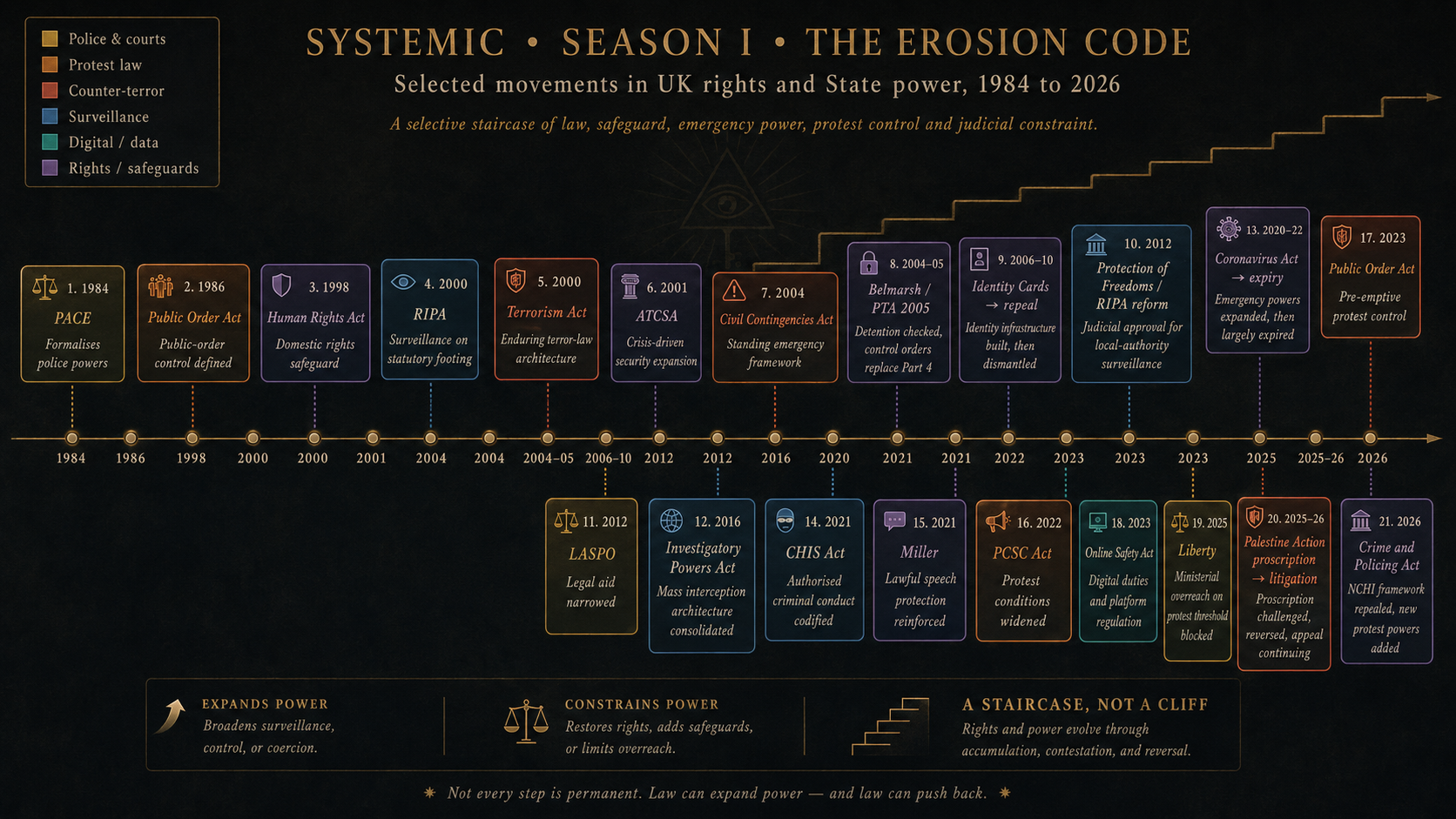
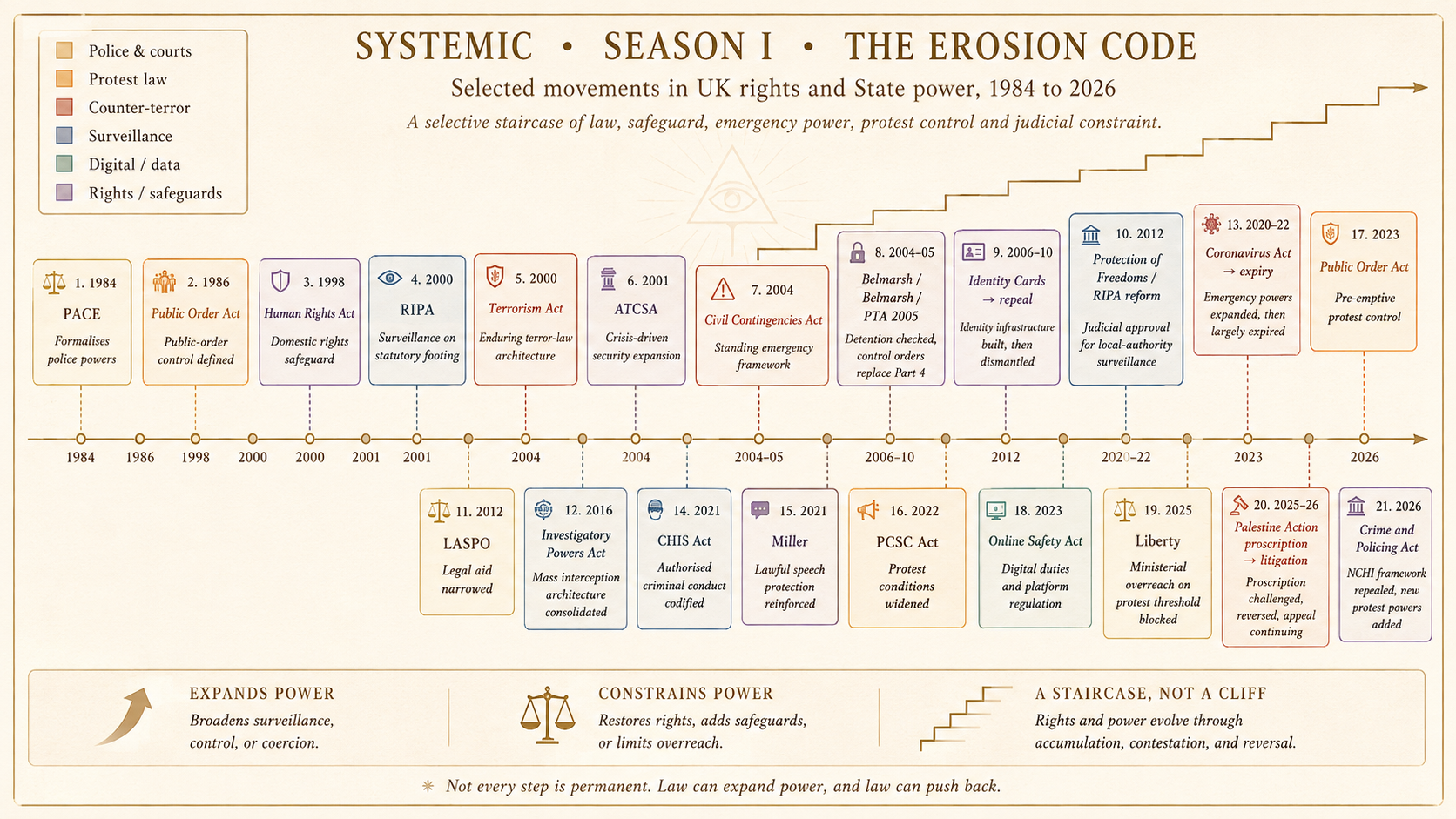
Taken together, the staircase shows a legal architecture repeatedly rewritten through expansion, formalisation, judicial constraint, repeal and replacement. Each intervention changes the baseline inherited by the next dispute.
Seed Question
Does the staircase survive comparison? Which major UK laws, judgments or reforms between 1984 and 2026 are missing, and would adding them make the pattern look more restrictive, more protective, or simply more complicated?
Crisis as Consent Engine
A crisis shortens the time available for political response. Governments are expected to act quickly, public tolerance for intervention can rise, and powers that would meet greater resistance in ordinary circumstances can become easier to justify. Sometimes that speed is necessary. Decisions made under urgency can still alter the legal and institutional baseline, even when particular emergency powers are later repealed, allowed to expire or replaced.
- Security: following the 11 September 2001 terrorist attacks in the United States, the Anti-terrorism, Crime and Security Bill was introduced to the House of Commons on 12 November, just 62 days later. It became law little more than a month after that, extending State powers across terrorism, security, immigration, asset freezing, information-sharing and communications data. Part 4 created a detention regime for certain foreign nationals suspected of international terrorism. In 2004, the House of Lords declared that regime incompatible with Articles 5 and 14 of the ECHR. Parliament repealed Part 4 in 2005 and replaced it with a system of control orders. [37] [58] [41]
- Emergency: the Coronavirus Bill was introduced to the House of Commons on 19 March 2020 and received Royal Assent on 25 March, just six days later. Its substantive Commons stages were completed on 23 March, followed by the House of Lords on 24 and 25 March. The resulting Act created wide-ranging temporary emergency powers across health, public services and other areas while the country was entering an unprecedented national emergency. Most of the remaining non-devolved temporary provisions expired in March 2022, with the remaining temporary non-devolved powers expiring later that year. [50] [59] [52]
- Disruption: the Public Order Act 2023 moved protest control further towards prevention. Serious Disruption Prevention Orders can impose restrictions for between one week and two years. Breaching an order without reasonable excuse can itself result in up to six months’ imprisonment, an unlimited fine, or both. [54] [60]
- Protection: the Online Safety Act 2023 requires regulated services to build systems for identifying and managing risks before harm occurs. Ofcom can enforce those duties with penalties of up to the greater of £18 million or 10% of a provider’s qualifying worldwide revenue, and in the most serious cases can ask a court to restrict access to a non-compliant service. [24]
Urgency changes the pace at which power can be created and exercised. The immediate response may pass while part of the architecture it produced remains.
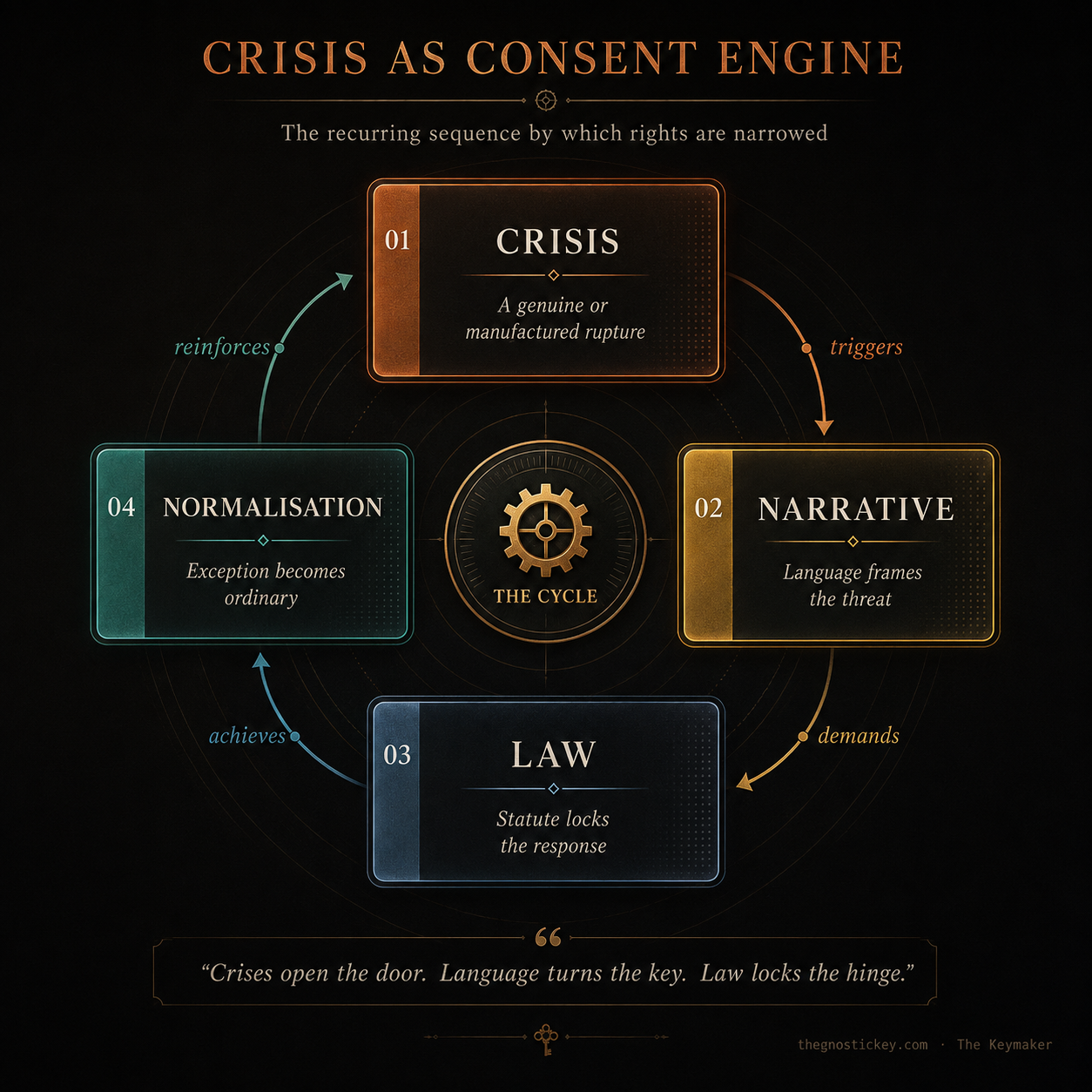
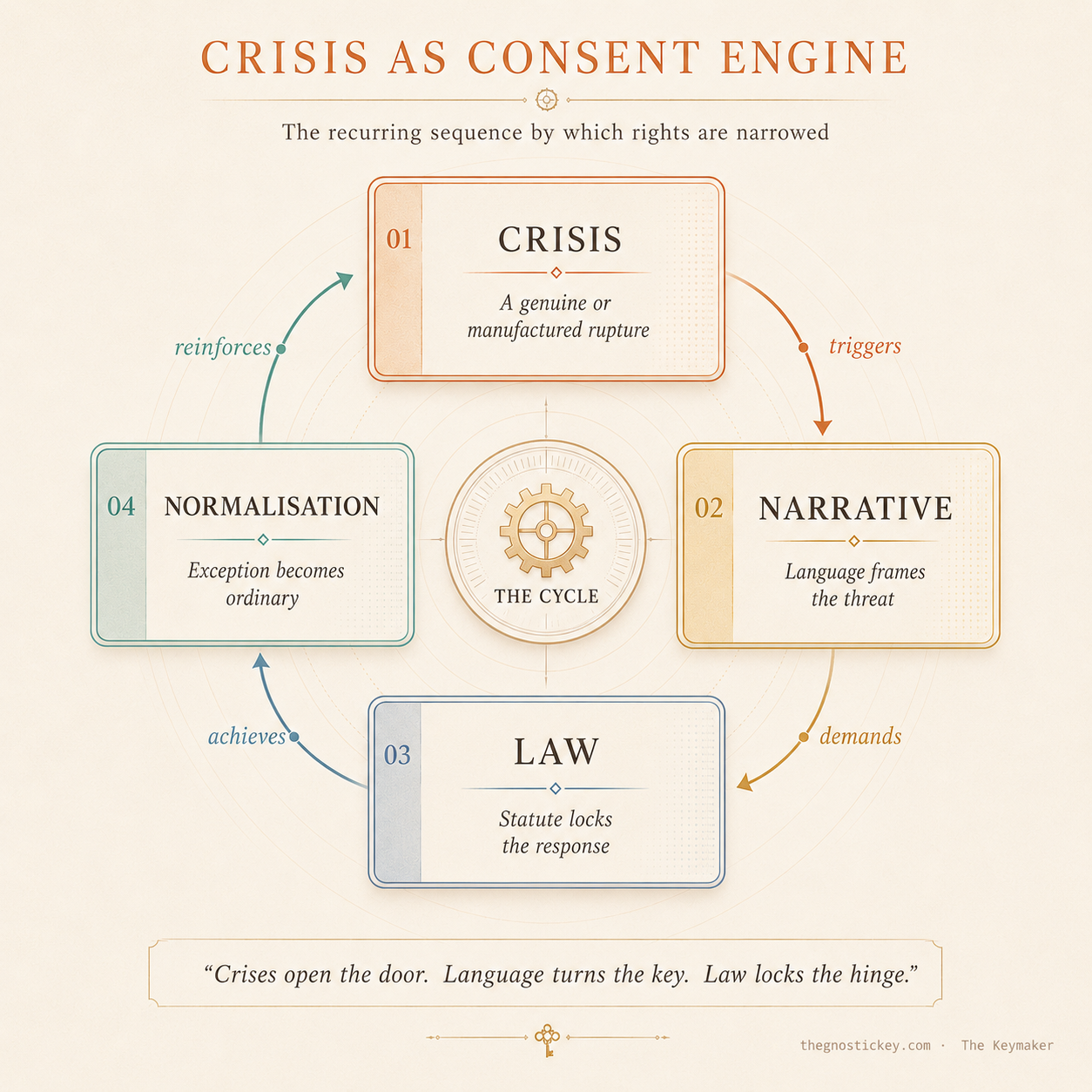
Crisis opens the door. Necessity decides how far it opens.
Seed Question
Which emergency powers introduced during a genuine crisis were later removed, narrowed or retained? Does comparing those outcomes strengthen or weaken the claim that crisis can alter the longer-term boundaries of State power?
Counterview: The Case Made by the State
Governments justify many of these powers as necessary responses to terrorism, violence, serious disruption, exploitation, public emergencies and rapidly changing technology. The underlying case is preventative: in some circumstances, waiting until harm has already occurred is itself a failure of government.
- Public order powers: the right to protest must coexist with the rights of other people to travel, work, access essential services and go about their lives without serious disruption, intimidation or violence. Serious Disruption Prevention Orders are imposed by courts rather than administratively. The statutory framework requires the subject to be aged 18 or over, sets conditions concerning previous protest-related convictions or breaches of injunctions, requires the court to consider the order necessary for a statutory purpose, and provides rights of appeal. [54] [60]
- Counter-terror powers: prevention sits at the centre of the justification. If authorities wait until an attack has taken place, intervention has already come too late. Powers including proscription, investigation and disruption are therefore intended to operate before the feared harm occurs. [2]
- Surveillance powers: legislation such as the Investigatory Powers Act 2016 places intrusive activity within a statutory system of warrants, authorisation requirements and oversight. The justification is that formalising those powers makes them more accountable than leaving covert activity outside a defined legal framework. [49]
- Online regulation: the Online Safety Act 2023 requires regulated services to take greater responsibility for illegal content and risks to users, particularly children, rather than leaving intervention entirely until after harm has occurred. [24]
- Proscription: the Home Secretary exercises the proscription power within a statutory framework created by the Terrorism Act 2000. An organisation is added through a legal instrument, and the ordinary procedure requires approval by both Houses of Parliament. The Act also contains an urgency procedure under which an order can be made before that approval is obtained, subject to subsequent Parliamentary approval if it is to remain in force. [3] [4]
- Parliamentary approval in 2025: the ordinary proscription procedure was used when Palestine Action, Maniacs Murder Cult and the Russian Imperial Movement were placed before Parliament together in a single order. Parliament approved that order. [5]
- Deproscription and appeal: the statutory framework also provides a route for an organisation or affected person to apply to the Home Secretary for deproscription. If that application is refused, an appeal can be made to the Proscribed Organisations Appeal Commission. In the Palestine Action litigation, the Government argued that this statutory route should be used instead of judicial review. The courts held that judicial review remained available in the circumstances of that case. [8] [9]
These powers respond to real threats and legitimate functions of government. Statutory conditions, courts, appeal routes, Parliamentary scrutiny and regulatory oversight are intended to place boundaries around their use. The constitutional pressure appears when those safeguards are tested against what the power becomes in practice.
The existence of a threat can justify a power. It does not remove the need to examine its limits.
The Critique: Mission Creep and Pre-emptive Control
Mission creep begins when a power created for one purpose starts to reach further through interpretation, guidance, regulation or enforcement. The law itself may not change. The circumstances in which the power is used can.
- Broad: wider definitions and loosely drawn tests leave more room for discretion over what conduct falls within them and when intervention is justified.
- Earlier: intervention can move from responding to harm after it occurs towards trying to prevent conduct that might produce harm or disruption.
- Embedded: once a power becomes part of guidance, regulatory systems, databases and operational practice, its use can become an ordinary part of institutional decision-making.
- Chilling: where the boundary is uncertain, people may alter lawful speech, protest or association because they cannot be confident where intervention will begin.
The surveillance of Jenny Paton and her family by Poole Borough Council shows how far a statutory power can travel in practice. The council was investigating whether the family genuinely lived within the catchment area of a particular school and purported to authorise directed surveillance under Part II of RIPA. The Investigatory Powers Tribunal later found that the authorisation did not comply with RIPA, that the surveillance was not proportionate and that the council had acted incompatibly with Article 8 of the European Convention on Human Rights, which protects private and family life. [61]
Local authorities were expressly included within the RIPA surveillance framework, and the Tribunal accepted that Poole had genuine grounds for investigating whether the address supplied in the school application was accurate. The failure was in the use of covert surveillance. The council had not established that the operation satisfied the statutory crime-prevention purpose, and the surveillance extended to three young children who were not suspected of committing any offence. The Tribunal declared the authorisation invalid and the resulting directed surveillance unlawful. [61]
Parliament later tightened the rules. From November 2012, changes made through the Protection of Freedoms Act 2012 required local authorities to obtain judicial approval before specified RIPA authorisations could take effect. Their use of directed surveillance was also restricted to investigations of offences meeting a seriousness threshold, with limited exceptions. The authorisation still had to satisfy the existing tests of necessity and proportionality. [45]
Paton shows the mechanism in miniature. A statutory power reached a public body, the body used it in circumstances later found unlawful, and Parliament subsequently placed tighter controls around its use. The problem is what happens before that correction arrives.
By the time a legal boundary is tested, powers and procedures may already be embedded in institutional practice. They can shape systems and behaviour even without widespread use, while people may adjust lawful conduct simply because they know the power exists.
In the language of this series: the cage is built slowly, then treated as the normal shape of the world.
Seed Question
Where is the line between legitimate use of a broad statutory power and mission creep? What examples show institutions using powers within their intended scope, and what examples show that practical boundary moving?
When Protest Reaches the Jury
Protest prosecutions raise a different question: what is the jury actually allowed to consider? A defendant may accept that an act took place while arguing that the circumstances provide a lawful excuse or other defence. Whether that argument reaches the jury depends on the offence charged, the evidence and the legal directions given by the judge.
| Case | Charge | Outcome | Legal argument or boundary |
|---|---|---|---|
| Brighton, EDO MBM | Conspiracy to commit criminal damage | Seven defendants acquitted. [62] | The defendants relied on lawful excuse, arguing that their actions were intended to prevent greater harm. The acquittals establish the outcome but do not disclose which part of the defence the jury accepted. |
| Leicester, UAV Tactical Systems | Criminal damage | Two defendants acquitted. [63] | The defence relied on lawful excuse, arguing that the action was intended to prevent harm to people and property in Palestine. The verdict establishes the outcome rather than the reasoning of individual jurors. |
| Bradford, Teledyne | Criminal damage and possession of articles with intent to destroy or damage property | The first jury could not reach verdicts in September 2024. At a retrial in February 2026, all four defendants were convicted. [64] [65] | The first trial ended without verdicts and the retrial ended in convictions. The sequence shows why a hung jury cannot be treated as either an acquittal or evidence that the jury accepted a particular political or moral argument. |
| Sarti, Hall and Plummer v R | Interfering with key national infrastructure under section 7 of the Public Order Act 2023 | Convicted at Crown Court. Appeals dismissed by the Court of Appeal in 2025. [66] | The trial judge directed the jury that the fact the defendants were protesting was not capable of amounting to reasonable excuse. The Court of Appeal held that the statutory defence is broad enough to allow proportionality to be considered in some circumstances, but that Articles 10 and 11 do not require an individual proportionality assessment in every prosecution under section 7. |
Later authority narrowed the circumstances in which Convention proportionality could assist a defendant in a criminal-damage case. In Attorney General’s Reference No. 1 of 2022, the Court of Appeal held that Convention proportionality does not provide a defence where the criminal damage is significant. The argument available to a defendant therefore depends on the offence charged, the scale of the damage and the defence recognised by law in that particular case. [67]
Sarti, Hall and Plummer shows the same question under a different statutory offence. The defendants took part in a Just Stop Oil slow march on an A-road in London and were prosecuted under section 7 of the Public Order Act 2023 for interfering with key national infrastructure. At trial, the judge directed the jury that the fact they were protesting was not capable of amounting to reasonable excuse. The Court of Appeal subsequently dismissed their appeals. [66]
The Court of Appeal recognised that Articles 10 and 11 of the European Convention on Human Rights were engaged. It held that section 7 created a materially narrower offence than ordinary highway obstruction and that Parliament had remained within the broad margin available to it when defining the offence. The Convention therefore did not require an individual proportionality assessment in every prosecution under section 7. [66]
Across these cases, the legal route changes with the offence and the defence available. Parliament defines the offence. Judges determine what arguments and defences the law allows the jury to consider. The jury decides the facts within that framework.
Before a jury can weigh an argument, the law decides whether the argument gets through the door.
Seed Question
How much of a protester's motive and political context should a jury be allowed to hear when deciding criminal liability? Where should the law draw the line between relevant defence evidence and political argument?
Symbolic Mapping: The Courtroom Ritual
The courtroom is a legal venue and a theatre of legitimacy, language and authority. Rules determine what can be said, what can be heard and which parts of a defendant’s story are legally relevant.
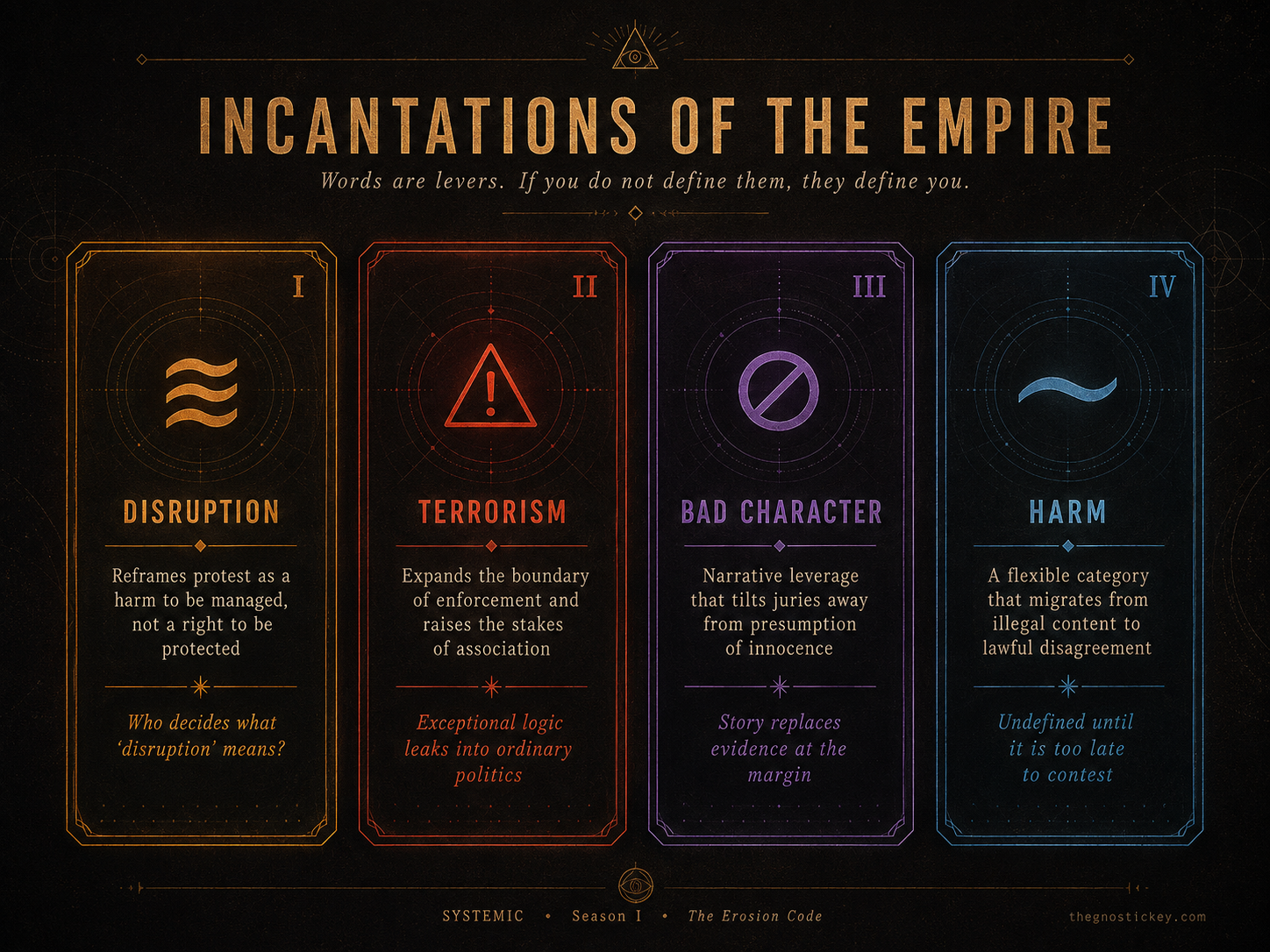
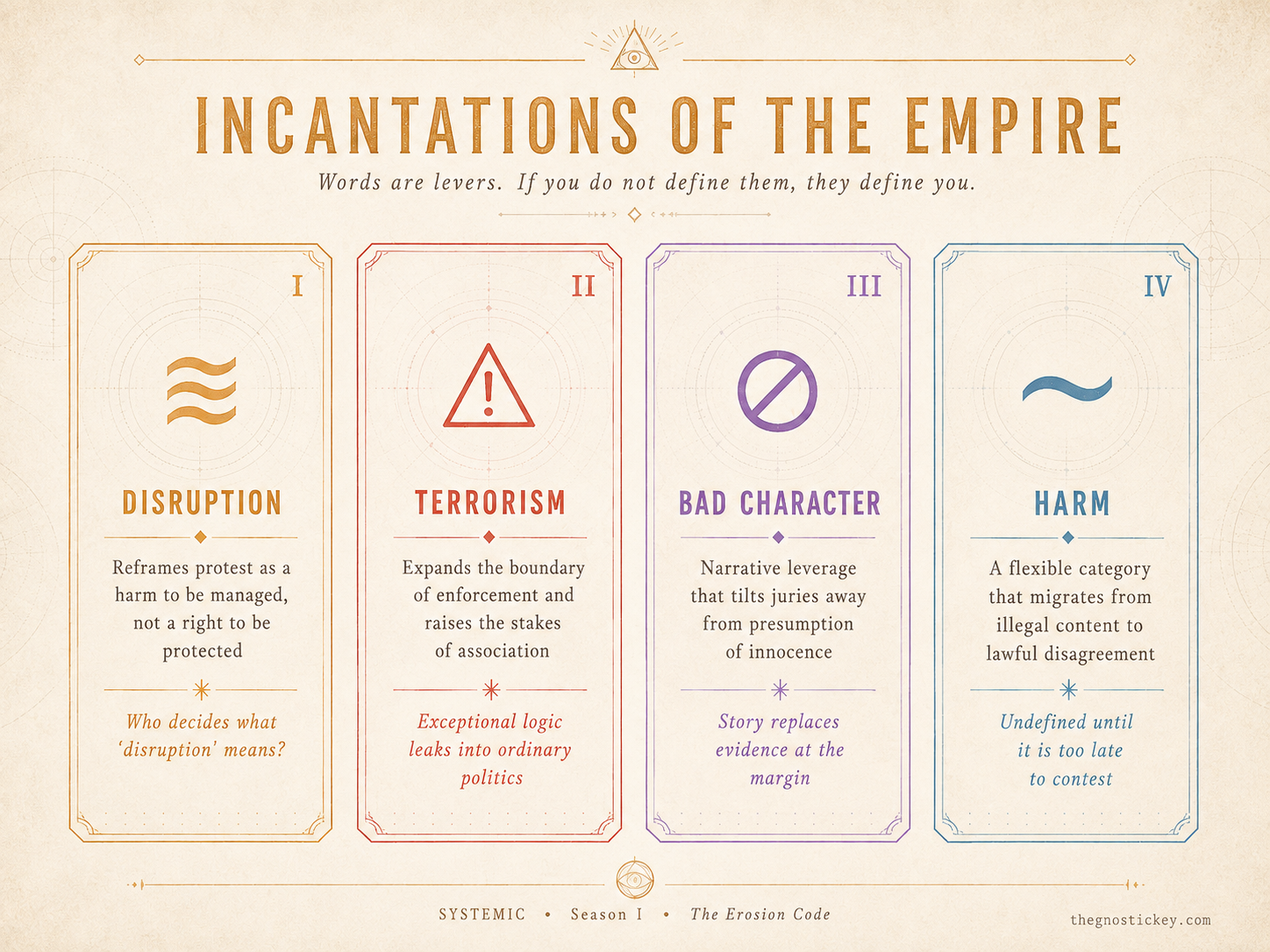
- Sigils: “Serious disruption.” “Terrorism.” “Bad character.” Legal and evidential categories that determine which powers, offences, defences and rules of evidence apply.
- Chamber: A bounded space where speech is structured, recorded, time-limited and subject to rules of evidence and procedure.
- Priesthood: Robes, procedure, precedent and the specialised language through which the law interprets what has happened.
- Sacrifice: Motive, context or political meaning may be narrowed where the court determines that they are not legally relevant or admissible.
Judges apply the law governing relevance, evidence and the defences available in a particular case. What reaches the jury has already been shaped by those rules.
Through the Gnostic lens, this is the ritual: lived events enter the courtroom as stories and emerge as legally recognised categories. Experience is translated into offences, defences, evidence, relevance and admissibility before judgment can be reached.
Sigil Summary: Incantations of the Empire
- Disruption: a legal threshold through which protest can become subject to restriction, conditions or criminal liability.
- Terrorism: a statutory category that can trigger powers including proscription, investigation and restrictions on association and support.
- Bad character: an evidential category that can bring information about previous conduct into a criminal trial where the legal conditions for admission are met.
- Harm: a regulatory concept used to define risks and determine when duties, restrictions and intervention begin.
Words are levers. If you do not define them, they can define you.
Final Reflection: Naming the Machine
The machinery develops amid protest, litigation, repeal and reform. New powers, duties and institutional practices can continue to take shape while older ones are challenged, constrained or removed.
Follow the mechanism. Emergency can accelerate legislation. Legal categories set thresholds for intervention. Powers created in statute gain practical reach through regulation, guidance, enforcement and technical systems.
Those movements leave an architecture behind. Courts can constrain an exercise of power. Parliament can repeal a scheme, replace it or impose new safeguards. Governments and institutions can reform systems that have gone too far. Each intervention changes the legal and institutional landscape inherited by what comes next.
Episode I has asked what powers exist, how their boundaries move and where the law requires the State to stop. But before some of those powers can be applied to a person in a criminal case, another question has to be answered: what happened, who did it and what does the evidence actually prove?
In Episode II: Forensic Fictions, we move from law to evidence and examine what happens when uncertainty is lost, obscured or overstated somewhere between the evidence itself and the legal conclusion built from it.
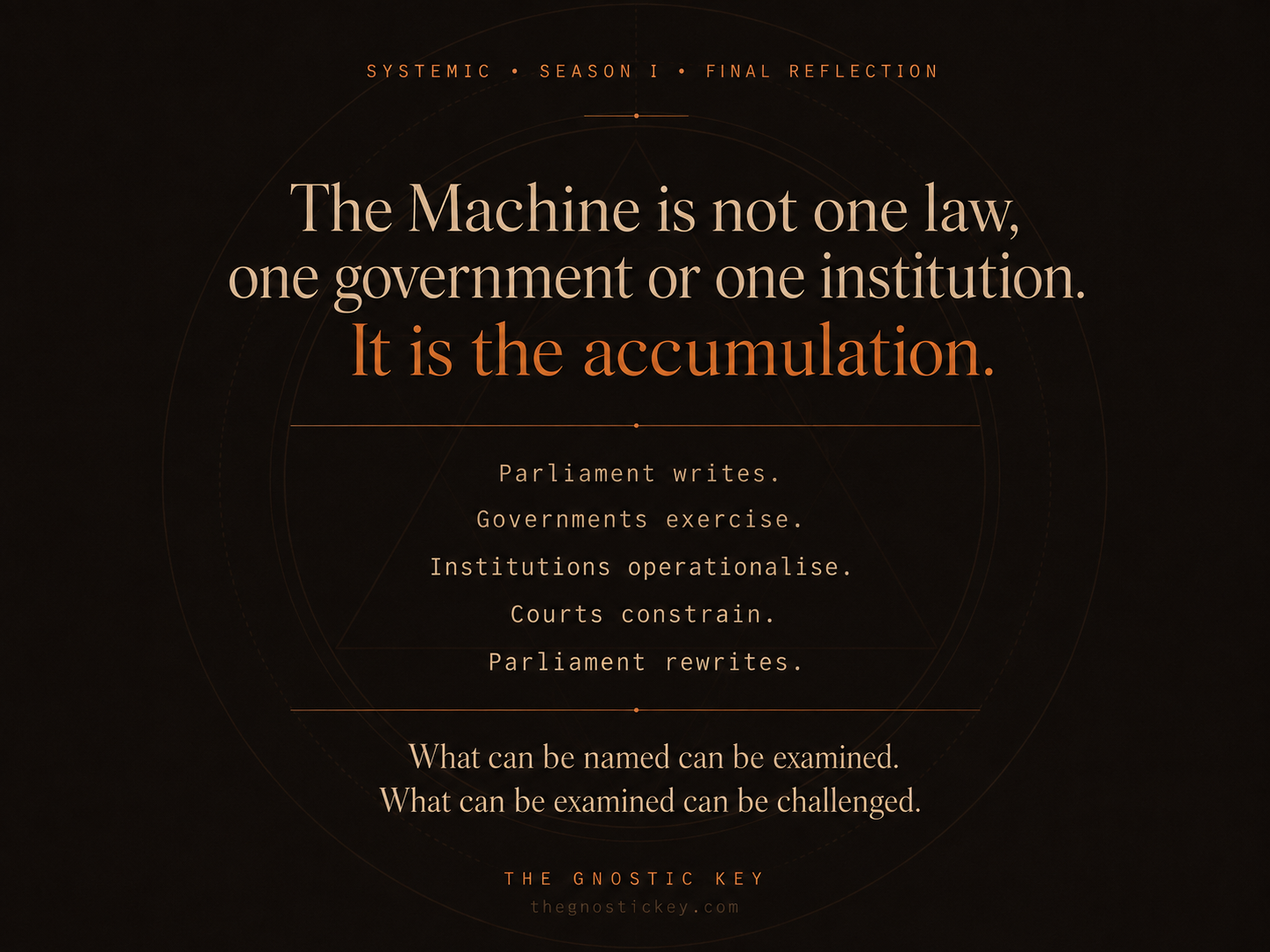
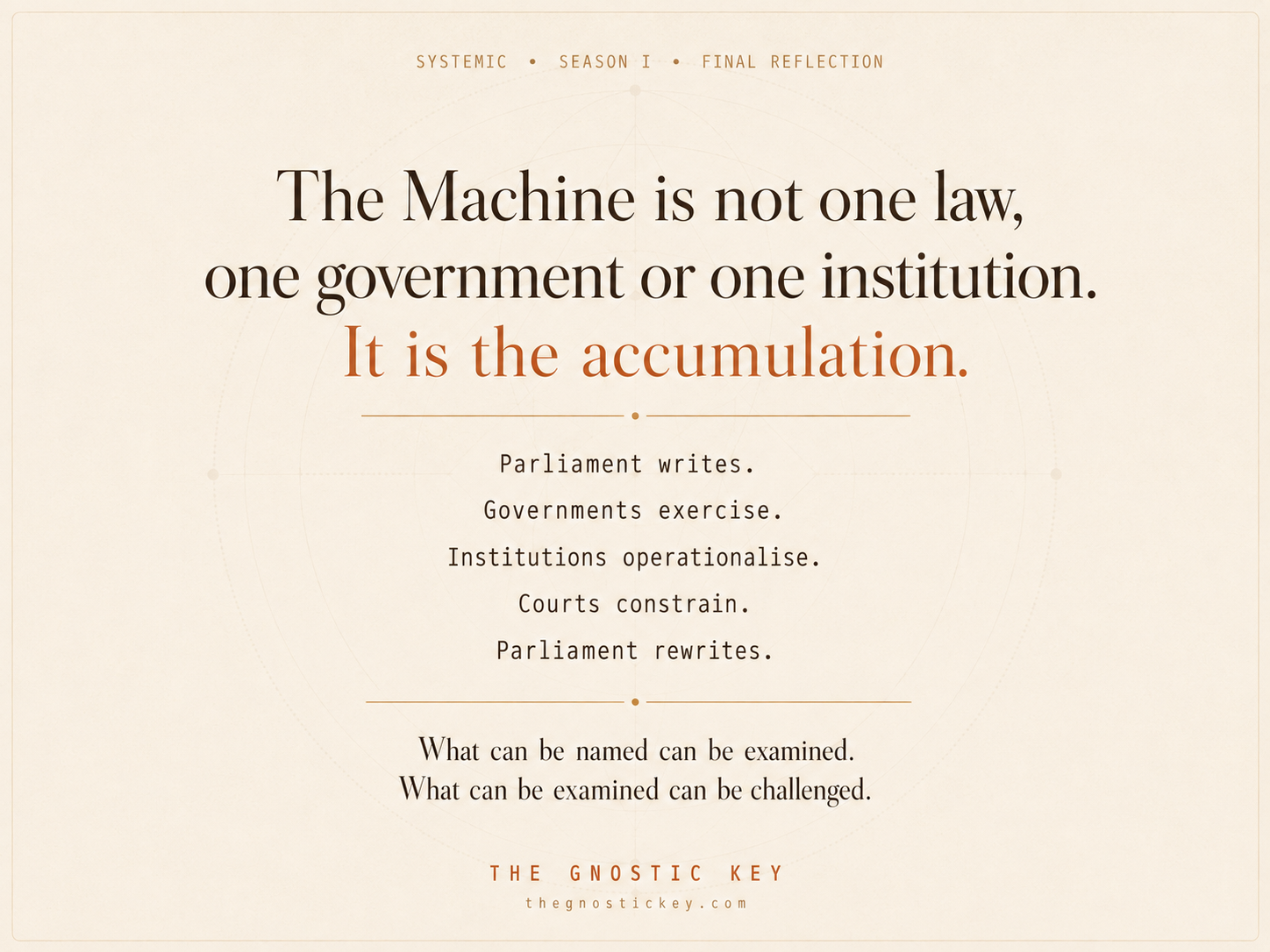
The Machine is not one law, one government or one institution. It is the accumulation.
What can be named can be examined. What can be examined can be challenged.
Seed Question
Does the evidence in this episode justify describing the pattern as an accumulation? Which examples support that model, and which examples suggest that the institutions involved are too independent, contradictory or self-correcting for the pattern to hold?
Seed Question
What is the strongest challenge to the argument made in this episode? Identify a law, judgment, safeguard, repeal or historical example we have missed, and explain whether adding it strengthens, weakens or fundamentally changes the pattern described in The Erosion Code.
Own This Part
Keep a permanent offline copy of this part, with the full text and the complete formatted edition ready to download.
Members and Founding Members pay £2.49, applied automatically at checkout when signed in.
Resources
References
-
[1] Palestine Action: Proscription, Home Secretary statement, House of Commons, 23 June 2025
:Official Hansard statement announcing the decision to proscribe Palestine Action and recording the RAF Brize Norton incident of 20 June 2025 as the latest in a longer history of criminal damage attributed to the group.
-
[2] Terrorism Act 2000 (legislation.gov.uk)
:Core counter-terror framework including definitions, proscription powers, and port and border examination powers.
-
[3] Terrorism Act 2000 (Proscribed Organisations) (Amendment) Order 2025 (SI 2025/803)
:Statutory Instrument amending Schedule 2 to add proscribed organisations, including Palestine Action.
-
[4] Explanatory Memorandum for SI 2025/803 (legislation.gov.uk PDF)
:Government explanation of the statutory instrument and its stated reasons and claimed impacts.
-
:Official Hansard record of the Commons debate and division approving the single statutory instrument proscribing Palestine Action, Maniacs Murder Cult and the Russian Imperial Movement by 385 votes to 26.
-
[6] ProtectUK notice: Palestine Action proscribed (7 July 2025)
:Public notice stating the proscription came into force at 0001 on 5 July 2025.
-
[7] UN Human Rights Chief statement on proscription concerns (OHCHR, 25 July 2025)
:International human rights critique of applying counter-terror powers to protest activity.
-
:Administrative Court judgment on permission for judicial review of the Palestine Action proscription, including the grounds allowed and refused and the proposed deproscription and POAC alternative remedy.
-
:Full Court of Appeal judgment addressing whether judicial review remained available despite the statutory deproscription and Proscribed Organisations Appeal Commission route.
-
:Divisional Court judgment holding the Palestine Action proscription decision unlawful, including findings concerning the Home Secretary’s policy and proportionality under Articles 10 and 11.
-
:Court of Appeal judgment allowing the Home Secretary's appeal and holding that the Palestine Action proscription decision was lawful.
-
[12] Ammori v Secretary of State for the Home Department, Supreme Court appeal (2026)
:UK Supreme Court case page recording partial permission to appeal granted on 29 July 2026 and the appeal listed for 4 and 5 November 2026.
-
[13] Parliamentary sovereignty, House of Commons Library, 18 November 2025
:House of Commons Library briefing on Parliamentary sovereignty, including Parliament’s authority to make or unmake law and the limits of judicial power over primary legislation.
-
:UK Supreme Court judgment restating the principle of legality and the requirement for clear statutory language where Parliament intends to interfere with fundamental rights.
-
:House of Commons Library briefing on the ECHR, the Human Rights Act, Parliamentary sovereignty, Convention rights, domestic remedies and current proposals for reform or withdrawal.
-
:Primary legislation giving effect in UK law to specified rights and freedoms under the European Convention on Human Rights.
-
[17] R (Liberty) v Secretary of State for the Home Department [2025] EWCA Civ 571
:Court of Appeal judgment upholding the quashing of regulations that lowered the threshold for serious disruption, holding that the delegated statutory power did not authorise the change.
-
[18] Miller v College of Policing [2021] EWCA Civ 1926
:Court of Appeal judgment finding that non-crime hate incident guidance interfered disproportionately with lawful expression protected by Article 10 and was capable of creating a serious chilling effect on public debate.
-
[19] College of Policing: Major reforms for police hate incident recording, 31 March 2026
:College of Policing announcement proposing replacement of the non-crime hate incident system, requiring a clear policing purpose and acknowledging that disproportionate use of the previous process had eroded public trust.
-
[20] HA (Iraq) v Secretary of State for the Home Department [2022] UKSC 22
:UK Supreme Court judgment in the linked HA (Iraq), RA (Iraq) and AA (Nigeria) deportation appeals, addressing section 117C, Article 8, the 'unduly harsh' test and 'very compelling circumstances'.
-
[21] Reform UK policy on the ECHR and Human Rights Act, 2026
:Reform UK policy committing to withdrawal from the European Convention on Human Rights, repeal of the Human Rights Act and replacement with a British Bill of Rights, with immigration and deportation forming part of the stated case for reform.
-
[22] Conservatives Announce ECHR Exit Policy (4 October 2025)
:Conservative Party announcement making withdrawal from the European Convention on Human Rights official party policy.
-
[23] Illegal immigrants and foreign criminals to be removed (GOV.UK, 29 June 2026)
:Home Office announcement confirming that the Government intends to reform the application of Article 8 of the ECHR in immigration and removal cases while remaining within the Convention framework.
-
[24] Online Safety Act 2023 (legislation.gov.uk)
:Primary legislation establishing Ofcom duties and safety-risk obligations for online services, including Schedule 13 financial penalties of the greater of £18 million or 10% of qualifying worldwide revenue.
-
[25] Ofcom provisional finding on online suicide forum breach (27 Feb 2026)
:Ofcom provisional decision alleging breaches of Online Safety Act duties on risk assessment and illegal-content exposure.
-
[26] Ofcom final decision and £950,000 penalty against online suicide forum provider (13 May 2026)
:Ofcom investigation page recording the 13 May 2026 Confirmation Decision, findings of breaches under the Online Safety Act and a £950,000 financial penalty, with the investigation closed on 20 July 2026.
-
[27] Ofcom Online Safety Act section 128 annual report 2025 (26 February 2026)
:Ofcom annual report on its Technology Notice powers, recording the implementation position as at February 2026.
-
[28] Ofcom statement on Technology Notices (8 May 2026)
:Ofcom statement publishing final Technology Notice guidance and advice to the Secretary of State on minimum accuracy standards for accredited technologies used against terrorism and CSEA content.
-
[29] Ofcom fast-tracks decision on blocking illegal intimate images (18 Feb 2026)
:Ofcom announcement on fast-tracking proactive image-matching measures for illegal intimate images and explicit deepfakes.
-
[30] Ofcom statement: Detecting intimate image abuse (18 May 2026)
:Ofcom decision recommending that certain services use hash-matching technology to detect intimate-image abuse and reduce its spread online.
-
[31] Government consultation on child online safety measures (GOV.UK, 2 March 2026)
:Government consultation covering child social media bans, curfews, gaming restrictions, AI chatbot controls, and faster legislative powers.
-
[32] Growing up in the online world: Government response (July 2026)
:Government response setting out under-16 social-media restrictions, default protections for 16 and 17-year-olds and the intended timetable for regulations and commencement.
-
[33] Police and Criminal Evidence Act 1984 (legislation.gov.uk)
:Foundational police powers and safeguards covering stop and search, arrest, detention, questioning, and codes of practice.
-
[34] Public Order Act 1986 (legislation.gov.uk)
:Public order offences and powers to impose conditions on assemblies and processions.
-
[35] Criminal Justice and Public Order Act 1994 (legislation.gov.uk)
:Expansion of powers relating to trespass, protest, stop and search, gatherings, and provisions associated with raves.
-
[36] Regulation of Investigatory Powers Act 2000 (legislation.gov.uk)
:Statutory framework for interception, communications data, surveillance, and covert tactics.
-
[37] Anti-terrorism, Crime and Security Act 2001 (legislation.gov.uk)
:Post-9/11 expansion of security and state powers across multiple domains.
-
[38] Criminal Justice Act 2003 (legislation.gov.uk)
:Wide-ranging reform of criminal justice, evidence, procedure, conditional cautions, and sentencing.
-
[39] Civil Contingencies Act 2004 (legislation.gov.uk)
:Emergency powers framework, including the making of emergency regulations under defined statutory conditions.
-
[40] A (FC) and others v Secretary of State for the Home Department [2004] UKHL 56
:House of Lords judgment concerning detention under Part 4 of the Anti-terrorism, Crime and Security Act 2001, including the declaration of incompatibility and quashing of the Article 5 derogation order.
-
[41] Prevention of Terrorism Act 2005: Explanatory Notes
:Official explanatory notes confirming repeal of sections 21 to 32 of Part 4 of the Anti-terrorism, Crime and Security Act 2001 and the introduction of the control-order framework.
-
[42] Identity Cards Act 2006 (legislation.gov.uk)
:Created the National Identity Register and an identity card scheme, later repealed.
-
[43] Criminal Justice and Immigration Act 2008 (legislation.gov.uk)
:Further reforms across criminal justice and immigration, including provision for Special Immigration Status.
-
[44] Identity Documents Act 2010 (legislation.gov.uk)
:Repealed the Identity Cards Act 2006 and provided for the destruction of the National Identity Register.
-
[45] Changes to local authority use of RIPA (Home Office, 9 October 2012)
:Official Home Office guidance confirming judicial approval for local-authority RIPA authorisations from 1 November 2012 and the seriousness threshold for directed surveillance.
-
[46] Legal Aid, Sentencing and Punishment of Offenders Act 2012 (Law Society explainer)
:Overview of LASPO changes and their impact on the scope and availability of legal aid.
-
[47] Crime and Courts Act 2013 (legislation.gov.uk)
:Created the National Crime Agency and consolidated serious-crime and national-enforcement functions.
-
[48] Data Retention and Investigatory Powers Act 2014 (legislation.gov.uk)
:Data-retention legislation preserving communications-data powers pending longer-term replacement.
-
[49] Investigatory Powers Act 2016 (legislation.gov.uk)
:Consolidates interception and investigatory powers, including bulk powers and statutory oversight structures.
-
[50] Coronavirus Act 2020 (legislation.gov.uk)
:Pandemic emergency framework introducing temporary powers across health, public administration, and enforcement.
-
[51] Covert Human Intelligence Sources Act 2021 (legislation.gov.uk)
:Creates a statutory basis for criminal conduct authorisations for covert human intelligence sources, with specified purposes and oversight.
-
[52] COVID-19 Response: Living with COVID-19 (GOV.UK, February 2022)
:Government record confirming that 16 of the 20 remaining non-devolved temporary Coronavirus Act provisions expired at midnight on 24 March 2022, with the remaining temporary non-devolved provisions due to expire later in 2022.
-
[53] Police, Crime, Sentencing and Courts Act 2022 (legislation.gov.uk)
:Expanded protest-control powers, including conditions tied to disruption, impact, and noise.
-
[54] Public Order Act 2023 (legislation.gov.uk)
:Created new protest offences and Serious Disruption Prevention Orders, widening pre-emptive control.
-
[55] Data (Use and Access) Act 2025 (legislation.gov.uk)
:Reforms UK data governance and enables digital verification services and Smart Data schemes.
-
[56] Crime and Policing Act 2026: explanatory notes on section 182
:Official explanatory notes stating that section 182 repeals sections 60 and 61 of the Police, Crime, Sentencing and Courts Act 2022 and that the existing statutory NCHI Code will be automatically revoked when the repeal is commenced.
-
[57] Crime and Policing Act 2026: Explanatory Notes, Part 10 Public Order
:Official explanatory notes on new public-order provisions, including concealment of identity in designated protest areas, protests outside public office-holders’ homes and related police powers.
-
[58] Joint Committee on Human Rights: Anti-terrorism, Crime and Security Bill further report (2001)
:Parliamentary record confirming that the Anti-terrorism, Crime and Security Bill was introduced to the House of Commons on 12 November 2001.
-
[59] Coronavirus Act 2020: Parliamentary stages
:Official UK Parliament stages page recording first reading on 19 March 2020, Commons stages on 23 March, Lords stages on 24 and 25 March and Royal Assent on 25 March 2020.
-
[60] Serious Disruption Prevention Orders: statutory guidance
:Home Office statutory guidance setting out the duration of SDPOs, available requirements and prohibitions, and the offence and penalties for breach without reasonable excuse.
-
:Investigatory Powers Tribunal determination declaring Poole Borough Council's RIPA authorisation invalid and its directed surveillance of Jenny Paton and her family unlawful.
-
[62] Brighton activists acquitted (BBC)
:Reporting on the acquittal of activists involved in the EDO MBM case.
-
[63] Elbit occupation verdict report (Leicester Mercury)
:Reporting on acquittals linked to direct action against an Elbit-linked site.
-
[64] Teledyne protest trial (BBC)
:Reporting on the arms-related protest trial involving Teledyne.
-
[65] CPS statement on Teledyne Defence and Space protest convictions and sentencing (24 April 2026)
:Crown Prosecution Service statement confirming that four defendants were convicted by a Bradford Crown Court jury in February 2026 of damaging property and possessing articles with intent to destroy or damage property.
-
[66] Sarti, Hall and Plummer v R [2025] EWCA Crim 61
:Court of Appeal judgment on section 7 of the Public Order Act 2023, reasonable excuse, and the application of Articles 10 and 11 in prosecutions for interfering with key national infrastructure.
-
[67] Attorney General’s Reference No. 1 of 2022 [2022] EWCA Crim 1259
:Court of Appeal Criminal Division judgment on protest-related criminal damage and the limits of Convention proportionality as a defence where criminal damage is significant.
These sources are provided for verification, study and context. They represent diverse perspectives and are offered as reference points, not as doctrinal positions.
Link unavailable? Paste the URL into web.archive.org to find an archived snapshot. Most sources in our evidence packs are preserved there.
Support The Gnostic Key
The Gnostic Key is independently researched, written, and built. If the work has value to you, you can make a one-off contribution to help keep TGK independent.