
Why This Matters
In 2025, capital punishment began to re-enter British political debate. Reform UK chair David Bull supported reopening the question, while Nigel Farage said that serious miscarriages of justice meant he did not think he could support bringing the death penalty back. [1]
The debate was not confined to the political sphere. A YouGov survey published in November 2025 found that 50% of Britons supported reintroducing capital punishment for some crimes, compared with 45% who opposed it. Support was heavily concentrated on the political right, rising to 82% among Reform UK voters and 67% among Conservative voters, while falling to 35% among Labour voters, 30% among Liberal Democrats and 26% among Green voters. [2]
Five days later, Rupert Lowe asked the Prime Minister in the House of Commons whether the British public should be given a legally binding referendum on restoring the death penalty for foreign and domestic criminals in cases where, as he put it, the “guilt is so undeniable”. He did not define what evidential standard would make guilt undeniable, instead placing the phrase alongside descriptions of brutal murder, rape and stabbing. Keir Starmer rejected the proposal, pointing to people who had previously been executed and were later shown to have been innocent. [3]
Mahmood Hussein Mattan shows what happens when the system gets it wrong and there is no way back. He was hanged for murder in 1952. Forty-five years later, the Court of Appeal quashed his conviction after serious failures involving undisclosed evidence and witness identification came to light. His case was not a forensic-science failure. It matters here because wrongful convictions can arise through many different evidential failures, and once a person has been executed, no later appeal can put that right. [4]
By February 2026, the UK Government was still formally opposed to capital punishment in all circumstances, citing among its reasons the fact that an innocent person cannot be brought back once the state has executed them. [5]
This episode does not seek to settle the argument over capital punishment. The question I want to ask first is more fundamental. What does undeniable guilt actually mean, and how certain can any evidential conclusion really be?
The question I want to ask first is more fundamental. What does undeniable guilt actually mean, and how certain can any evidential conclusion really be?
The cases examined here show that evidence can be revisited, scientific conclusions can change, undisclosed material can alter the picture and convictions once treated as settled can later be quashed. The system can correct some of its mistakes, even if it takes years.
What it absolutely cannot do is reverse an execution.
Seed Question
What would the evidence have to show before you were willing to call someone's guilt undeniable? Is there a point at which the possibility of later error becomes small enough to justify a punishment that cannot be reversed?
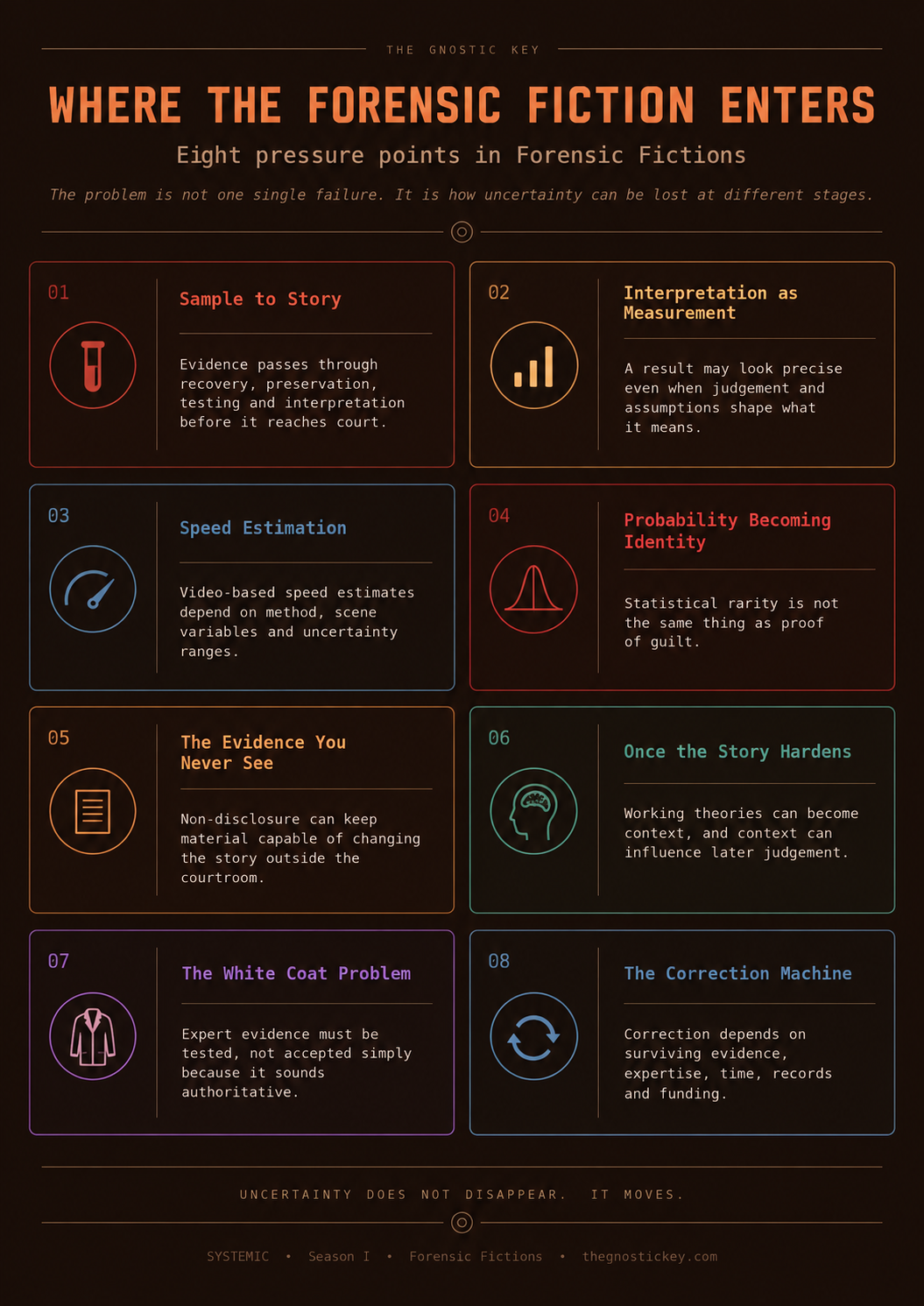
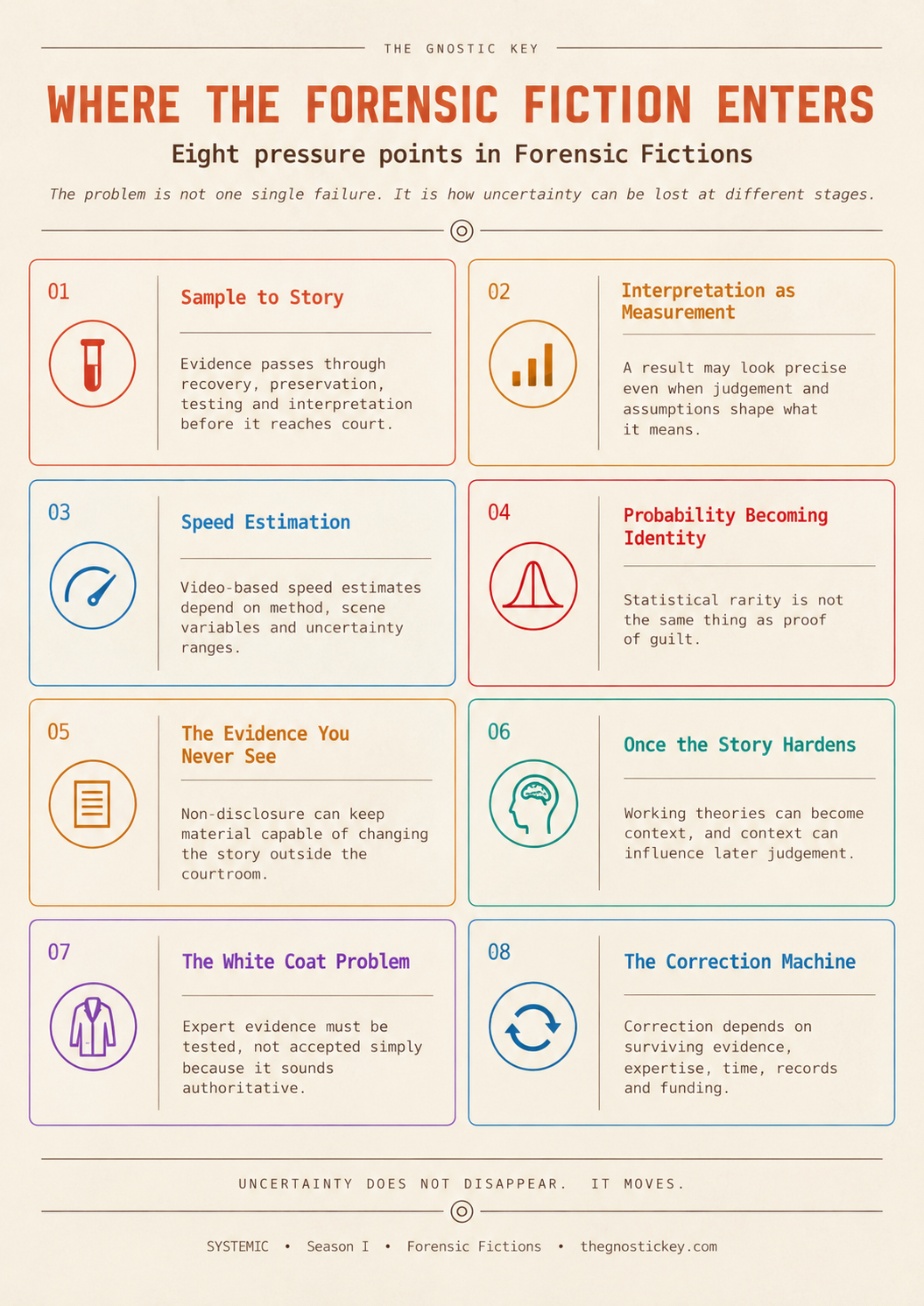
From Sample to Story
When we talk about evidence we tend to imagine that it arrives in court as a finished fact. It doesn't. What eventually reaches the courtroom is the end of a very long process.
Let's start with the crime scene itself. There may be a stain, a discarded mobile phone, a fibre, a trace chemical, a partial fingerprint, a frame from CCTV footage or a biological sample. None of those things arrives with an explanation of why or how it got there. Somebody has to notice it, recover it, label it, preserve it, decide whether it matters and determine what question it might help to answer.
Once the evidence has been collected, the next step is to examine it. A laboratory may test a sample, take measurements or compare it with something else. From there, an expert may be asked what the result actually means, whether it supports one explanation over another, whether two samples could share a source, or what can reasonably be inferred from the finding.
Ask the wrong question of the evidence and you can end up with the wrong conclusion. Establishing that biological material could have come from a particular person is not the same as establishing how it arrived at the scene, when it was deposited, or what that person was doing when it got there. The first question may be about the source of the material. The second requires an inference about the activity that caused it to be there. Evidence capable of supporting one does not automatically prove the other. [6]
Investigators then have to evaluate it, placing it alongside witness statements, timelines, suspects and competing theories about what happened. Prosecutors decide how, if at all, it fits the case being presented. The defence can test the assumptions and conclusions attached to it. Experts translate specialist findings into language the court can understand. Judges determine questions such as admissibility and give directions on how evidence should be approached. Where the case is tried before a jury, those jurors are eventually asked to decide what happened.
Some of those stages move evidence forward through the case, while others are there to test it. Defence challenge, expert disagreement, disclosure duties, judicial scrutiny and appeal all exist because evidence can be misunderstood, overstated or incomplete.
The risk is that uncertainty does not move neatly through the process. An expert may say that a finding is only consistent with one explanation and that other explanations remain possible. By the time that finding is summarised, discussed and repeated further down the line, the caveat can disappear while the conclusion survives. An assumption can pass forward as context. A weak interpretation can be challenged before trial, or reach the courtroom carrying far more authority than it deserves.
A forensic finding may support a proposition without establishing it. An investigator may place that finding alongside other evidence pointing in the same direction, and a prosecutor may then build those pieces into the case presented in court. If the limits attached to the original finding are lost along the way, by the time a jury hears the finished story the distance between could be, supports and is can become surprisingly thin. [6]
The forensic fiction does not require anybody to invent a result. Sometimes it emerges in the distance between what the evidence can actually establish and what the finished story makes it appear to establish.
Where the Evidential Picture Can Distort
There is no single type of forensic failure. A contaminated sample is not the same problem as an overstated probability. An unreliable laboratory is not the same problem as a valid finding given more weight than it can carry. If we collapse all of those failures into one category, we lose sight of where the problem actually entered the process.
The more useful question is simpler. Where does the problem enter the evidential picture, and what kind of failure are we looking at?
Contamination and laboratory integrity
The most obvious failures can happen before interpretation even begins. Forensic samples can become contaminated, mislabelled, mishandled or processed through a system whose integrity has been compromised. If the underlying material, or the record attached to it, cannot be trusted, every conclusion built on top of it inherits that weakness.
The data-integrity failures uncovered at Randox Testing Services show what the problem looks like on an institutional scale. In 2017, the Forensic Science Regulator was alerted to suspected data manipulation at Randox, with concerns later extending to Trimega Laboratories. The wider data-integrity issue across the two laboratories ultimately affected more than 10,000 forensic toxicology test results. [7]
Once confidence in the process had broken at that scale, thousands of results could no longer simply inherit credibility from the laboratory that produced them.
We will come back to Randox later, because once a failure reaches that scale, the problem is no longer only how the evidence was produced. It is how the system repairs everything built on top of it.
Interpretation masquerading as measurement
Other failures enter later, when the measurement itself may be sound but the meaning attached to it is not.
Not every forensic finding involves the same kind of interpretation. Some observations can be reported factually or questions answered directly through analysis. Others require an expert to evaluate findings against competing propositions. The court therefore needs to understand where observation ends, where interpretation begins and how much uncertainty remains. [6]
A comparison may support one proposition more strongly than another without establishing either proposition as fact. A trace may be capable of coming from a particular source without proving the activity that placed it there. Technical language can blur those distinctions if the limits of the finding are not communicated clearly. [6]
A current example comes from something that sounds almost purely mathematical, estimating the speed of a vehicle from video footage during collision investigations.
In August 2024, the Forensic Science Regulator issued a formal notification warning the criminal justice system about risks associated with this work. The notification followed referrals involving unsatisfactory proficiency-test results. The Regulator identified concerns around practitioner competence, validation of methods, method selection, measurement uncertainty, checking and peer review. [8]
The uncertainty matters because a speed estimate can depend on several case-specific variables, including the position of the camera and vehicle, the quality and frame rate of the footage, measurements taken at the scene, pixel selection and the method used to turn those observations into a speed. The Regulator warned that if the uncertainty range is missing, or does not properly reflect the individual case, the estimate can appear more precise than the measurement really allows. [8]
The Regulator's 2024 to 2025 annual report returned to the issue. It recorded that no organisations then met the accreditation requirements for this activity and again identified risks including incomplete validation, unclear measurement uncertainty and insufficient checking or peer review. [9]
The number produced at the end may still look exact. The harder question is whether the method, assumptions and uncertainty underneath it actually justify that level of confidence.
Probability becoming identity
Numbers can feel different because they give the impression of certainty.
A witness can sound uncertain, while a statistic can make it seem as though mathematics has finished the argument.
A probability, however, can only answer the question it was calculated to answer, using the assumptions built into it. Ask the wrong question and a precise-looking number can produce a profoundly misleading conclusion.
Sally Clark's case gives us one of the clearest examples. At her 1999 trial, expert evidence concerning the statistical improbability of two sudden infant deaths in the same family included the now infamous figure of 1 in 73 million. [10]
The statistic was only one part of what went wrong in Clark's case. Even so, it shows how a number can appear objective while still carrying assumptions, limitations and the risk of being used to answer a question it was never designed to answer.
The Evidence You Never See
We tend to imagine that a wrongful conviction happens because something false was put before a jury.
Sometimes the problem is the opposite.
Something important never arrives.
Criminal investigations generate an enormous amount of material, far more than will ever be used in a courtroom. Much of it will have no bearing on the issues in the case. Some of it may never be relied on by the prosecution at all. Other material may undermine a key witness, complicate an expert conclusion, support the defence or point away from the theory investigators eventually adopted.
Material does not fall out of the legal process simply because the prosecution does not intend to use it. Investigators are required to retain and record relevant material, and prosecutors must disclose anything that might reasonably be considered capable of undermining the prosecution case or assisting the accused. [11]
Disclosure matters because the defence cannot challenge something it does not know exists.
This creates a different kind of evidential failure. Nothing put before the jury needs to be fabricated. The exhibits may be genuine and the witnesses may believe what they are saying. The overall picture can still become misleading if material capable of changing its meaning never reaches the court.
Sally Clark's case brings this problem sharply into view. Microbiological test results relating to her son Harry were not disclosed to the defence at trial. When those results later came to light, they formed part of the appeal in which her convictions were quashed. [10]
A justice system needs more than rules governing what evidence may be admitted. It also needs reliable processes for recording, reviewing and disclosing material capable of changing the story that reaches the court. [11]
A story does not have to contain a lie to become misleading. Sometimes it only needs something important left out.
Once the Story Hardens
Evidence is not interpreted in a vacuum.
The job of the investigators assigned to a case is to establish, as far as they can, what happened and under what circumstances. That means forming a working hypothesis, identifying possible suspects, building a timeline, corroborating witness statements and examining how the forensic evidence fits. That is ordinary investigation.
The danger begins when the theory stops behaving like a question and starts behaving like the answer.
The Forensic Science Regulator explicitly warns about this. Its guidance identifies confirmation bias, anchoring and contextual bias as risks in forensic decision-making. Investigators can become fixed too early on a particular subject, with later information then interpreted around that initial focus while simpler alternative explanations receive less attention. [12]
The guidance cannot tell us how often cognitive bias changes the outcome of a criminal case, or whether it affected any of the convictions examined here. What it does show is that the risk is taken seriously enough for safeguards to be built around it.
The same problem can enter the forensic examination through context. An examiner may know details of the offence, the status of a suspect or other information about the investigation that is not needed to answer the scientific question in front of them. Where the material is ambiguous or the assessment depends on subjective judgement, that information can influence what they see and the conclusion they reach. [12]
Assumptions created at one stage of the process can become context at the next. A working theory becomes background information, that information creates expectation and expectation can influence judgement. If nobody goes back and tests the original assumption, the story can begin to reinforce itself.
The safeguards can be very practical. Context that is not needed for the forensic task can be restricted, independent or blind verification can be used where appropriate, and the reasoning behind conclusions can be recorded so the interpretive process can be examined afterwards. [12]
Once a story exists, the system has to work deliberately to stop that story from becoming evidence in its own favour.
Seed Question
Where is the line between necessary investigative focus and confirmation bias? What evidence would show that the safeguards described here are strong enough to stop a working theory from becoming evidence in its own favour?
The White Coat Problem
Courts need experts because judges, barristers and jurors cannot become toxicologists, pathologists, statisticians, DNA specialists or digital forensic analysts every time they hear a case.
The problem begins with uncritical deference, when an expert's opinion is accepted because of their status rather than examined against the evidence, assumptions and limits behind it.
A genuine expert knows things the rest of the courtroom does not. That is precisely why their evidence carries weight. The more specialised the subject becomes, the harder it may be for a non-specialist to see where established science ends, where professional judgement begins and where reasonable disagreement between experts is still possible.
The law builds safeguards around that problem. Expert opinion must be sufficiently reliable to be admitted, and the court can look at the quality of the underlying data, whether the method is valid, how safe the inference is, and how much precision or uncertainty the opinion really carries. Where experts legitimately disagree, the court can also consider where the particular opinion sits within that range and how well it has been explained. [13]
From 18 November 2025, expert reports must also disclose relevant authoritative advice or warnings, along with past adverse findings or disciplinary proceedings, even where those matters have since been resolved. An expert report has to do more than deliver a conclusion. The court needs to be able to see what the opinion rests on, how the result was reached, what assumptions were made and where the limits remain. [14] [13]
This is where communication becomes part of the problem. A forensic result can support one proposition more strongly than another without telling the jury that the proposition itself is probably true. If those two questions are blurred, a scientifically legitimate calculation can become a very different claim by the time it is translated into ordinary language. [6]
The same problem appears in less mathematical language. Phrases such as consistent with can sound more decisive than they are if the court is not told that the same findings may also fit alternative propositions. [6]
A justice system must respect the expertise without converting the expert into an oracle.
Case Files: What Failed, and Where
A list of miscarriages can become numbing. A name, a sentence, a release date, another terrible outcome. We know that somebody was harmed without necessarily understanding how the system came to the decision that harmed them.
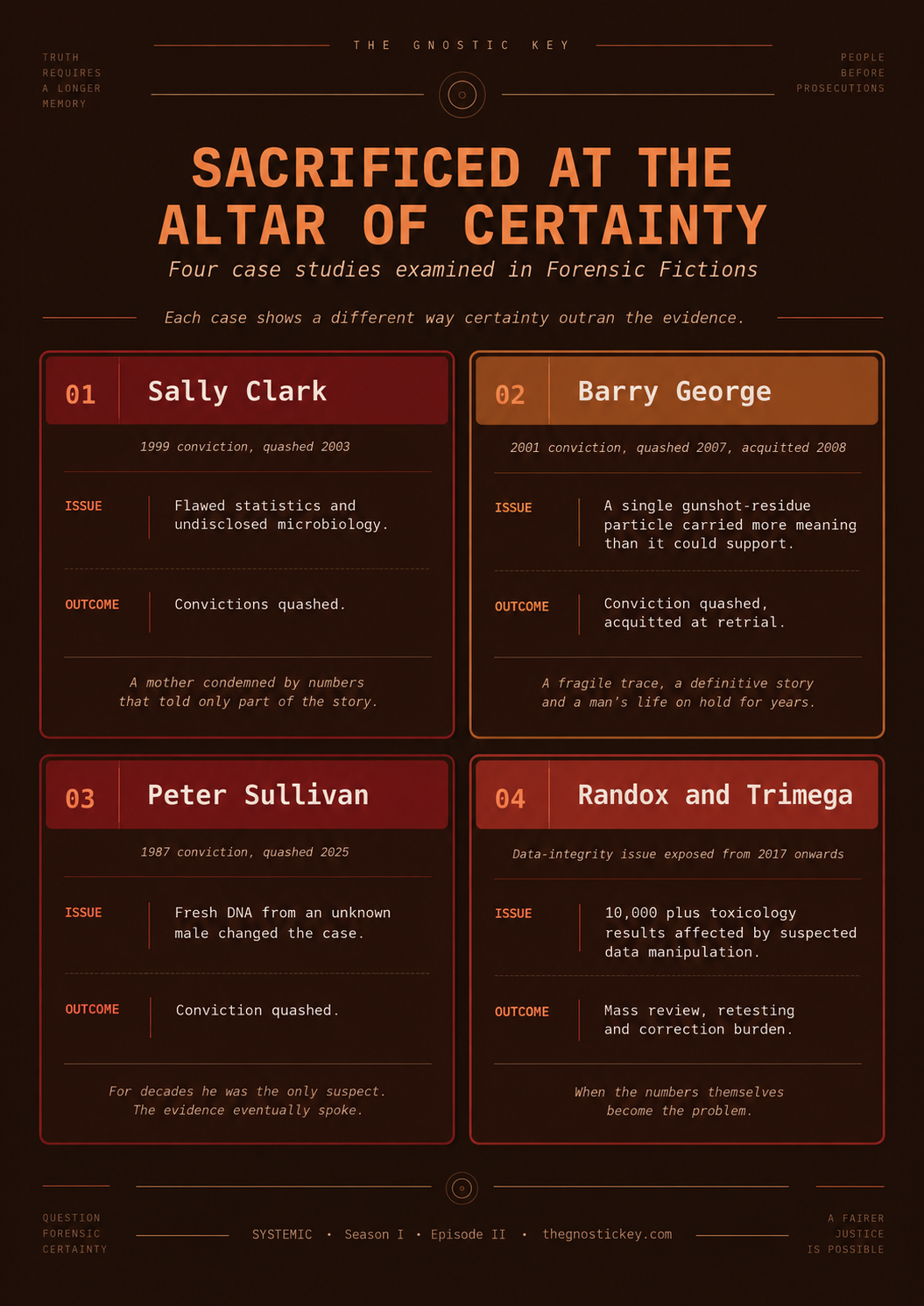
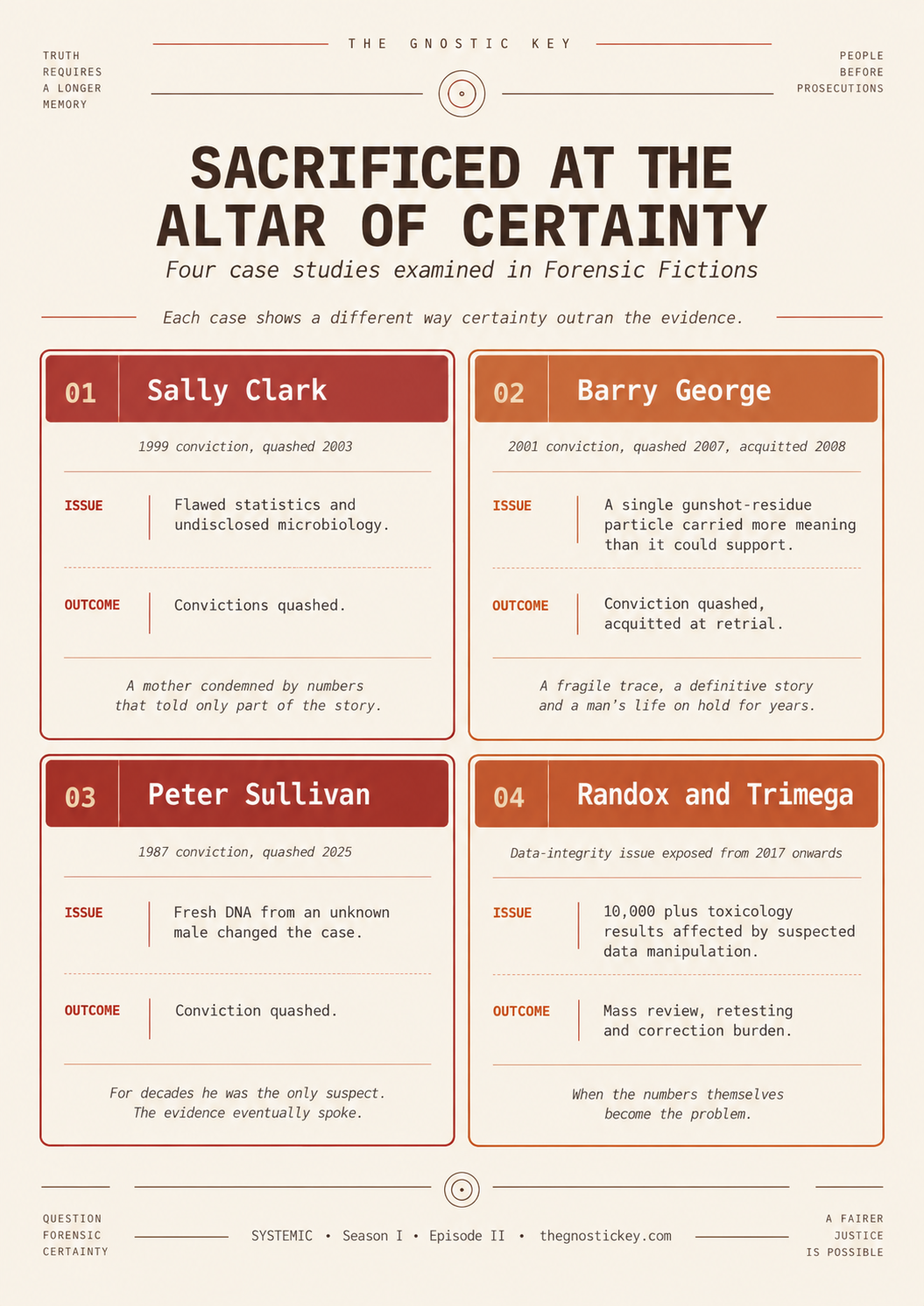
The cases below expose different points in the journey from evidence to verdict. We can see what entered the system, what meaning was attached to it, what the court eventually accepted and what later forced that version of events back under examination.
These cases do not tell us how often these failures happen. Their value is in showing how they can happen, what it looks like when safeguards miss them and what becomes visible when a conclusion once treated as settled is examined again. In SYSTEMIC, I use the term systemic when the conditions capable of producing a failure come from recurring structures, rules or processes rather than depending on one isolated bad actor.
There is another limit built into the evidence. The failures we can examine in detail are usually the ones the system eventually caught.
Barry George: when a particle carried more meaning than it could support
Barry George was convicted in July 2001 of murdering television presenter Jill Dando, who had been shot outside her Fulham home in April 1999. The prosecution case rested on several strands of evidence. Witnesses placed a man resembling George near the scene, prosecutors said he had repeatedly lied during police interviews, and they alleged that he had tried to manufacture a false alibi. Alongside all of that was a single microscopic particle of firearm discharge residue found in the pocket of George's coat when his flat was searched almost a year after the murder. Its constituent elements matched residue recovered from the cartridge case at the scene and from Dando's hair. [15]
At trial, that single particle was presented as an important part of the prosecution case. The prosecution argued that its presence was “no coincidence” and, when taken alongside the identification and alibi evidence, formed part of what it described as compelling evidence of George's guilt. The problem was not that the particle had been invented or wrongly detected. It was the meaning attached to finding it. [15]
By 2006, the forensic position had changed. Fresh evidence concluded that a single particle could have come from an innocent environmental source and that it was just as likely to have been deposited that way as it was to have come from George firing the weapon. The finding could no longer distinguish between those possibilities. The Court of Appeal quashed his conviction in 2007 and ordered a retrial. [15]
The firearm discharge residue evidence formed no part of the retrial, and in August 2008 George was acquitted of Dando's murder. [16]
The particle itself had not changed. What changed was the meaning the science could legitimately attach to it.
George's case comes from an earlier regulatory era, but the distinction it exposes still matters. The current Code treats the examination of gunshot residue separately from later opinions about when, where or how those particles may have been acquired. [17]
That is the part of George's case that matters here. The question was not whether the particle existed, but what the finding could actually tell us. The modern system still has to make that distinction.
The Regulator's 2026 interpretation guidance makes that distinction explicit. It separates questions about the source of material from questions about the activity that put it there, warning that answering the first does not automatically answer the second. The current Code reinforces that separation by treating activity-level interpretation as a distinct forensic task, with its own requirements for how opinions are developed and reported. [6] [17]
George's case does not tell us that the same failure would happen today. What it does show is why the distinction matters. Detecting a particle is one task. Deciding what that particle means is another. The modern framework is designed to keep those questions separate rather than allowing one to slide quietly into the other.
That interpretive step is where the risk is concentrated, which is why the current framework treats it separately. A particle can be detected correctly while the harder question is still unanswered. What does it actually prove?
Sally Clark: when certainty arrived as a number
Sally Clark was convicted in 1999 of murdering her two infant sons, Christopher and Harry. Her case became notorious for expert statistical evidence concerning the likelihood of two sudden infant deaths occurring naturally in the same family. [10]
At trial, Professor Roy Meadow told the jury that the probability of a single sudden infant death in a family with characteristics similar to the Clarks was approximately one in 8,543. That figure was then multiplied by itself to produce the now infamous probability of approximately one in 73 million for two such deaths in the same family. [10]
The problem was that the calculation treated the two deaths as though they were completely independent events. The Court of Appeal recorded expert evidence describing that approach as an illegitimate oversimplification and concluded that the one-in-73-million figure very likely grossly overstated the rarity of two unexplained but natural deaths in the same family. [10]
There was another problem hidden inside the number. Even if the calculation had been sound, it still could not answer the much more important question of whether Clark had murdered her children. The rarity of two natural deaths is not the same thing as the probability that their mother killed them. [10]
The statistics were not the only failure. Microbiological tests had been carried out during Harry's post-mortem examination, but the results were never disclosed to the defence. They identified Staphylococcus aureus, a bacterium that can live harmlessly on the skin or in the nose but can cause serious infection if it enters deeper tissues or the bloodstream, in several sites including his cerebrospinal fluid. That later became important because it raised a possible natural explanation for his death. [10]
The jury never heard that evidence. When it was eventually examined by other medical experts, it changed the medical picture surrounding Harry's death and weakened the reasoning that had treated the deaths of two children in the same family as mutually reinforcing evidence of murder. The Court of Appeal quashed Clark's convictions in January 2003. [10]
Clark's case brings several failures together. A precise number appeared to carry more certainty than its assumptions justified, while evidence capable of changing the medical explanation never reached the trial. Together they helped create a story that looked far more settled than the evidence underneath it really was.
Randox: when the laboratory becomes the evidence
Clark shows what these failures can look like inside an individual prosecution. Randox exposes something different. What happens when the problem sits much further upstream, inside the laboratory producing the evidence in the first place?
In January 2017, Randox Testing Services told the Forensic Science Regulator that improper manipulation of quality-control data had been discovered at its Manchester laboratory. The apparent purpose was to make batches of work that had failed quality checks appear as though they had passed. Results were then supplied to the criminal justice system when the analysis should have been repeated. [18]
Two members of staff were suspended and later dismissed, and forensic toxicology work at the Manchester site was stopped. As the investigation widened, the period of unreliable testing was traced back to November 2013 and concerns extended to work connected with Trimega Laboratories. [18] [7]
By April 2017, the Regulator had advised that results produced using the affected drug-analysis methods at Randox's Manchester and Belfast sites could not be regarded as sufficiently reliable for use in the criminal justice system. [18]
The scale was enormous. Around 10,000 cases were caught up in the original Randox review, while the later investigation covering Randox and Trimega involved more than 10,000 forensic toxicology test results. Those are different measures and should not be treated as though they describe 10,000 wrongful convictions. What they show is the size of the problem the system suddenly had to unravel. [18] [7]
Randox agreed to fund independent retesting where appropriate, but forensic toxicology capacity was limited. The Regulator warned that working through the affected cases could take two to three years. [18]
There is another part of Randox that matters here. The laboratory held the relevant accreditation, yet the normal quality system had not exposed what was happening. The Regulator later warned that standard audits are unlikely to prevent determined malpractice by skilled personnel. [18]
That does not make accreditation meaningless. It shows its limit. A safeguard designed to test quality can still be defeated by people who understand the system well enough to manipulate what the safeguard is looking at.
Once confidence in a forensic provider breaks down, the problem travels through everything built on top of its work. Results have to be identified, surviving samples located, retesting commissioned where possible and individual cases reviewed to decide whether the original evidence can still safely be relied upon.
The laboratory normally provides the evidence. This time, the reliability of the laboratory became the thing that had to be investigated.
Seed Question
Do George, Clark, Randox and Sullivan justify describing the vulnerability examined here as systemic? Which failures arise from recurring structures or processes, and which are better explained as historical, exceptional or individual failures?
When Science Changes but the Verdict Doesn't
Science does not stop when the judge leaves the courtroom.
Methods improve, instruments become more sensitive and techniques that once reached their limit can sometimes recover information years later. Other methods lose credibility as new research exposes weaknesses that were not understood before.
A conviction does not move automatically with any of it.
Once the ordinary trial and appeal process has finished, new science does not simply reach backwards and reopen a case. Somebody has to recognise what has changed, establish why it matters and find a legal route capable of putting the new evidence back before a court.
Peter Sullivan: when a settled conviction met new DNA
Peter Sullivan was convicted in 1987 of murdering 21-year-old Diane Sindall in Birkenhead the previous year. Semen had been recovered from her body, but the sample had been diluted by rain and the forensic techniques available at the time could not identify who it came from. The prosecution case instead relied on other evidence, including Sullivan's police interviews and expert bite-mark evidence. [19] [20]
Sullivan first asked the Criminal Cases Review Commission to revisit the DNA evidence in 2008. Forensic scientists advised that further testing was very unlikely to produce a useful DNA profile, and the case was not referred to the Court of Appeal. [19]
There was another problem. The techniques available at the time risked using up or damaging the surviving material without producing anything useful. Testing it simply because it existed could have destroyed the very sample that later became capable of answering the question. [21]
Sullivan applied to the CCRC again in 2021. By then, the science had changed. Modern DNA techniques were able to recover a profile from the semen found on Diane Sindall's body. It belonged to an unknown man and did not match Sullivan or Sindall's fiancé. [20]
That changed the case completely. The Court of Appeal found that the attack clearly had a sexual aspect, that there was a very strong inference that the attacker had deposited the semen and that there was no evidence suggesting the involvement of two men. The court observed that if the DNA evidence had been available during the original investigation, the evidence as a whole would have been insufficient even to charge Sullivan. [20]
In May 2025, the Court of Appeal admitted the fresh DNA evidence and quashed Sullivan's conviction as unsafe. The court did not need the fresh bite-mark or confession evidence to reach that decision and rejected those separate grounds. [20]
The biological material had been there all along. What changed was what forensic science was capable of finding inside it.
For almost four decades, the legal conclusion remained fixed while the scientific possibilities moved underneath it.
New science still needed a route back into the legal system. The CCRC had to investigate the evidence, decide whether there was a real possibility that the conviction would not be upheld and refer the case back to the Court of Appeal. [22]
Sullivan's case shows how many things have to line up before an old conviction can be disturbed. The evidence has to survive, somebody has to return to it, the science has to be capable of finding something new, and there still has to be a body with the power to put that evidence back before a court.
The CCRC has said that its decision not to refer Sullivan's conviction in 2008 was correct because the DNA techniques that eventually produced the decisive evidence did not then exist. It has nevertheless expressed regret that it did not identify his conviction as a potential miscarriage of justice during that earlier review. [21]
That distinction matters. The safeguard did eventually work, but only because the evidence survived long enough for the science to catch up with it.
Correction is never automatic. It depends on surviving evidence, access to expertise and testing, review capacity, funding and somebody with the power to reopen the question.
A safeguard can work eventually and still arrive far too late. Sullivan entered prison at 30 and walked out at 68. Thirty-eight years cannot be returned to him. No appeal can give him back the life he would have lived, the people he lost, or the years the system took before it was finally able to correct itself.
The Correction Machine
Finding an error is not the same as repairing it.
That becomes obvious when the failure is larger than one case.
When the Randox data-integrity problem emerged, potentially affected cases did not simply reopen themselves. Police forces and the Crown Prosecution Service had to review criminal cases individually, and samples were retested where that was still possible. Priority was given to people already in custody and cases where proceedings were still under way. [23]
Trimega created a different problem. Its testing had also been used in family-court proceedings, including decisions involving children and local-authority care. That meant the response could not be identical. Different parts of the justice system had to work out how potentially unreliable evidence could be identified, reviewed and, where necessary, put back before a court. [23]
Scale changes everything. More than 10,000 forensic toxicology test results were affected across the wider Randox and Trimega data-integrity issue. Working through a failure on that scale meant identifying affected cases, finding surviving samples, commissioning retesting where possible, reassessing results and deciding whether any legal outcome required further action. [7]
The Randox failure also unfolded while the regulatory machinery around forensic science was changing. When the investigation began in 2017, the Forensic Science Regulator did not have statutory powers to investigate laboratories or take enforcement action. The Forensic Science Regulator Act 2021 later placed the office on a statutory footing, with investigatory powers coming into force from 2022 and the first statutory Code of Practice following in 2023. The current version came into force in October 2025. [9]
Much of what went wrong in Clark, George and Sullivan happened under versions of the forensic system that have since changed. Those cases cannot simply be laid over the framework operating in 2026 as though nothing happened in between.
Interpretation guidance, cognitive-bias controls, stronger requirements for expert evidence and the statutory powers of the Regulator all show a system that has responded to weaknesses it already knows about.
The response is not uniform. A rule can identify a risk without covering every part of the forensic process, and stronger regulation does not mean every safeguard has the same reach or capacity.
Post-conviction forensic case review is a good example. In its latest annual report, published in July 2026 and covering the year to July 2025, the Regulator described that work as a critical part of the criminal justice system, including work capable of revealing miscarriages of justice. It also recorded that the sector remains outside the Code's compliance requirements, has no regulatory barrier to entry and no requirement for formal assessment of the competence of those carrying out the review. [9]
The same report describes a fragile sector heavily dependent on sole traders and microbusinesses, with concerns that funding for peer review of defence casework is frequently refused. [9]
That matters when an earlier forensic interpretation needs to be tested again. A scientific basis for challenge is only part of the equation. Somebody still needs the expertise, time, funding and, where necessary, peer review to pursue it.
The report does not tell us that an overstated interpretation survives every time funding is refused. It does show a practical limit inside post-conviction review. An expert conclusion may be open to challenge while the capacity to mount that challenge remains constrained. [9]
George shows why that matters. The particle did not change. The meaning attached to it did. Once a conviction is settled, getting back to that question depends on whether somebody has the resources and authority to reopen it.
More regulation is not a simple answer either. The Regulator has warned that imposing further requirements on an already fragile case-review sector could undermine its viability. [9]
The failed Randox criminal investigation exposes the same problem from another direction. In November 2024, Greater Manchester Police ended its investigation without further criminal action against seven suspects after facing what the Regulator described as an “unprecedented mass of materials” and insufficient funding to analyse them. [7]
The story did not simply end there. The Regulator is now working with Greater Manchester Police to gain access to the abandoned investigation material, understand how the manipulation was carried out and decide whether the current Code needs to change again. [7]
That is what correction really looks like. Randox led to retesting and individual case review. Sullivan reached the Court of Appeal because forensic evidence was revisited decades after conviction. The Regulator gained powers it did not have when the Randox failure first emerged, and is still using what happened to test whether the safeguards now in place are good enough.
A safeguard only matters if it can still work when the system needs it most. If the evidence cannot be revisited, the expertise cannot be funded or the case cannot be reopened, then the safeguard exists in theory while the mistake survives in practice.
Seed Question
When should we say a safeguard has worked? If a mistake can eventually be corrected but only after years, lost evidence, limited funding or repeated review, what would distinguish a functioning correction system from one that works mainly when the right conditions happen to survive?
So What Is a Forensic Fiction?
Forensic evidence can be extraordinarily powerful. DNA has helped overturn wrongful convictions as well as support prosecutions. Better science has exposed old errors. Expert evidence can challenge a prosecution theory as well as support one. The criminal justice system also contains procedures capable of identifying and correcting mistakes.
The lesson is not that science is theatre. It is that certainty can be.
A forensic fiction emerges when uncertainty in forensic evidence or its interpretation is lost, obscured or overstated, leaving the conclusion with more certainty than the evidence can support.
That definition matters because the failures in this episode are not interchangeable. Contaminated samples, manipulated laboratory data, non-disclosure and failures of review can all distort the case or prevent an error from being corrected. The forensic fiction sits in the gap between a finding and the meaning attached to it, and in what can happen to that meaning as it travels through the case.
The current evidence shows more than one route into that gap. In vehicle-speed estimation, the Regulator has identified concerns around validation, measurement uncertainty, checking and peer review, and reported that no organisations then met the accreditation requirements for the activity. [8] [9]
Gunshot residue raises a different question. The current Code separates the examination of the residue from later opinions about when, where or how those particles may have been acquired. One question is whether the finding itself is sound. The other is what meaning can legitimately be attached to it. [17]
The route may be different, but the danger is the same. The conclusion can outrun the evidence underneath it.
That is what makes the problem harder to see. The fiction is not always the evidence. Sometimes the fiction is the certainty attached to it.
Seed Question
Does 'forensic fiction' describe a distinct problem, or does it simply rename ordinary evidential uncertainty and forensic error? Which examples in this episode fit the definition, and which examples fall outside it?
Final Reflection: Authority Is Not Truth
A criminal court cannot remain permanently undecided. Eventually, it has to determine whether the prosecution has proved its case. That is what a verdict does. It creates a legal conclusion from evidence about an event the court did not witness.
The legal system does not pretend that a verdict is a form of historical omniscience. Standards of proof, appeals and the possibility of quashing a conviction all exist because legal conclusions are reached through evidence and can sometimes be wrong.
Once a conclusion acquires legal authority, its practical weight can begin to exceed the uncertainty underneath it. A laboratory result, an expert opinion and a jury verdict do different jobs, but all can become harder to disturb once a case is settled.
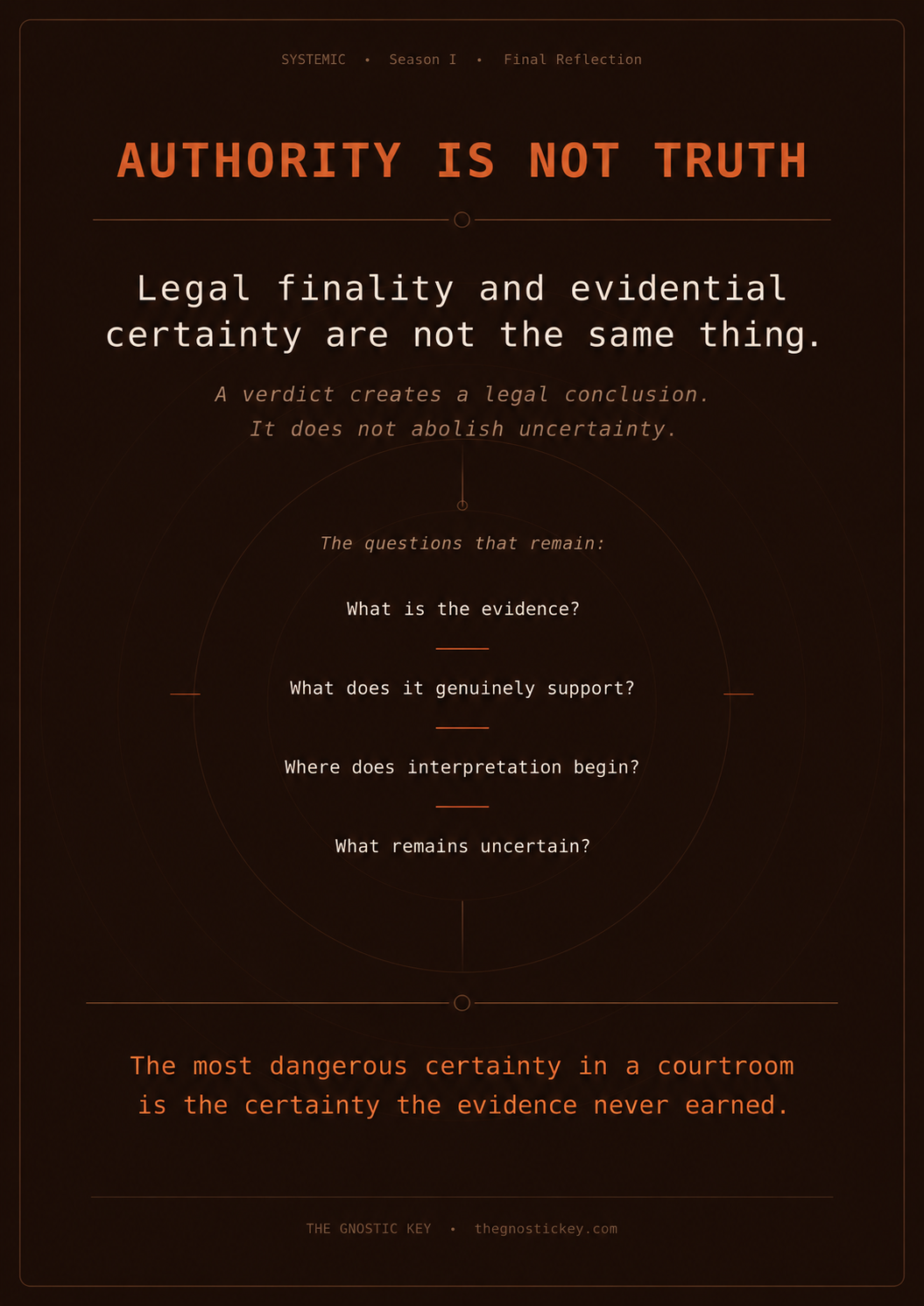
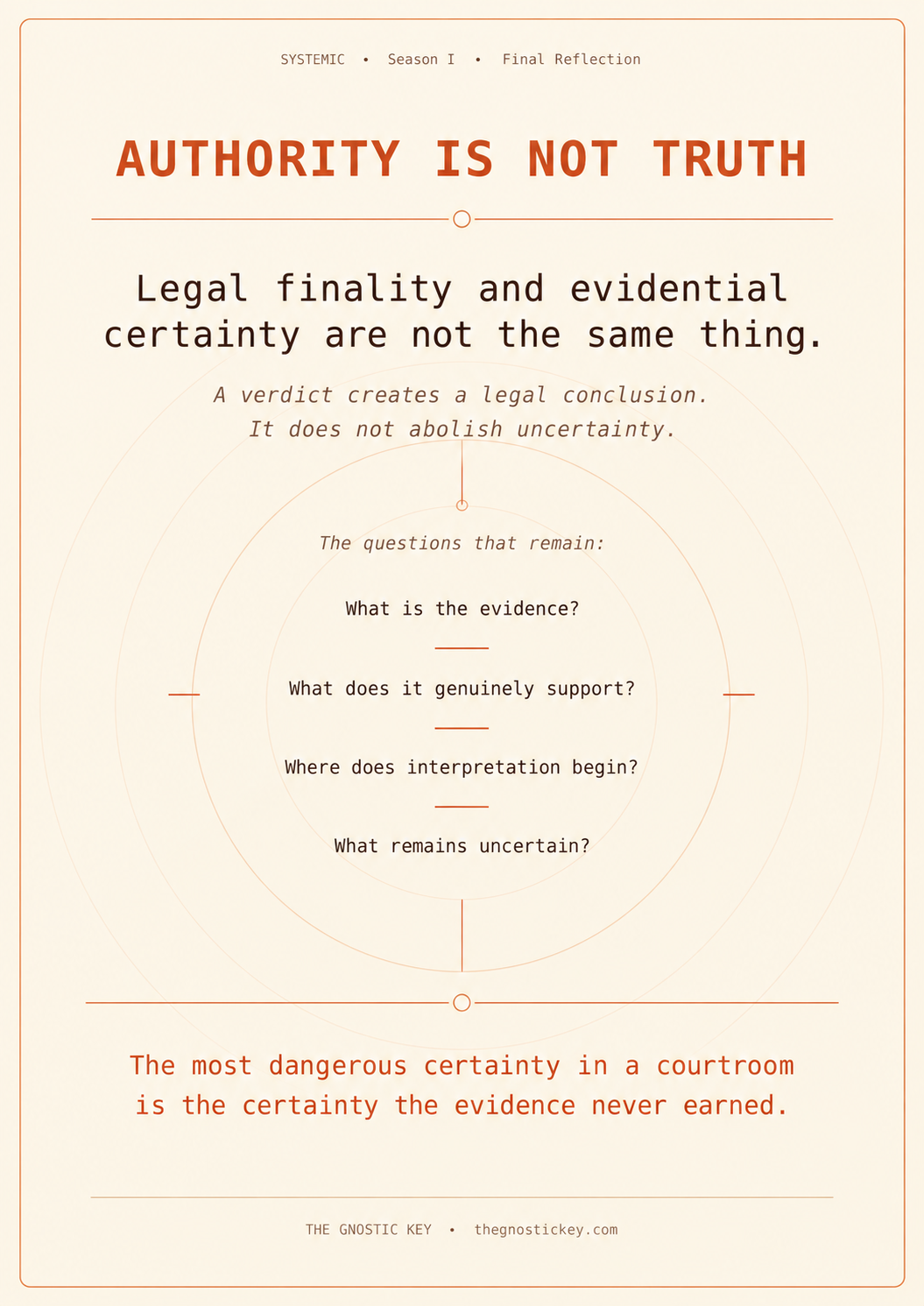
Legal finality and evidential certainty are not the same thing. A conviction can stand on the evidence available at trial and later be quashed as unsafe when fresh evidence changes that picture.
The Gnostic lesson here is not to reject knowledge, science or expertise in favour of instinct. It is almost the opposite. It is to keep asking what something actually proves after status, ritual and authority have been stripped away.
The distinction becomes brutal when the punishment cannot be undone. A justice system can revisit evidence, revise an interpretation and quash a conviction. Those correction mechanisms may arrive late, but they still exist. An execution removes that possibility at precisely the point where later scrutiny may prove it was needed.
What is the evidence?
What does it genuinely support?
Where does interpretation begin?
What remains uncertain?
And what happens when that uncertainty disappears somewhere between the evidence and the verdict?
The most dangerous certainty in a courtroom is the certainty the evidence never earned.
Where This Goes
Forensic Fictions has followed the evidence as it moves towards a legal conclusion. Episode III moves inside the courtroom itself.
Once evidence becomes part of a prosecution case, another set of pressures begins. The language changes. The procedure changes. The accused enters a room with its own hierarchy, rules, incentives and expectations about how they are supposed to behave.
Courtroom Alchemy asks what happens when justice is not only decided through evidence, but shaped by the process used to deliver it. Who understands that process, who can afford to challenge it, where pressure enters, and when procedure begins to carry authority of its own?
Seed Question
Can you find current evidence, cases or safeguards that materially weaken the argument in this episode that uncertainty can still be lost, obscured or overstated between forensic evidence and the legal conclusion?
Own This Part
Keep a permanent offline copy of this part, with the full text and the complete formatted edition ready to download.
Members and Founding Members pay £2.49, applied automatically at checkout when signed in.
Resources
References
-
[1] New Reform chair David Bull calls for return of death penalty
:Independent report recording support for capital punishment from Reform UK chair David Bull and Nigel Farage's contrasting statement that serious miscarriages of justice meant he did not think he could support reintroducing the death penalty.
-
[2] Do Britons support the return of corporal and capital punishment?
:YouGov survey published 7 November 2025 finding that 50% of Britons supported reintroducing capital punishment for some crimes and 45% opposed it, with support higher among Reform UK and Conservative voters than among Labour, Liberal Democrat and Green voters.
-
[3] Prime Minister's Questions - Rupert Lowe: Death Penalty Referendum
:Official Hansard record of Rupert Lowe asking the Prime Minister on 12 November 2025 whether the death penalty should be put to a legally binding referendum in cases where guilt was described as undeniable, and Keir Starmer rejecting reintroduction while citing historical executions of people later found innocent.
-
[4] Mahmood Mattan case review
:Official Criminal Cases Review Commission account of Mahmood Mattan, who was executed for murder in 1952 and whose conviction was quashed by the Court of Appeal in 1998 after the CCRC identified serious non-disclosure and identification-evidence failures.
-
[5] UK Government position on abolition of the death penalty - 25 February 2026
:Official parliamentary answer restating the UK Government's opposition to the death penalty in all circumstances, citing human dignity, the absence of conclusive evidence of deterrent value, and the irreversible and irreparable consequences of a miscarriage of justice resulting in execution.
-
[6] Forensic science activities: interpretation and communication (FSR-GUI-0004)
:Official Forensic Science Regulator guidance for England and Wales on the interpretation and communication of forensic observations and opinions, including the distinction between source-level and activity-level propositions, evaluation of competing propositions, assumptions, uncertainty, and the risk of misleading conclusions.
-
:Official Forensic Science Regulator notification concerning suspected data manipulation in forensic toxicology testing at Randox Testing Services and Trimega Laboratories, affecting more than 10,000 test results, and the subsequent Greater Manchester Police investigation.
-
[8] Regulator's notification 02-2024: estimating vehicle speed from video footage
:Official Forensic Science Regulator notification warning the criminal justice system about current risks in estimating vehicle speed from video footage, including practitioner competence, method validation and selection, measurement uncertainty, checking, peer review and the management of non-compliant forensic work.
-
[9] Forensic Science Regulator annual report for 2024 to 2025
:The statutory Forensic Science Regulator's July 2026 annual report, covering the development of statutory regulation and Code of Practice version 2, as well as current weaknesses in forensic Case Review, which remains outside Code compliance requirements and is described as an unregulated and fragile sector.
-
[10] R v Clark [2003] EWCA Crim 1020
:Court of Appeal judgment quashing Sally Clark's murder convictions, addressing undisclosed microbiological evidence and the statistical evidence presented at trial.
-
[11] Attorney General's Guidelines on Disclosure 2024
:Current Attorney General guidance for England and Wales on the criminal disclosure regime under the Criminal Procedure and Investigations Act 1996, including investigators' duties to pursue reasonable lines of inquiry, retain and record relevant material, and the prosecution test for disclosure of material capable of undermining the prosecution case or assisting the accused.
-
[12] Cognitive bias effects relevant to forensic science examinations
:Forensic Science Regulator guidance on confirmation, anchoring and contextual bias in forensic examination, including the influence of case information on subjective judgement and safeguards such as context limitation, blind verification and independent review.
-
[13] Criminal Practice Directions 2023, Chapter 7: Expert Evidence
:Current Criminal Practice Directions governing expert evidence in criminal proceedings, including admissibility and reliability factors such as data quality, methodology, inference, uncertainty, peer review, competing expert opinion and compliance with established practice.
-
[14] Fourth Amendment to the Criminal Practice Directions 2023 - November 2025
:Official Judiciary amendment to the Criminal Practice Directions 2023, effective 18 November 2025, strengthening Chapter 7 requirements for expert evidence by requiring disclosure of relevant authoritative advice or warnings, past adverse findings or disciplinary proceedings even where subsequently resolved, and updated expert-report compliance declarations.
-
[15] R v George [2007] EWCA Crim 2722
:Court of Appeal judgment concerning Barry George's conviction for the murder of Jill Dando, including fresh forensic evidence showing that the single firearm discharge residue particle relied upon at trial was of neutral evidential value.
-
[16] Jill Dando case: The evidence
:Contemporary Guardian report on Barry George's 2008 retrial, confirming that the firearm-discharge-residue evidence relied upon at his original trial did not form part of the retrial and that the retrial ended in George's acquittal.
-
[17] Forensic science activities: statutory code of practice - version 2
:Current statutory Forensic Science Regulator Code of Practice for England and Wales, effective from 2 October 2025, including the separate regulatory treatment of gunshot-residue examination and analysis and subsequent interpretation concerning where or when particles were acquired and what activity may have caused their transfer.
-
[18] Forensic Science Regulator annual report 2017
:Official Forensic Science Regulator annual report covering November 2016 to November 2017, including the Randox Testing Services data-integrity investigation, manipulation of quality-control data, reliability concerns affecting toxicology results, the scale of affected cases and the programme of independent retesting.
-
[19] Peter Sullivan case review
:Official Criminal Cases Review Commission record of Peter Sullivan's case, including his earlier application concerning DNA and bite-mark evidence, later advances in DNA testing, the resulting unmatched DNA profile, referral to the Court of Appeal, and the quashing of his 1987 murder conviction in May 2025.
-
[20] R v Sullivan [2025] EWCA Crim 772
:Court of Appeal judgment quashing Peter Sullivan's 1987 murder conviction after fresh DNA analysis produced a profile from semen recovered from Diane Sindall's body that did not match Sullivan; the court admitted the fresh DNA evidence, held the conviction unsafe, and rejected the separate fresh-evidence grounds concerning bite-mark analysis and confession reliability.
-
[21] CCRC response to Peter Sullivan judgment - 13 May 2025
:Official CCRC response following the quashing of Peter Sullivan's conviction, confirming that the appeal succeeded on new DNA evidence rather than the separate bite-mark, interview or weapon issues; explaining that the successful DNA techniques were unavailable during the 2008 review; and recording the CCRC's regret that the potential miscarriage was not identified at that earlier stage.
-
:Official Criminal Cases Review Commission explanation of its statutory investigatory powers, ability to obtain material and commission new expert evidence including DNA testing, and the 'real possibility' test applied when deciding whether to refer a conviction back to an appeal court.
-
[23] Forensic toxicology tests
:Official Ministry of Justice guidance on the response to potentially affected Randox forensic toxicology cases, including case-by-case police and CPS review, independent retesting where possible, and prioritisation of cases involving people in custody or ongoing proceedings.
This restored edition preserves the original 2 March 2026 publication record. The body was restored and frozen on 8 September 2026 and reflects sources and events available up to 17 July 2026. Sources include courts, Parliament, government and regulatory bodies, the CCRC, survey evidence and selected reporting. Interpretive synthesis represents the author's analysis through the Gnostic lens.
These sources are provided for verification, study and context. They represent diverse perspectives and are offered as reference points, not as doctrinal positions.
Link unavailable? Paste the URL into web.archive.org to find an archived snapshot. Most sources in our evidence packs are preserved there.
Support The Gnostic Key
The Gnostic Key is independently researched, written, and built. If the work has value to you, you can make a one-off contribution to help keep TGK independent.