


Introduction
Episode I mapped the legal staircase. Episode II steps into the evidentiary chamber where uncertainty is dressed as certainty and then handed to the court as fact.
Forensic fictions are not only about bad science. They are also about deference: contaminated samples, weak methods, overstated expert claims, and disclosure failures treated as authoritative because the institution presenting them sounds neutral. The Randox fallout and the Peter Sullivan case are not marginal embarrassments. They are public warnings about what happens when performance outruns reliability. [19][18]
This episode stays with the visible record: regulator findings, commission statements, primary legislation, and reported case outcomes. The claim is not that every forensic practice is fraudulent. It is that the system repeatedly rewards courtroom certainty before it has earned epistemic certainty.
⚡ TL;DR
- Forensic certainty is often staged. Expert language and lab presentation can hide weak methods, contamination, or overclaim.
- Disclosure failure matters as much as junk science. Cases collapse not only because tests are bad, but because exculpatory material is buried or arrives too late.
- Institutional deference keeps weak evidence alive. Methods can keep appearing in court long after their scientific basis has cracked.
- Miscarriages are structural warnings. Randox, Peter Sullivan, Sally Clark, and related cases show the cost when the system mistakes authority for truth.
- The issue is not only the lab. Police, prosecutors, experts, and courts each help convert ambiguity into a verdict-shaped story.
🧪 Forensic Failures
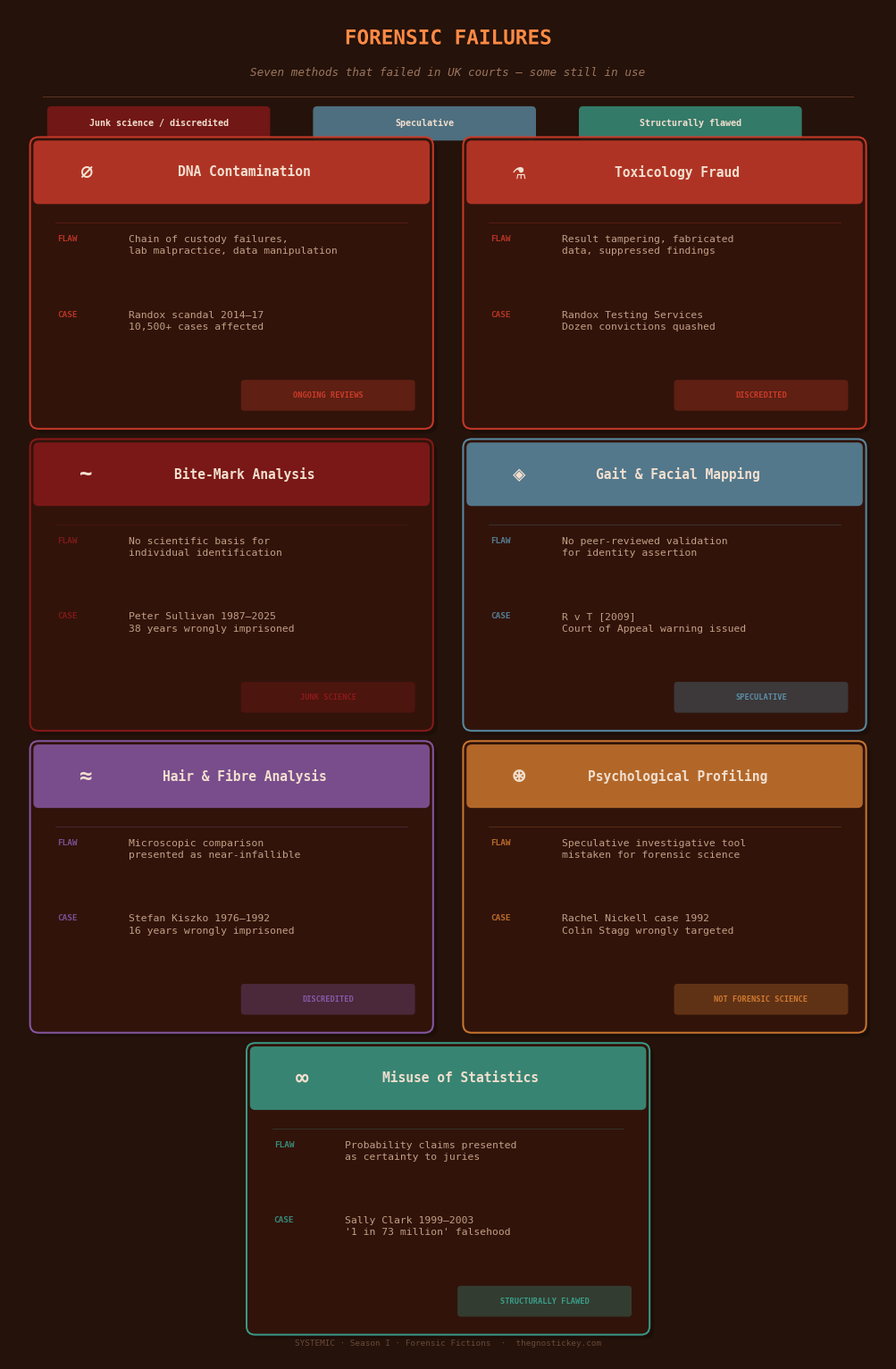
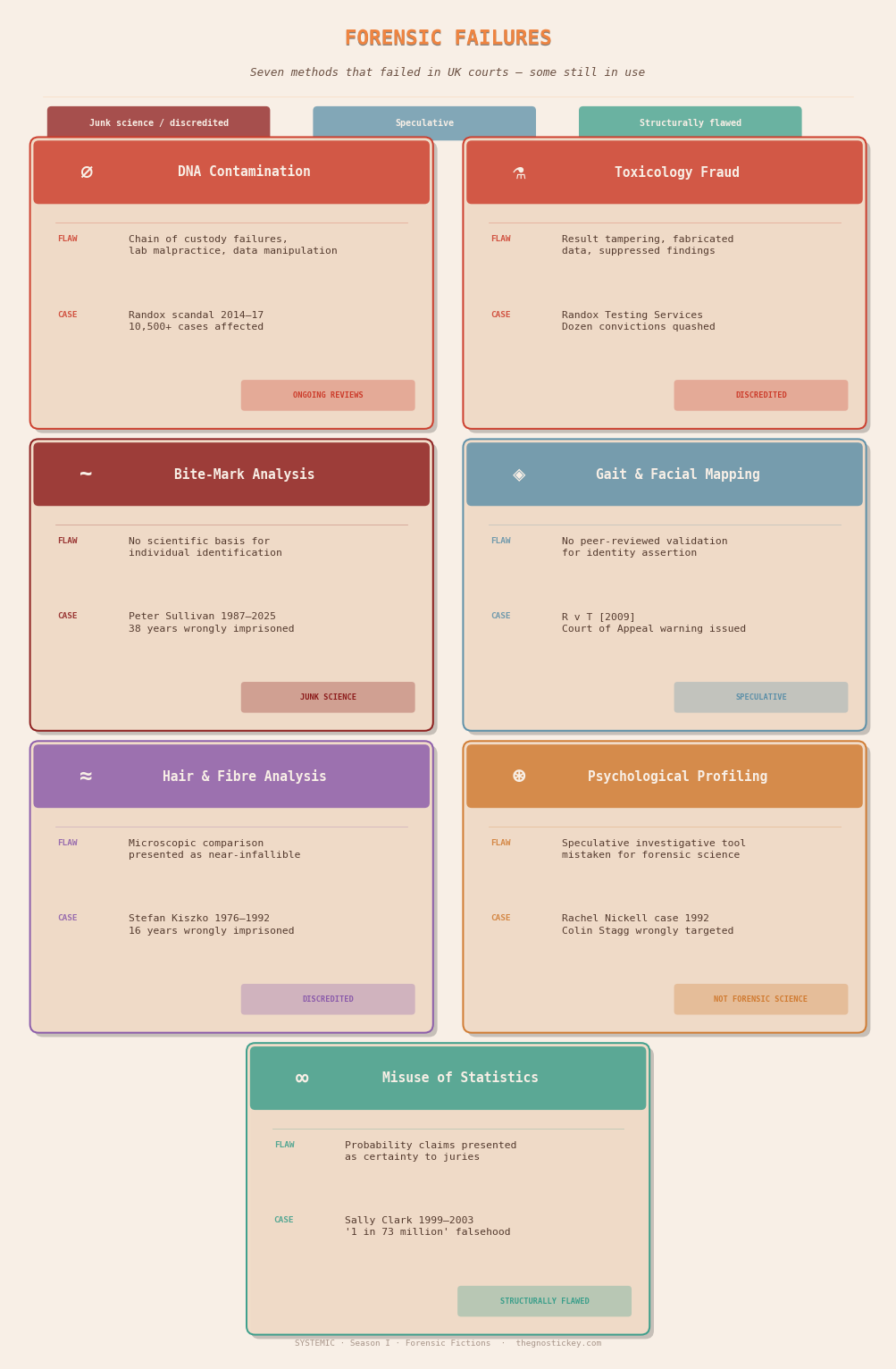
The courtroom promises objectivity; yet behind the veil of white coats and laboratory reports lies a machinery riddled with error, bias, and illusion. Forensic “tools” are repeatedly used to project certainty where none exists. Below are key forensic practices that have failed in UK courts, some of which continue to be admitted despite lacking robust scientific validation, leaving lives permanently damaged.
- DNA contamination and mishandling: Failures in chain of custody, storage, and laboratory process have led to wrongful convictions. The Randox scandal (2014–2017) exposed systemic malpractice, affecting more than 10,500 cases, with reviews continuing into 2025. In November 2024, Greater Manchester Police announced that no further criminal action would be taken against seven suspects, citing insufficient funding and an “unprecedented mass of materials” to analyse, underscoring not only forensic failure but prosecutorial collapse driven by resource constraints.
- Toxicology fraud: At Randox Testing Services, data manipulation and result tampering between 2014–2017 led to dozens of convictions being quashed, with thousands of cases still under review. A 2019 House of Lords report confirmed deep structural failures across the UK’s forensic oversight system.
- Bite-mark analysis: Widely discredited as junk science, bite-mark evidence was used to convict Peter Sullivan in 1987 for the murder of Diane Sindall. In 2025, DNA evidence proved the attacker was an unknown male, overturning his conviction after 38 years, the longest miscarriage of justice in UK history.
- Gait and facial mapping: These techniques lack sufficient peer-reviewed validation yet continue to be used to assert identity from CCTV imagery. In R v T [2009], the Court of Appeal warned that such evidence is speculative and must not be treated as conclusive without robust scientific foundation.
- Hair and fibre comparison: Once presented as near-infallible, microscopic hair and fibre analysis contributed to Stefan Kiszko’s wrongful conviction in 1976 for the murder of Lesley Molseed. DNA evidence in 1992 proved his infertility, directly contradicting the semen evidence relied upon at trial and leading to his exoneration after 16 years in prison. BBC News
- Psychological profiling: Profiling, a speculative investigative tool rather than a forensic science, misled police inquiries such as the Rachel Nickell case (1992), where Colin Stagg was wrongly targeted, publicly vilified, and subjected to years of suspicion without evidence.
- Misuse of statistics: In Sally Clark’s case, flawed statistical claims, including a purported “one in 73 million” chance of double sudden infant death, misled the jury. Her conviction was overturned in 2003, fundamentally undermining confidence in expert medical testimony.
These are not isolated mistakes but recurring, ritualised failures embedded within the justice system. While some methods have been formally discredited, others continue to appear in courtrooms, clothed in the authority of science. The 2019 House of Lords inquiry concluded that chronic underfunding, weak regulation, and institutional deference have allowed such practices to persist for decades.
Sullivan’s 38 years in prison, Clark’s personal destruction, and the thousands affected by the Randox scandal expose a system that repeatedly mistakes authority for accuracy. In the Gnostic view, truth must be apprehended inwardly, not surrendered to institutional performance. These forensic failures demonstrate how “truth” in court can be manufactured, rehearsed, and imposed, while the innocent bear the cost.
🕯️ High-Impact Case Studies
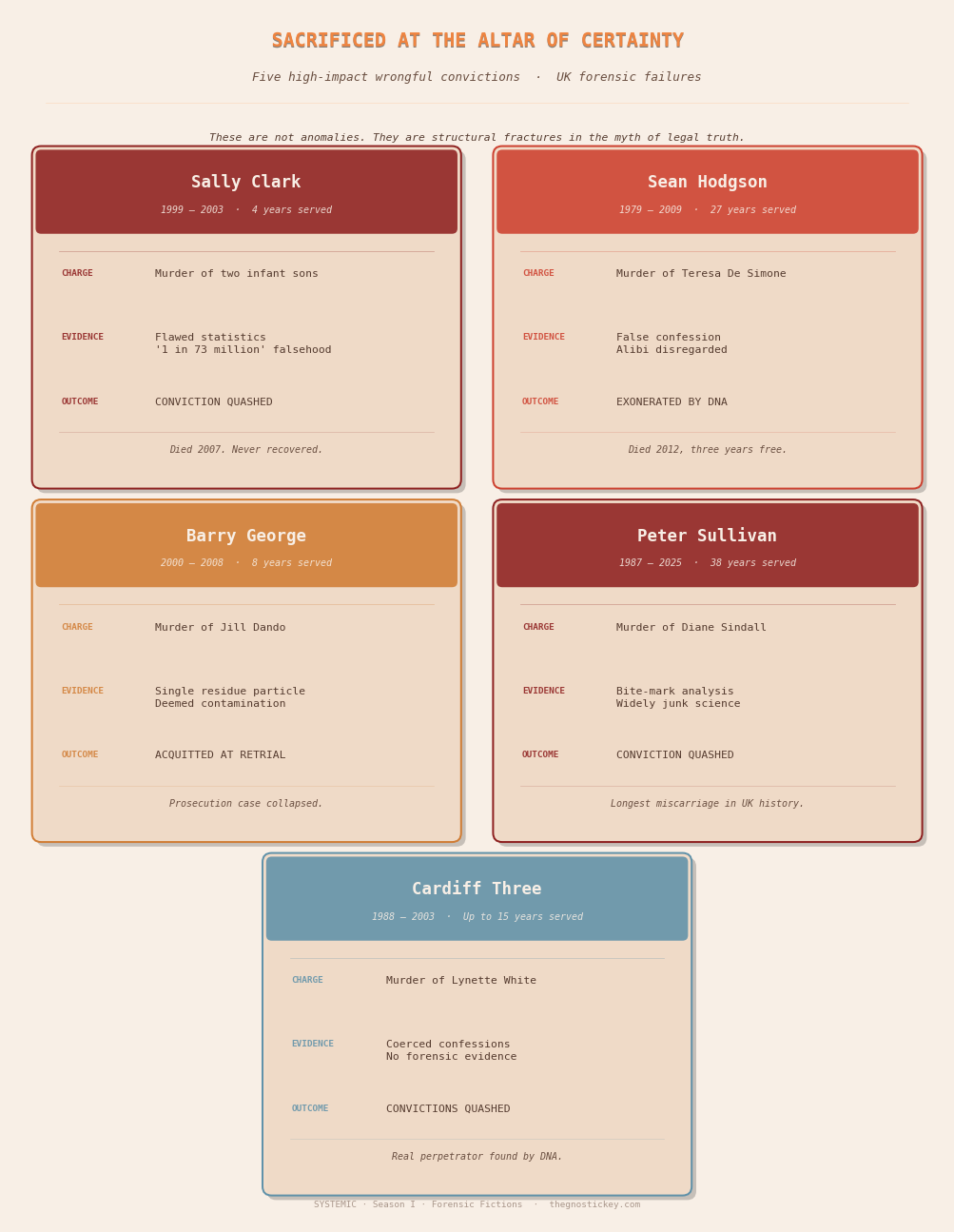
Beneath the veneer of forensic credibility lie ruined lives. These cases show how junk science, expert overreach, and courtroom ritual can converge to seal the fate of the innocent. They are not anomalies. They are structural fractures in the myth of legal truth.
- Sally Clark (1999–2003): A solicitor falsely convicted of murdering her two infant sons. Prosecutors relied on deeply flawed statistical evidence and failed to disclose critical microbiological reports. Her conviction was overturned after four years in prison, a case that profoundly damaged confidence in expert medical testimony. BBC News
- Sean Hodgson (1979–2009): Imprisoned for 27 years for the murder of Teresa De Simone, Hodgson’s conviction rested on a false confession and the disregard of a strong alibi. DNA evidence later proved his innocence. He was released in 2009 and died in 2012, three years after regaining his freedom. BBC News
- Barry George (2000–2008): Convicted of the murder of television presenter Jill Dando, the prosecution case hinged on a single particle of firearm discharge residue. This evidence was later deemed unreliable and likely the result of contamination. George was acquitted at retrial. BBC News
- Peter Sullivan (“Beast of Birkenhead”): Bite-mark analysis, now widely recognised as junk science, was central to Sullivan’s 1987 conviction for the murder of Diane Sindall. In 2025, DNA evidence established that the attacker was an unknown male, overturning his conviction after 38 years, the longest-running miscarriage of justice in UK history. The Guardian, CCRC
- Cardiff Three (part of the Cardiff Five) (1988–2003): Three men were wrongly convicted of the murder of Lynette White following coerced confessions, prosecutorial tunnel vision, and the absence of forensic evidence. Subsequent DNA testing identified the real perpetrator, exposing one of the most serious miscarriages of justice in British history. The Guardian
Each of these individuals was sacrificed at the altar of forensic certainty. Their cases reveal a systemic preference for conviction over truth and expose the terrifying power of courtroom illusion when authority is mistaken for evidence.

📉 Timeline of Rights Erosion (1986–2025)
A sacred pattern: each law a spell binding the collective voice, transforming dissent into crime through rituals of control.
| Act | Legal Effect | Spiritual Meaning |
|---|---|---|
| Public Order Act (1986) | Criminalised mass gatherings, raves, and political dissent following the miners’ strike and the Battle of the Beanfield [1] | Ritual suppression of collective voice |
| Terrorism Act (2000) | Broadly defined terrorism, reframed protest speech as pre-crime, and enabled expansive surveillance powers later exercised under related legislation such as RIPA, exemplified by the Poole school-catchment surveillance case (2008) [2][3] | Fear-based surveillance of dissent |
| Anti-Terrorism, Crime and Security Act (2001) | Enabled detention of foreign nationals without charge or trial [4] | Normalisation of fear-based imprisonment |
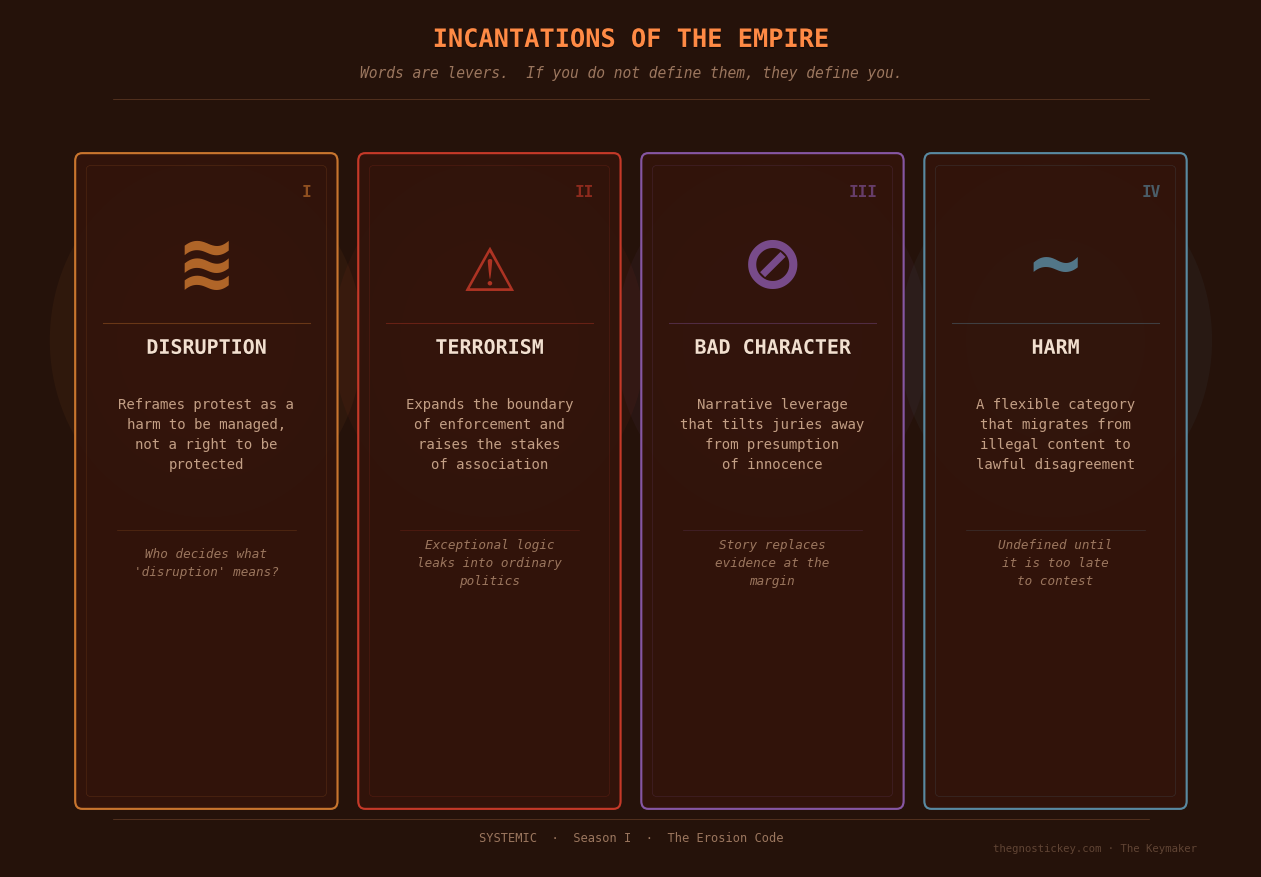
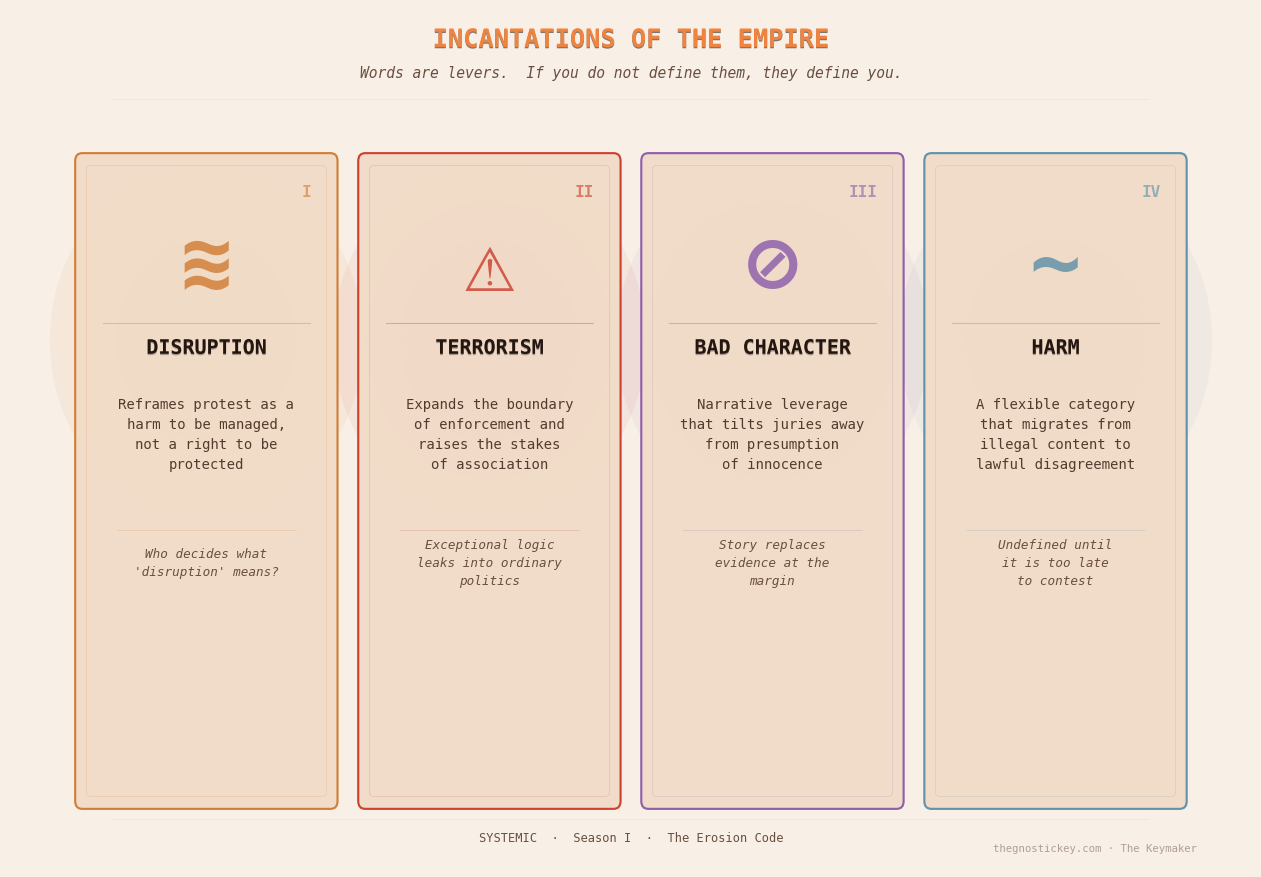
| Criminal Justice Act (2003) | Admitted “bad character” evidence, tilting jury bias [5] | Collapse of presumption of innocence |
| Criminal Justice and Immigration Act (2008) | Enabled anonymous witnesses and secret testimony [6] | Truth hidden behind legal veils |
| LASPO (2012) | Slashed legal aid, accelerated court closures, and produced a 50% rise in unrepresented litigants by 2025 [7] | Access to truth became a privilege |
| Investigatory Powers Act (2016) | Legalised bulk surveillance (“Snoopers’ Charter”), with over 700,000 data access requests annually by 2023, later ruled a human-rights breach by the European Court of Human Rights [8] | Sanctification of the Watcher State |
| Police, Crime, Sentencing and Courts Act (2022) | Criminalised “noisy” protest and subjective “annoyance,” contributing to thousands of Just Stop Oil arrests by 2025 [9] | Banishing the sacred right to resist |
| Public Order Act (2023) | Introduced protester tagging, pre-emptive arrests, and Serious Disruption Prevention Orders [10] | Binding of the body and silencing of intent |
| Dartford Protest Judgment (2023) | Barred climate defence arguments for Morgan Trowland and Marcus Decker, imposing record custodial sentences (3 years; 2 years 7 months) under the PCSC Act [11][12] | Excommunication of conscience from the courtroom |
| Palestine Action Proscription (2025) | Proscribed under the Terrorism Act 2000, labelling protest as terrorism, damage to RAF Brize Norton aircraft cited, despite the absence of violent convictions; later ruled unlawful by the High Court pending appeal steps [13][20] | Final inversion: good becomes evil |
Key moments: In 2000, counter-terror legislation enabled expansive surveillance powers, later exercised under RIPA in cases such as the Poole school-catchment scandal. In 2012, LASPO reshaped access to justice, producing a sharp rise in unrepresented defendants. In 2016, the Investigatory Powers Act normalised mass data collection. In 2023, the Dartford Crossing sentences drew condemnation from a UN Special Rapporteur as a breach of freedom of expression and assembly. In 2025, Palestine Action was proscribed despite repeated jury acceptance of lawful-excuse defences in related protest trials. By February 2026, the High Court had ruled the ban unlawful, while the order was held pending appeal submissions. The proscription also drew international criticism, including from United Nations human rights experts [20].
A sacred pattern: each law a spell binding the collective voice.
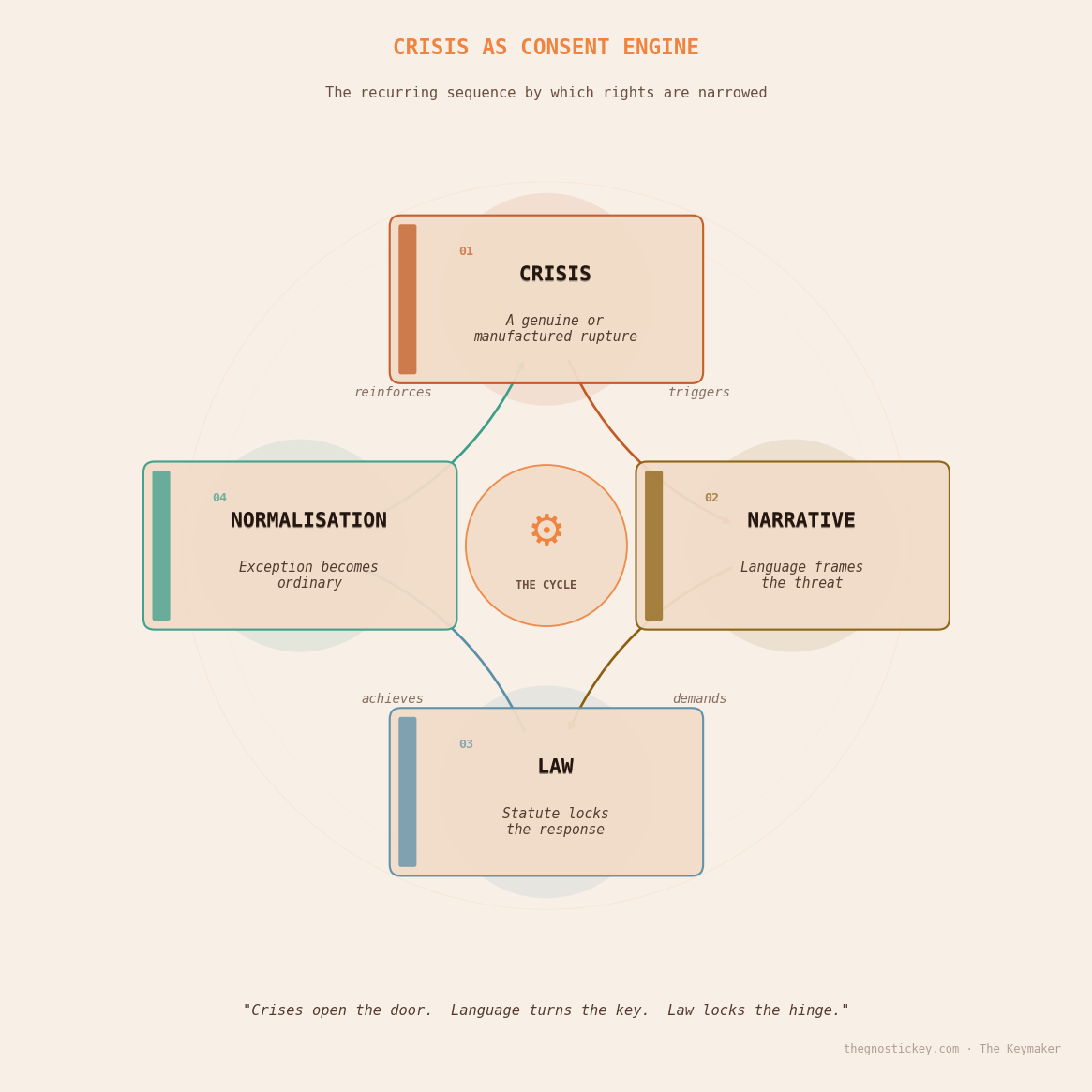
🧪 Crisis as Consent Engine
Every erosion follows a ritual: crisis → media → law. The 7/7 bombings were used to justify the expansion of Prevent. Climate and racial justice protests were cited to accelerate the Police, Crime, Sentencing and Courts Act. Mass Gaza solidarity protests were invoked to rationalise the proscription of Palestine Action. Fear is cultivated. Consent is summoned.
“Crises are the rituals. Consent is the spell.”

🛡️ When Juries Disobey the Crown
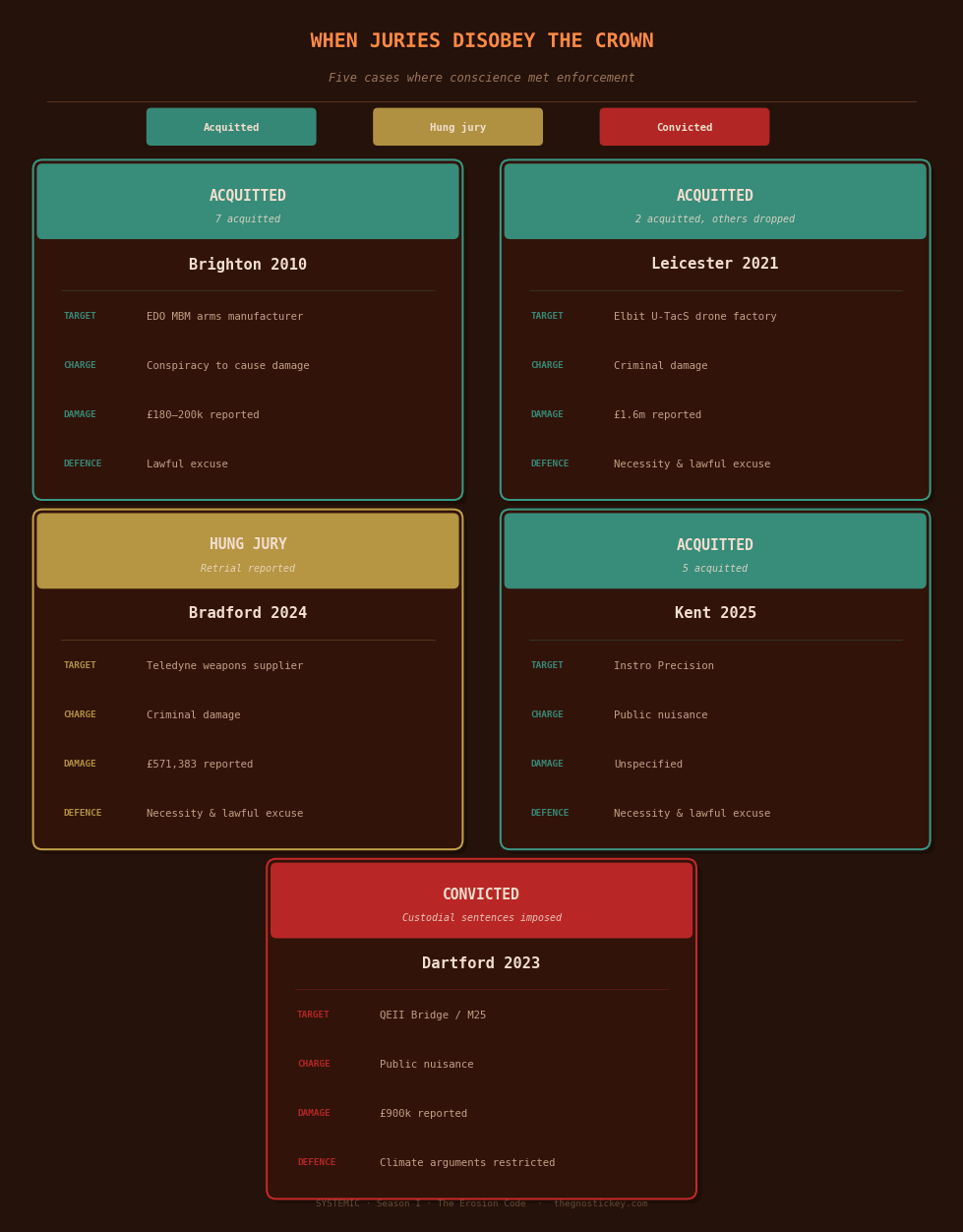
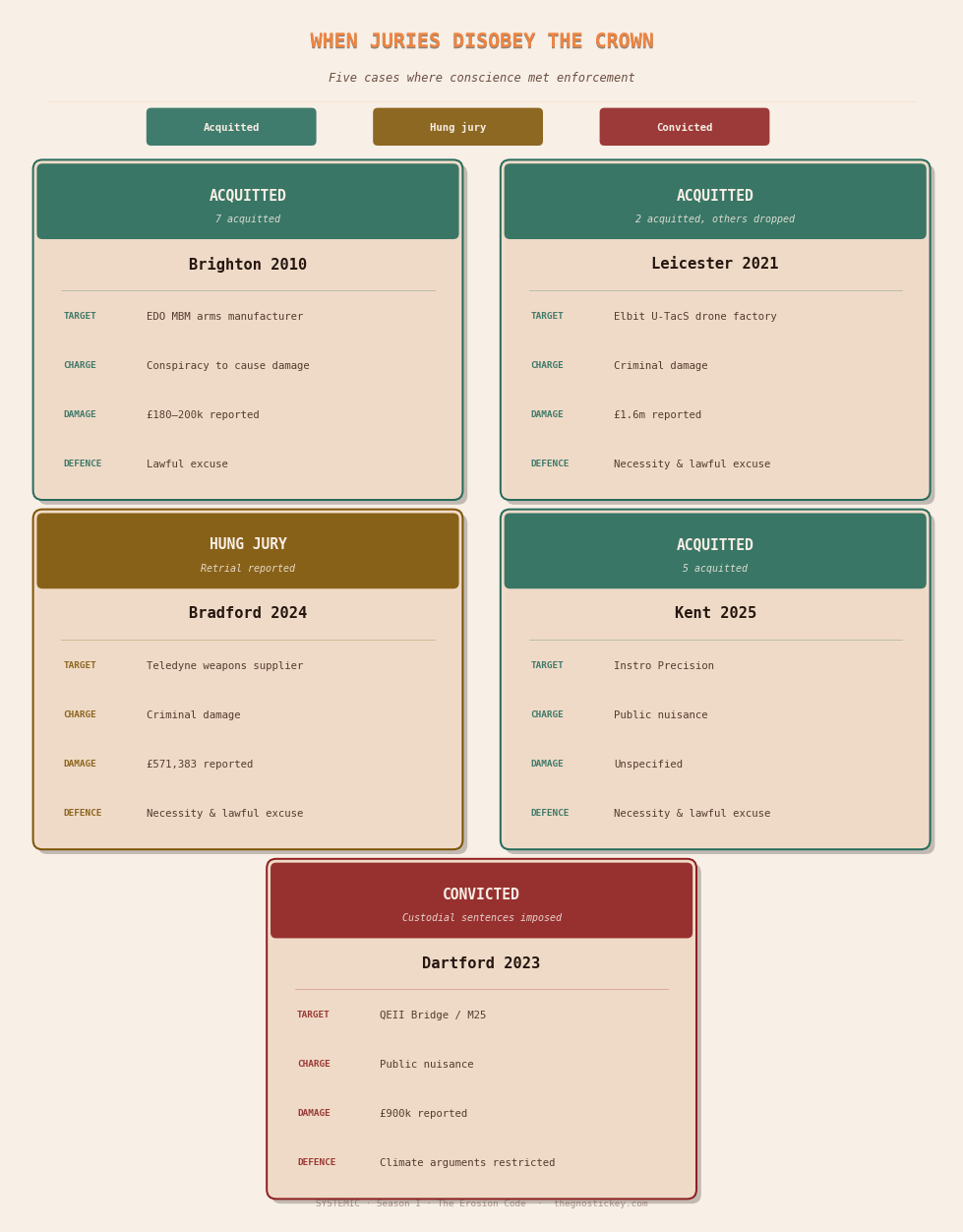
In rare moments, the courtroom fractures. When juries follow conscience over law, they restore something older than empire, the people’s role as the final arbiters of justice.
- Leicester (2021): The Elbit Three acquitted following the occupation of an Elbit Systems drone factory.
- Brighton (2010): Smash EDO activists acquitted after disrupting an arms manufacturer linked to military exports.
- Bradford (2024): Jury failed to reach a verdict in the Teledyne protest trial, illustrating the limits of state narrative control.
- Kent (2025): Charges dismissed following a symbolic protest at an arms supplier, after the prosecution offered no further evidence.
In each case, defendants raised the ancient doctrine of lawful excuse:
“We acted to prevent war crimes.”
“We acted to prevent genocide.”
“We disobeyed because the law no longer served justice.”
🧿 Symbolic Mapping: The Courtroom Ritual
The courtroom is no longer neutral ground. It functions as ritual theatre.
- Sigils: “Serious disruption.” “Terrorism.” “Bad character.”
- Chamber: A square enclosure, observed from above
- Priesthood: Barristers in robes, reciting legal incantations
- Sacrifice: The truth. The protester. The right to resist
Morgan Trowland, imprisoned following a motorway protest, was barred from explaining his motives to the jury. They were permitted to hear the facts of the act, but not the moral reasoning behind it.
⚔️ Final Reflection: Naming the Machine
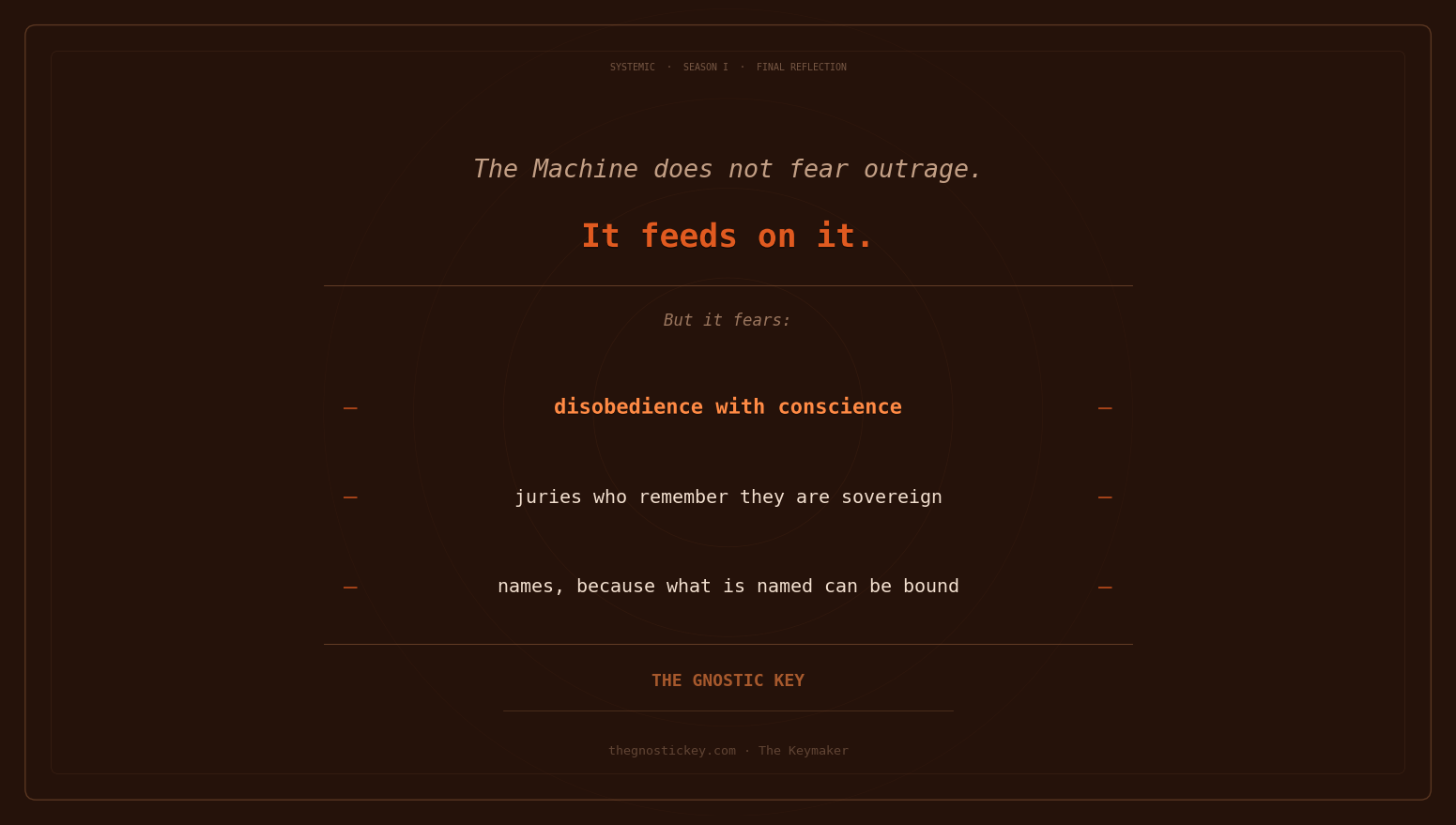
The Machine does not fear outrage. It feeds on it.
But it fears disobedience with conscience. It fears juries who remember they are sovereign.
It fears names, because what is named can be bound.
🪞 Reflection Prompt
Pause and reflect before moving outward into discussion:
- When does a right become a crime?
- Would you disobey the law to stop genocide?
- If law functions as ritual, which spell would you choose to break?
- When Trowland’s truth was barred, whose justice was being served, and how might the Logos be reclaimed to disrupt the Archons’ illusions?
Consider these questions carefully before entering the wider conversation.
🗣️ Where does law end and morality begin?
After examining how legal systems manufacture truth and shield power, consider:
Has the legal system in your country become a tool of truth, or a shield for empire?
- Where do you personally draw the line between legality and morality?
- Is obedience still virtuous when law protects injustice?
- What responsibility does an individual hold when the system itself is unjust?
Join the wider discussion under #TheGnosticKey.
📖 Glossary
Legal, political, and symbolic terms used in SYSTEMIC: Forensic Fictions.
- Public Order Act
- The Public Order Act 1986: a central UK framework for public order offences and for imposing conditions on assemblies and processions.
- Palestine Action
- A direct action network targeting UK-linked arms supply chains connected to Israel. It was proscribed under the Terrorism Act 2000 in July 2025; in February 2026 the High Court ruled the ban unlawful, with the order held pending appeal.
- Inversion
- A mechanism where truth is reversed to uphold domination: light is framed as darkness and virtue is masked by vice.
- LASPO
- The Legal Aid, Sentencing and Punishment of Offenders Act 2012, a major UK statute that cut access to legal aid and reshaped who can realistically defend themselves in court.
- SDPO
- A Serious Disruption Prevention Order: a civil order that can restrict movement, association, and protest-related activity in anticipation of future disruption.
- Lawful Excuse
- A defence arguing that an otherwise unlawful act was justified by preventing greater harm or by another recognised legal necessity.
- Proscription
- The formal designation of an organisation as banned under counter-terror law, making membership, support, or associated activity a criminal matter.
- Courtroom Ritual
- The structured sequence of language, posture, symbols, and authority through which legal outcomes are normalised and accepted, regardless of substantive justice.
Resources
📑 References
-
:Core public order legislation governing assemblies, processions, and protest-related offences in the UK.
-
:Foundational counter-terrorism framework defining terrorism offences, proscription powers, and extended police authority.
-
[3] Poole council loses school catchment surveillance tribunal case (BBC)
:Illustrative case highlighting misuse of surveillance powers under the Regulation of Investigatory Powers Act by local authorities.
-
[4] Anti-terrorism, Crime and Security Act 2001
:Post-9/11 emergency legislation expanding detention, surveillance, and state security powers.
-
:Major reform of criminal procedure, evidence rules, and sentencing in England and Wales.
-
[6] Criminal Justice and Immigration Act 2008
:Further expansion of enforcement powers, anonymous witnesses, and criminal justice reforms.
-
[7] Legal Aid, Sentencing and Punishment of Offenders Act 2012 (LASPO)
:Legislation that severely restricted access to legal aid, accelerated court closures, and reshaped sentencing and court access.
-
[8] Investigatory Powers Act 2016
:Comprehensive surveillance framework consolidating interception, bulk data collection, and oversight mechanisms.
-
[9] Police, Crime, Sentencing and Courts Act 2022
:Expanded protest restrictions, police powers, and sentencing provisions.
-
:Introduced new protest offences, pre-emptive controls, and Serious Disruption Prevention Orders.
-
[11] Climate protesters jailed today. Who’s next?
:Guardian letters reflecting on the harsh custodial sentences for Just Stop Oil’s planned M25 blockade, used here as an example of how disruption is framed, punished, and justified through public-order and deterrence narratives.
-
[12] Just Stop Oil protesters jailed for Dartford Crossing protest (The Guardian)
:Reporting on protest sentencing and judicial interpretation of disruption and proportionality.
-
[13] Government announcement on proscription of Palestine Action (GOV.UK)
:Official framing and justification for the 2025 proscription decision under the Terrorism Act 2000.
-
[14] Brighton activists cleared over arms factory damage (BBC)
:Jury acquittal case demonstrating conscience-based verdicts and lawful excuse defences in protest trials.
-
[15] Two Palestine Action activists acquitted over Elbit occupation (Leicester Mercury)
:Acquittal reporting linked to direct action against arms-linked sites.
-
[16] Jury fails to reach verdict in Teledyne protest trial (BBC)
:Hung jury outcome illustrating limits of state narrative control in protest prosecutions.
-
[17] Five activists acquitted after Instro Precision blockade (The Canary)
:Additional acquittal reporting. Use alongside corroborating mainstream sources.
-
[18] CCRC Response to Peter Sullivan Judgment (May 2025)
:Official Criminal Cases Review Commission statement on the DNA evidence leading to the quashing of the longest miscarriage of justice in UK history.
-
[19] Regulator’s Notification on Randox Data Manipulation (GOV.UK, December 2024)
:Regulatory confirmation of data manipulation findings and Greater Manchester Police decision to take no further action due to resource constraints.
-
[20] High Court rules Palestine Action ban unlawful (The Guardian, 13 Feb 2026)
:Reporting on the High Court ruling that the Palestine Action proscription was unlawful, with the order held pending appeal submissions.
These sources are provided for verification, study and context. They represent diverse perspectives and are offered as reference points, not as doctrinal positions.
Continue the Conversation
All discussions are publicly readable. Posting requires an Initiate-tier account. New thread creation is currently available at Initiate while Adept upgrades are not yet live.
Support The Gnostic Key
If this work helps you, a small contribution keeps the archive alive.