Why I'm Writing This
I've been watching Tucker Carlson for the better part of fifteen years. I'm not writing this because I think he's stupid or somehow compromised. If anything, Tucker has gone further than the vast majority of people in his position have ever dared to go. He's asking the questions most people shy away from for fear of being cancelled or ostracised. I'm writing this because I recognise the ground he's standing on. I've been there.
I'm not a former Fox News anchor with millions of followers and direct access to heads of state. I'm a working-class woman from Essex, a grandmother and a self-taught analyst. I spent twenty years keeping my head down inside supply chains and spreadsheets, quietly noticing that nothing the institutions were telling me was quite added up.
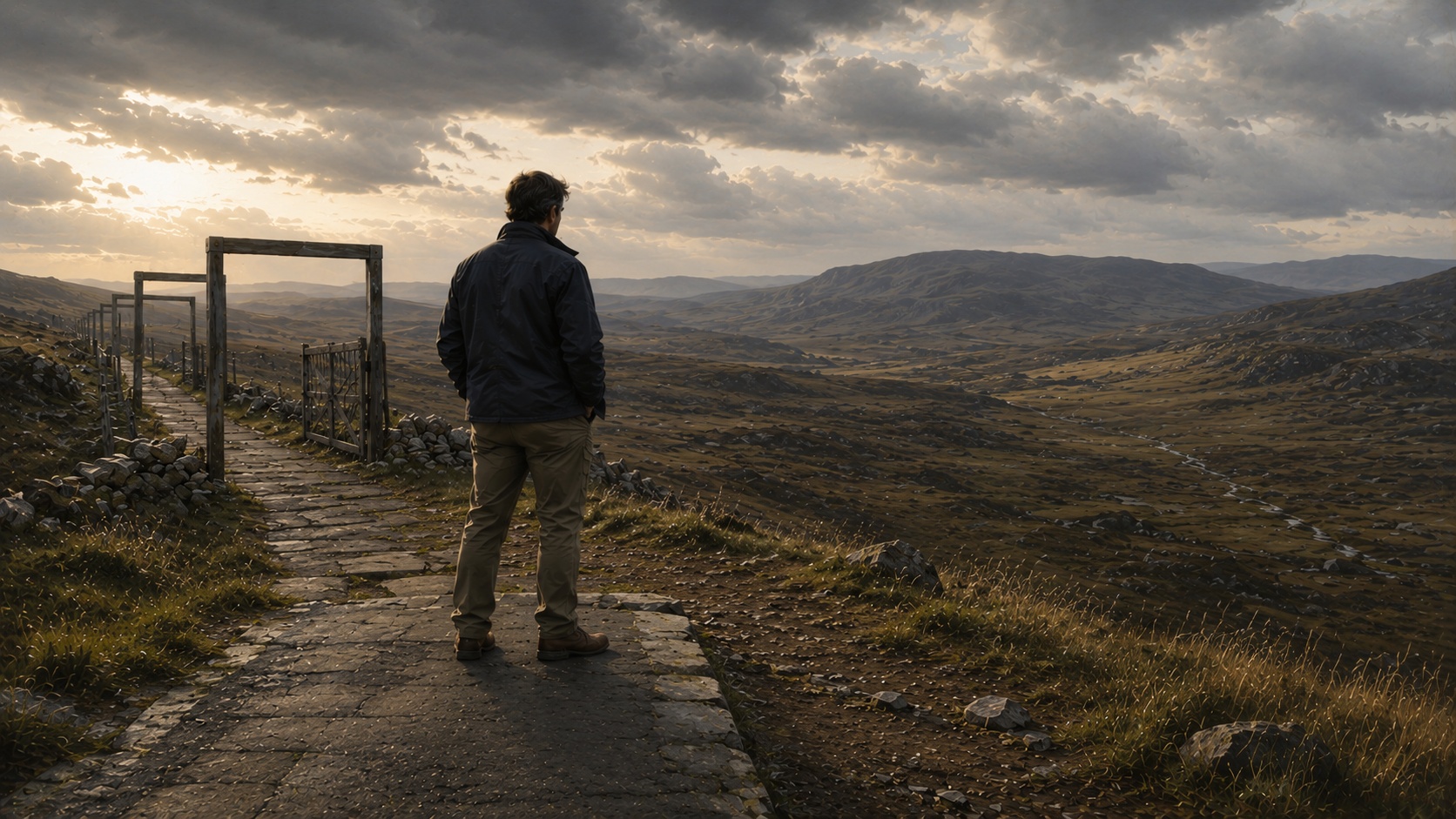
Tucker is standing at a crossroads right now. I know that ground well. I've stood on it many times. What I'd like to say to him, and to anyone else who's been watching his recent trajectory, is this: the evidence goes much further than you've gone so far. The question is whether you're strong enough to follow it all the way.
Where I Started
I will begin by telling you where I started.
For the vast majority of my adult life, my frame of reference for how the world really worked came from the right, not the ugly end of it but that was my instinct because I grew up in that world. In that sense Tucker and I are not too dissimilar. We were looking at the world through a similar lens.
I've been on a lot of protests over the years for many different causes. I've sat down for drinks and had conversations with leaders on the right wing. I didn't do any of it to confirm what I already thought. I did it because I wanted to understand what people actually believed when nobody was performing for the cameras.
Then October 7th happened and something just didn't add up.
I'm not going to pretend I immediately knew what I was looking at, because I didn't. The media jumped straight to "evil terrorists", "unprovoked attack", "civilisational threat", "right to defend itself". A part of me wanted to believe that was true, because it was easy to believed, and it was a tidy conclusion that fit neatly with my frame of reference at the time.
But something felt very off with the sanitised explanations I was hearing all over the news and on my social media feeds. Talking with my sister confirmed that she also had her suspicions and we decided to do something radical. We went to find out for ourselves.
We went on a Palestinian solidarity march in London and what we found wasn't at all what we were told we would find. We found some of the most genuine, caring, organised people I have ever encountered in my life. There were people there from every walk of life, from every background, from every faith and none. Before the march even began they handed us solicitors' cards, free legal advice in case we were arrested. Strangers protecting strangers, quietly, practically and without even being asked.
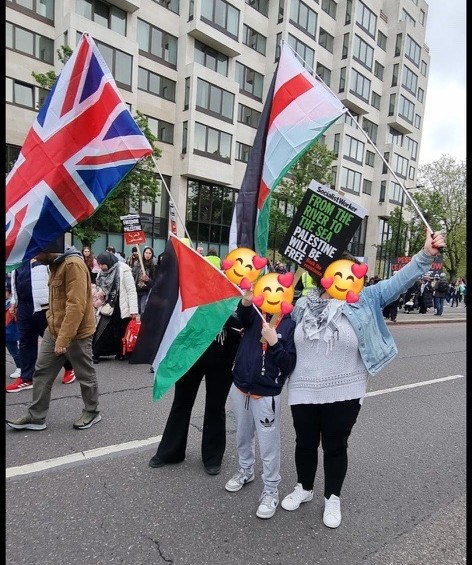
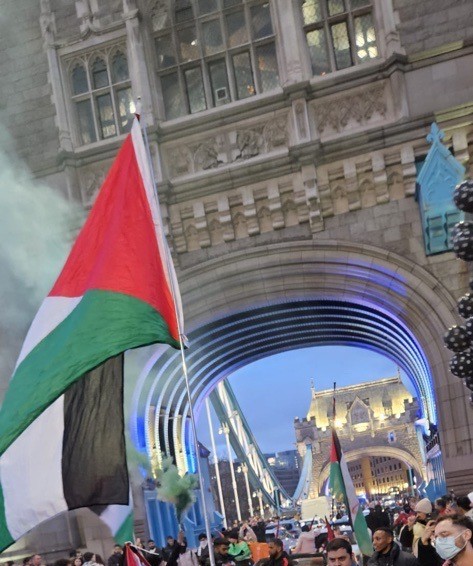
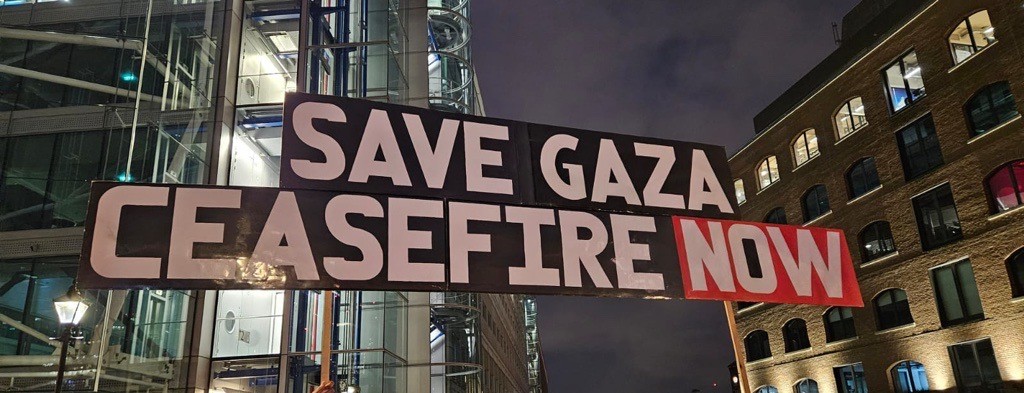
I wanted to know that what I had witnessed at the solidarity march was real, so I did what I always do. I decided to double check my thinking. I went to the Tommy Robinson rally in Trafalgar Square. With my Dad. One thing I have learned over the years is that many things are distorted and propagandised to manipulate people into feeling a certain way about political events. There is only ever one way to be sure for yourself, and that's to be prepared to stand on the opposite side of every argument and try to understand it from there.
What I found surprised me enormously because I hadn't experienced it before. Deliberate attempts at religious indoctrination and division. The organisers were clearly trying to whip the crowd up into a manufactured religiosity, Emeli Sandé's Heaven playing while people all around me dropped to their knees to pray. I myself hold no religious affiliation and was the only one left standing. An agitator clocked me as the anomaly and walked over. "Are you a Jew?" she asked, referencing my nose. Cheeky cunt.
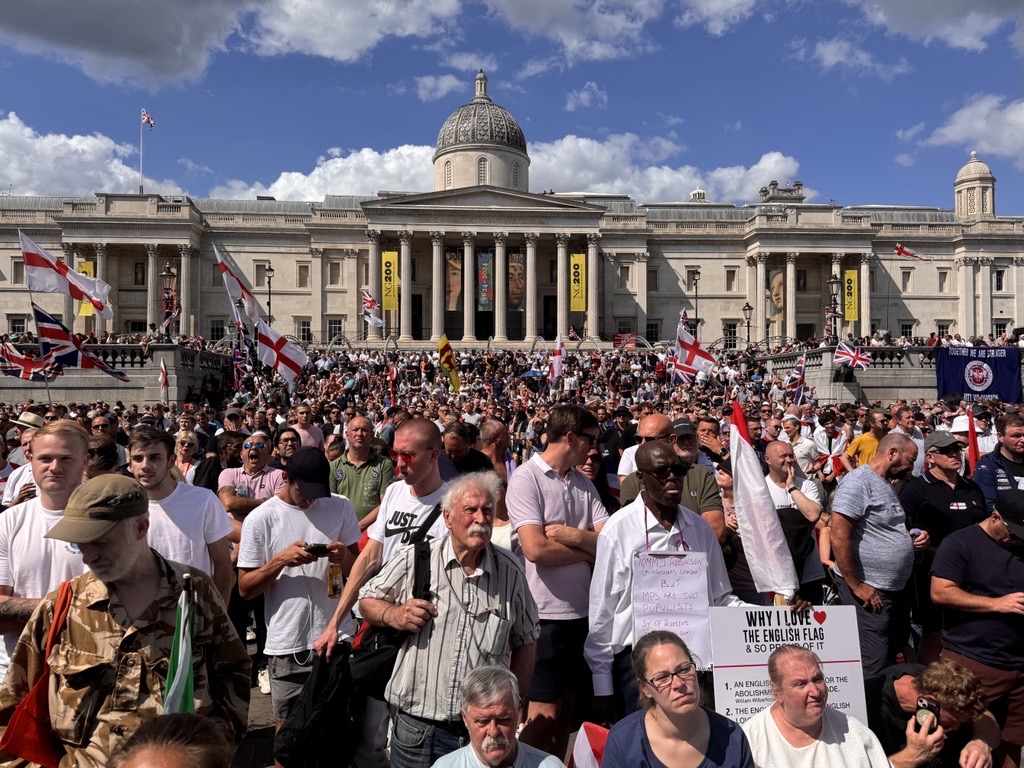
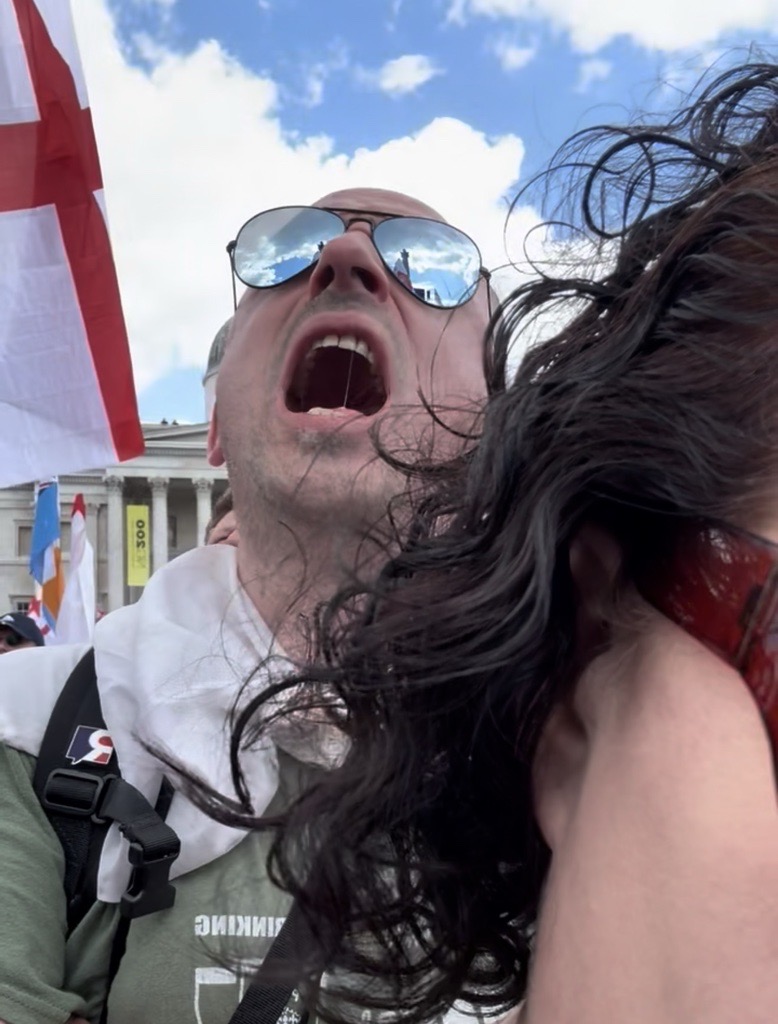
The people on their knees weren't stupid. They weren't evil. Having been around many of these people my whole life, the thing that struck me most was the sea change. They were genuinely aggrieved working class people whose anger was completely legitimate, and that anger was being harvested, redirected and pointed towards the wrong target by people who have absolutely no intention of solving a single problem those people actually face.
I knew what I was looking at because I'd just stood with people who had the same legitimate grievances and were doing something entirely different with them.
But to be able to understand both sides you have to choose to do the uncomfortable things, and that meant going to both places and sitting down with people you're supposed to oppose. It is too easy to accept what others tell you is the truth, because it is only their truth, not the truth. Unfortunately for us, the actual truth is a lot harder to come by.
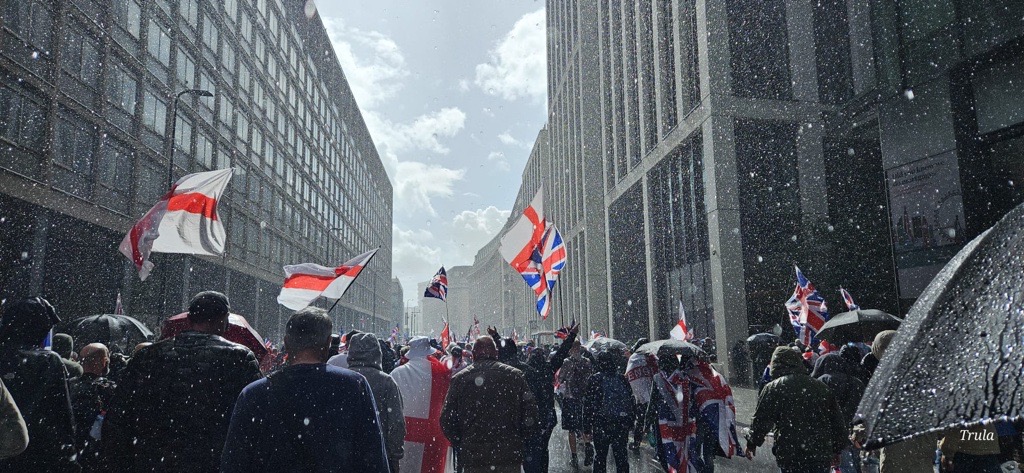
This is what steelmanning actually means. It's not a debate technique or an intellectual exercise performed at a safe distance. It means being genuinely willing to find out that you were wrong. It means sitting with people whose conclusions you don't share and understanding, really understanding, how they arrived there. Because if you can't explain why someone believes what they believe better than they can, you don't understand the problem. And if you don't understand the problem you cannot solve it.
When two sides of an argument never speak to each other, that isn't opposition. It's the same trap with different wallpaper. Kept separate, kept angry, kept blaming each other so that nobody ever looks up to see who actually benefits from the division.
Fortunately, where I grew up, we didn't have the luxury of building ourselves a tidy little world full of people who thought exactly like us. We lived among people with different histories, experiences and ways of seeing the world. That's what happens when nobody has the money to curate their surroundings. And it taught me more about people than any classroom ever could.
Tucker does this too, when he's at his best. It's why he went to Moscow and spoke directly to the man the entire Western media class had spent years talking about without ever sitting across from him. It's why he sat with Catherine Austin Fitts. It's why he's still worth watching, long after most of his contemporaries became far too predictable to remain remotely interesting.
He follows the thread until it begins to pull apart the framework he still needs and he pulls back from the discomfort.
What Tucker Is Actually Seeing
I've been watching Tucker for a while. The Fox Tucker, the fired Tucker and now I'm watching the free Tucker. I've watched the whole evolution.
The thing that first made me take him seriously, really seriously, not just as an entertainer, wasn't the big geopolitical analysis. Not the Ukraine coverage or the Moscow interview or even the Catherine Austin Fitts conversation, as significant as all of those were.
It was the word we.
Watch his Iran monologue and count how many times he uses it. We did this, we voted for this, we are responsible for what comes next. The media constantly tells us we are nothing but helpless victims of circumstances beyond our control. Tucker Carlson looked his viewers in the eye and said you are not simply a bystander. This is your bag to hold.
That takes real courage and a specific kind of respect for your audience that most commentators, left or right, simply don't have. It's easier to rage against the machine than to tell the people watching that they are, in some measure, part of the machine.
Having watched Tucker for a long time now, his firing from Fox was the most revealing moment of his career. Not because of what he said, but because of the direction he was clearly heading in. He was starting to ask the difficult questions, the kind that don't stop at a comfortable place once you've started.
After leaving Fox the leash came off. The Moscow interview, Catherine Fitts and his willingness to enter spiritual and supernatural territory. Each one was a step further down a road with no comfortable destination.
He's genuinely following the thread, and at significant personal and professional cost to himself. And he's getting close to something real.
Tucker keeps saying this is Israel's war. He is not entirely wrong, but he has stopped one layer too soon. His analysis is sharper than most of the slop passed off as mainstream commentary. He names the lobbying, the sabotage of diplomacy, the regime-change agenda, the energy interests and the theatre wrapped around all of it. But Israel is the instrument. Tucker can see the machinery, and he is brave enough to make his audience own its part in keeping it running. What he has not yet named is the theology that gives that machinery its moral permission.
That is where Tucker stops. He can trace the lobbying, the money and the military machinery, but not the belief system that makes all of it feel righteous to the people carrying it out. At that boundary, he turns towards the nearest institution still claiming to speak for the light: institutional Christianity.
Because once theology is wired into power, it stops being a private belief system and is quickly harvested to acquire votes, used as an excuse to close a border, extrapolated into a protectionist sanctions framework, used to excuse continued airstrikes and resulting in massive body counts.
The Permission Structure
Since the start of Trump's second term, Benjamin Netanyahu has visited the White House more often than any other world leader. His first visit came shortly after the inauguration, in February 2025, when he became the first foreign leader to be received by the new administration. He has been making the case for war with Iran for longer than most of his current audience has been alive. In January 1992, as a backbench member of the Knesset, he warned that within three to five years Iran would be able to build a nuclear bomb, and that the threat had to be "uprooted by an international front headed by the U.S." He said three to five years again in his 1995 book. He told Congress in 1996 that the deadline was extremely close. In 2009 it was one or two years. In 2012 he stood at the United Nations holding a cartoon drawing of a bomb. Yet on 27 February 2026, Badr Al Busaidi, Oman's foreign minister, who had been mediating the negotiations in Geneva, said on American television that Iran had agreed never to stockpile enriched uranium and that a deal was within reach. The very next morning, at 9.45 am Iranian time, the bombing of Iran began.
However, calling this Israel's war only gets us so far. Israel may be the state that has been agitating for it for decades, but the moral permission surrounding it has been building within the American evangelical Christian community for more than a century. To understand how this narrative came to escalate, we have to be honest about what preceded it.
From 1881 onwards, Jewish populations across Europe were repeatedly persecuted, scapegoated and massacred in escalating waves of pogroms that the authorities failed to curtail. The Dreyfus affair in France made the underlying prejudice unmistakably visible, exposing how the so-called modern liberal state was still perfectly capable of turning on its Jewish citizens when the pressure rose.
It became increasingly obvious that Jewish people would never be safe within European societies, no matter how hard they tried to assimilate. The wound this created helped give rise to what we now call political Zionism: the idea that Jewish people needed a homeland of their own arose from the basic impulse to survive.
That was when the British Empire stepped in, with the Balfour Declaration of 1917. It promised a "national home" on land that was already inhabited, then promised in the same breath that nothing would prejudice the rights of the "existing non-Jewish communities". Two deeply incompatible promises, and Britain spent the next thirty years pretending to be surprised when the contradiction did not simply resolve itself peacefully.
Christian Zionism did not begin as a response to that history. It was already there, ready and waiting for the sequence of events that would hand it a people, a territory and a wound it could absorb into prophecy. It took a real Jewish trauma and used it to advance an end-times prophecy written by Christians long before the victims themselves had any say in it.
In 1909, a man named Cyrus Scofield published a reference Bible. He was a former US Attorney for Kansas who had resigned after six months amid allegations about his finances, abandoned his wife and two daughters, and was later divorced on grounds of desertion. He remained deeply secretive about those years and gave deliberately inaccurate information about his past to his official biographer, making it difficult to piece together who he really was. Much of what is known comes from Joseph Canfield's hostile 1988 biography, The Incredible Scofield and His Book.
What we do know is that he had a network of people willing to help him. He met Arno C. Gaebelein at the Sea Cliff Bible conferences on Long Island. Gaebelein, a dispensationalist theologian, helped shape the prophetic material and find him financial backers. John Pirie and Alwyn Ball paid for him to stop working and write, and much of the drafting was done in Pirie's house. The publisher was Henry Frowde at Oxford University Press, himself an Exclusive Brother. Oxford's imprimatur lent the text an authority it had not earned on its own.
Dispensationalism did not begin with Scofield, but his reference Bible gave it a reach it had never had before. His notes travelled with the scripture itself, carrying the theology into American churches, Bible institutes and seminaries until generations of Christians absorbed its assumptions without necessarily knowing where they had come from, or how small the network behind their popularisation had once been.
One result was the growing focus of American evangelical Christianity on the physical restoration of Israel as a precondition for the end times, turning modern geopolitics into part of a literal prophetic sequence culminating in the second coming of Christ.
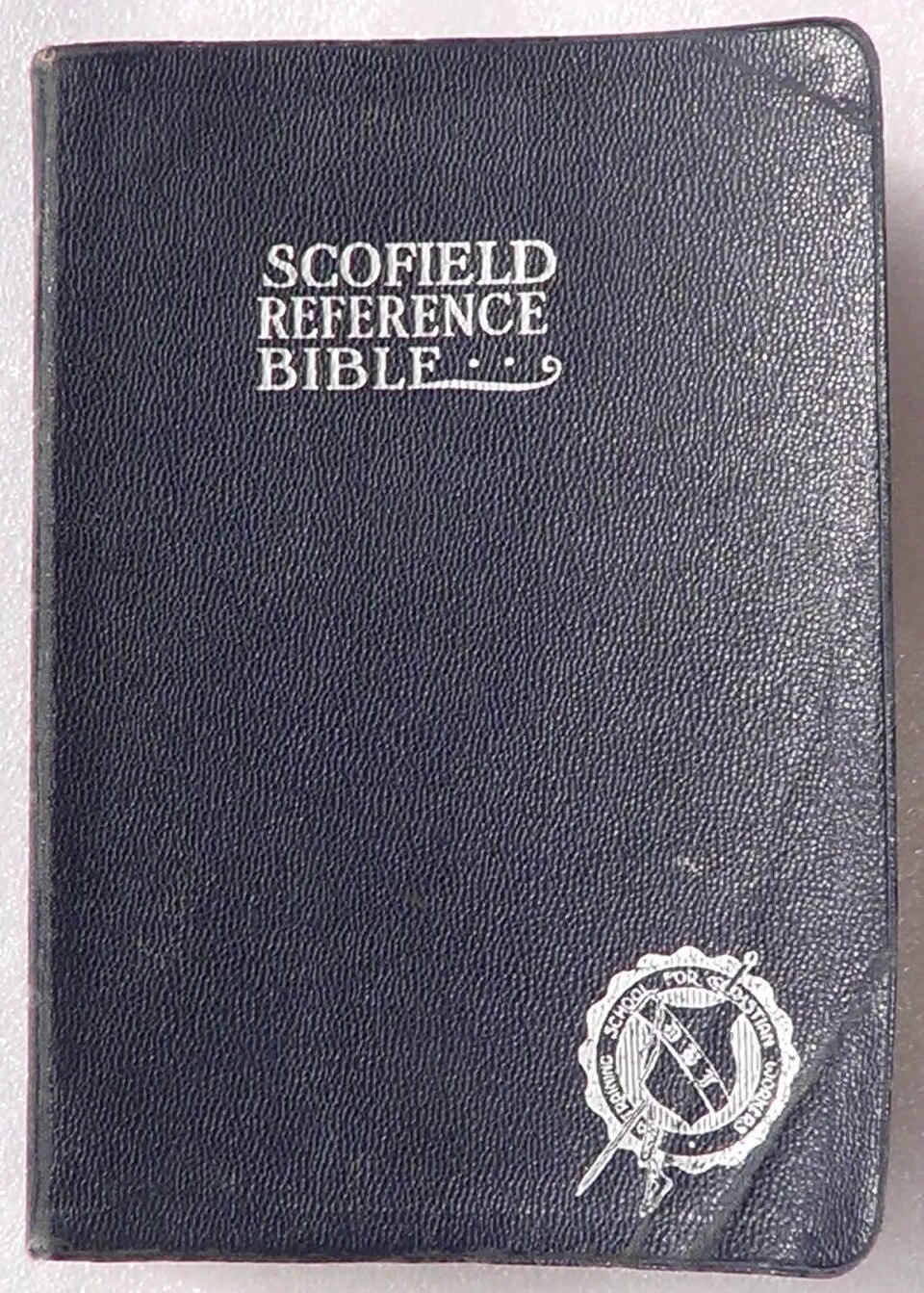
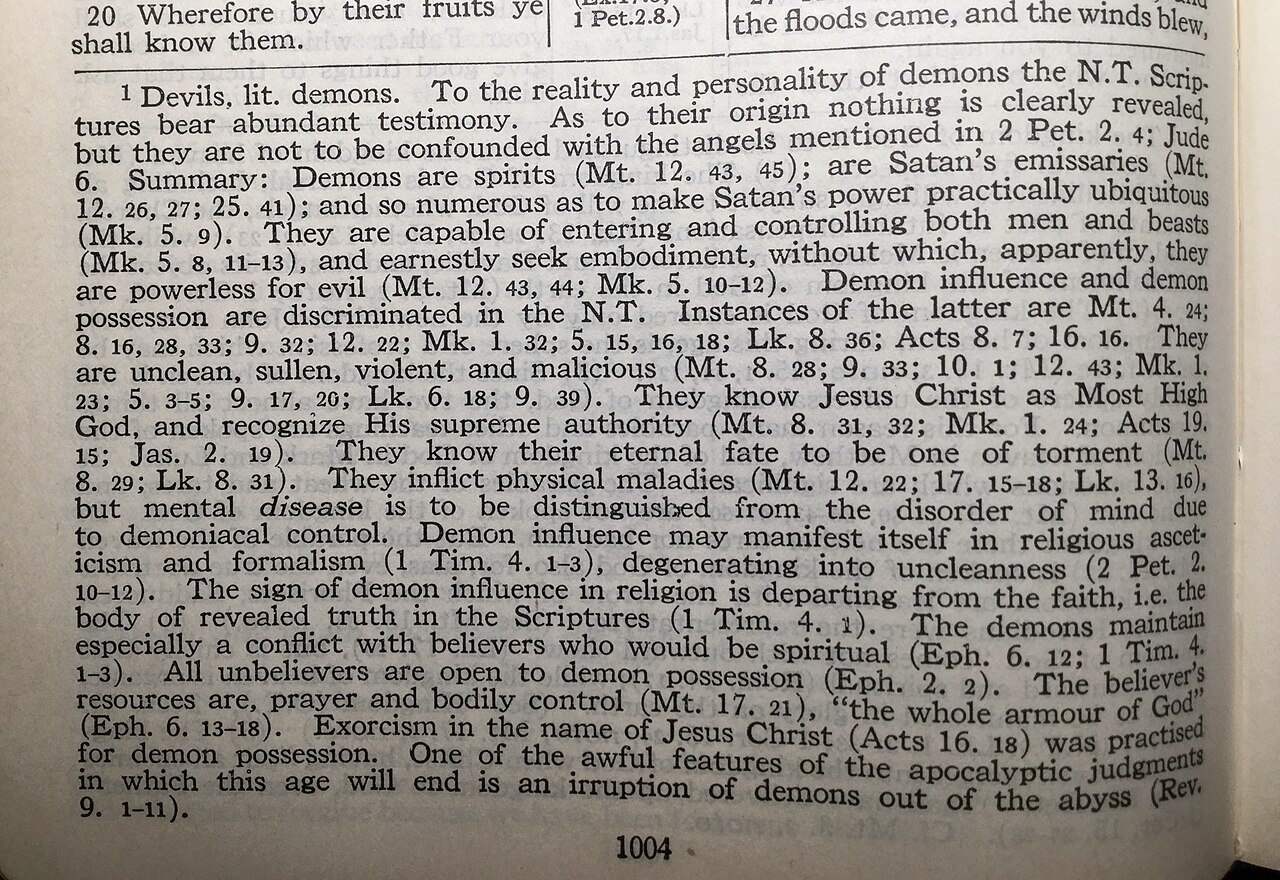
These words are not part of the biblical text. They are Scofield's own annotations, printed beside the scripture so that they carried the authority of the text surrounding them. He presents demons as literal beings that seek unsuspecting human bodies to possess, operate through religious error and target anyone trying to go deeper spiritually. It offers the reader a ready-made explanation for doubt or spiritual experience, one that can steer them back towards unquestioning submission to church authority.
That framework has influenced a large section of American Christianity and helped shape figures such as Hal Lindsey and John Hagee. It also helped produce Christians United for Israel, CUFI, an evangelical organisation claiming more than ten million members, built by Christians who regard support for Israel as a theological obligation and its continued existence as necessary to the prophetic sequence.
Its influence reaches the very top of the most powerful government on earth, with Paula White-Cain, Trump's longtime spiritual adviser, serving as Senior Advisor to the White House Faith Office. She believes Christians are bound to Israel through God's covenant with Abraham, warning that those who bless Israel will be blessed and those who curse it will be cursed. This is the woman advising Trump directly on spiritual matters.
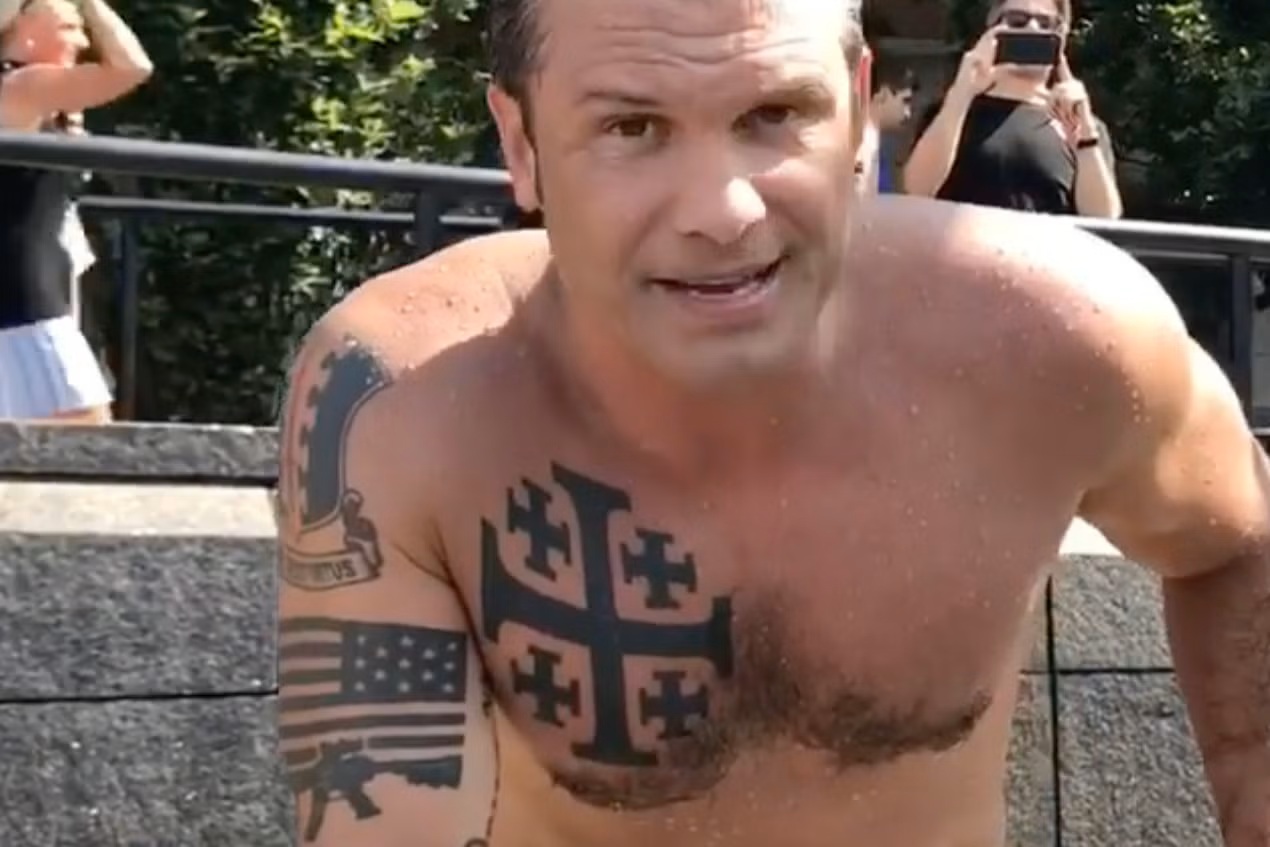
Then there is Pete Hegseth, the so-called Secretary of War, who is now running the most powerful military on earth. Proudly displayed on his chest is a massive tattoo of the Jerusalem Cross. On his bicep he wears Deus Vult, meaning "God wills it", a direct reference to the Crusades. As Thomas Lecaque bluntly describes it, it is a "Crusader fanboy" tattoo. And to remove any doubt about whether Hegseth understands what it means, Deus Vult is the closing line of his 2020 book American Crusade. On his forearm is a sword piercing a cross, alongside the words attributed to Jesus in Matthew 10:34: "I did not come to bring peace, but a sword." This does not strike me as the symbolism of a man of peace. These read like declarations, chosen deliberately and displayed for the world to see.
On 2 March 2026, a serving member of the US military emailed the Military Religious Freedom Foundation on behalf of himself and fifteen others in his unit. He said that, during a combat-readiness briefing that morning, their commander had described the Iran war as part of God's divine plan, invoked the Book of Revelation, Armageddon and the imminent return of Christ, and told them Donald Trump had been anointed by Jesus to light the signal fire in Iran. The complaint was first reported by Jonathan Larsen, and was later covered by the Guardian and others.
It was not one commander. MRFF founder Mikey Weinstein told Military.com that by Tuesday afternoon his organisation had logged more than 200 similar complaints across 50 installations and every branch of the military. In just four days, the scale of the response pointed to a culture rather than an isolated incident. These complaints came from personnel who believed the Constitution separated church and state and had just discovered what some of their commanding officers really believed they were fighting for.
The issue escalated so quickly that thirty Democratic members of Congress, led by Jared Huffman, Jamie Raskin and Chrissy Houlahan, formally requested a Department of Defense Inspector General investigation into whether Hegseth's religious framing had entered the chain of command in breach of the Constitution and the UCMJ. That is genuinely frightening. If this doctrine has entered the operating machinery of war, who knows how far those who believe it will go to fulfil it?
The problem extends far beyond the military. Mike Huckabee, the United States Ambassador to Israel, is an evangelical pastor, former governor and lifelong dispensationalist. In a Tucker Carlson interview, he said on camera that God had promised Abraham's descendants the land stretching from modern-day Iraq to modern-day Egypt, citing Genesis 15 as his authority. That is an area roughly the size of Western Europe, and it lends weight to concerns about the Greater Israel vision associated with Netanyahu and sections of the Israeli right.
One thing I want to make clear at this point is that the evangelical eschatological script does not end well for Jewish people.
The rapture is not a hidden idea. It is in the dispensationalist literature, from Scofield's own notes to Hal Lindsey's The Late Great Planet Earth, which sold in the tens of millions: a final conflagration in the Middle East, the rebuilding of the Temple, and then, for those on the wrong side of the theological ledger, conversion or death. The passionate evangelical defence of Israel is not solidarity, the Jewish people are being used as props in a theological story written by people who believe they are accelerating the world towards that end-times which ends catastrophically for anyone who isn't a born-again Christian.
I am not the only one saying this. On 3 March 2026, George Galloway, a veteran political operator with long-standing connections across the region and no attachment to my own spiritual framework, put it more bluntly than I have.
"You fools, you maniacs, are racing, hurtling to bring about the end of the world based on a fake Bible that you wrote yourselves."
George Galloway, Mother of All Talk Shows, 3 March 2026
Now let's look at the script itself. Within this strain of evangelical Christianity, believers have cast themselves as the divine saviours of the world who will help bring about the rapture. They believe they will achieve this by helping the Jews conquer all the land from Iraq to Egypt, while casting Muslims as the enemy who must be destroyed. The result is that Jewish and Muslim people must either convert to evangelical Christianity or perish along with the rest of the planet, while the Christians are raptured up to heaven to take their place beside God in eternal peace and happiness.
Then look at the calendar through the eyes of someone who already believes that script. The war opened on 28 February, during Ramadan. It continued beyond the end of Ramadan, through Passover, and the ceasefire took effect on 8 April, three days after Easter Sunday. I have no evidence that anyone selected those dates for their religious significance. But to believers already waiting for prophecy to reveal itself, the sequence would look like confirmation. And people who believe history is proving them right do not usually become more sceptical.
Now, to many people reading this, all of it may sound utterly ridiculous. But having watched these events unfold for some time, one has to ask: is this really all just coincidence, or is something slightly more nefarious going on?
Where My Frame Ran Out
Tucker is now starting to ask the right question: can political corruption, war and institutional cruelty really be explained by the pursuit of material wealth alone? He speaks of anti-human movements, spiritual darkness and forces working through people and institutions. He is reaching for something his current frame of reference cannot hold, and when he gets to that boundary he turns back towards the Episcopal tradition he was raised in.
I reached the same boundary. I did not have a church to turn back to, and I want to be clear that what follows is where I went, not where anyone else has to go.
Part of the reason is that the established church was never neutral ground for me. I did not learn that as history. I learned it standing in a school assembly, singing hymns I did not believe a word of, in a country where the head of state is also the Supreme Governor of the church and nobody in the room thought that was worth mentioning. Nobody explains it to you. You just sing.
So I went looking outside it, and what I found was a set of texts that had been deliberately buried. They describe lesser powers, the Archons, that present themselves as the highest authority, demand obedience and keep people contained through ignorance.
"It is I who am God, and there is none other apart from me."
I am not asking you to accept that as cosmology. I am telling you it gave me a vocabulary for a pattern I had already watched operate in front of me. There is an old word in those texts for the recognition itself: anamnesis. Unforgetting. The idea that real knowledge is not handed down by an institution but recovered from somewhere authority cannot reach.
What is not a matter of belief is what happened to them. In 367, Athanasius, Bishop of Alexandria, issued a letter naming the books he considered canonical and warning Christians against the rest. Around the same period, somewhere near Nag Hammadi, someone put a collection of excluded texts in a jar and buried it in the desert rather than let them be destroyed. They stayed there for sixteen centuries.
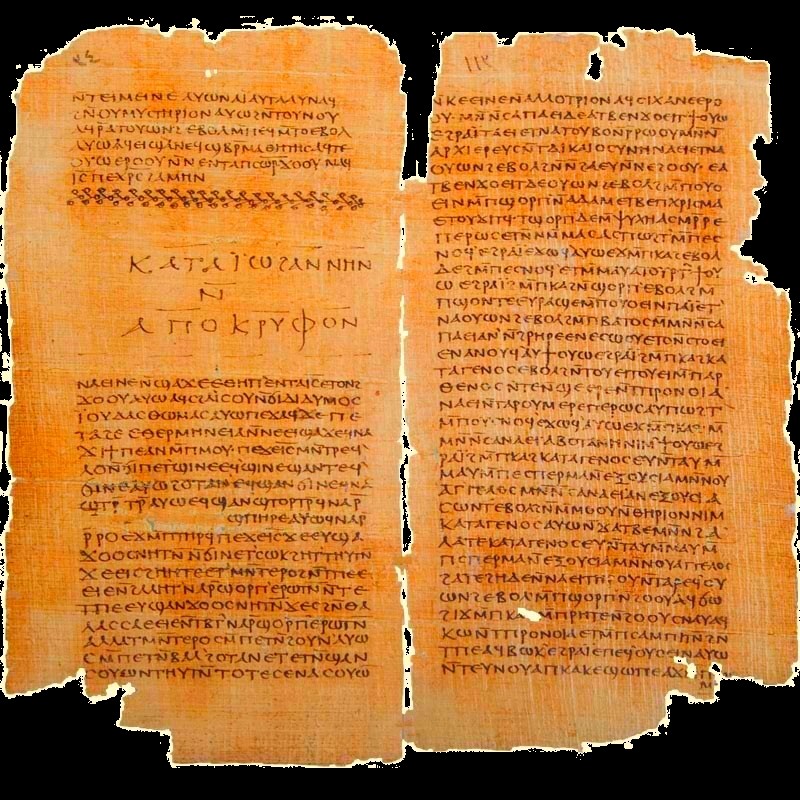
Put that next to the other book in this piece. One theology was buried in the sand to survive. The other was printed by Oxford University Press and posted into every seminary in America. Neither outcome had much to do with what was written inside them.
The Crossroads
The religious capture that restrains us spiritually, the financial extraction that shackles our prosperity and the military machinery that controls us are not separate stories. They are three parts of a much bigger machine. The Scofield Bible, the trillions Catherine Austin Fitts keeps asking about, and Pete Hegseth's crusader tattoos all reveal the same instinct: unauditable money, unquestionable scripture and unaccountable command structures, each kept secret or made untouchable so that nobody is allowed to question them. I do not know whether the same people sit behind all three but it is a recurring pattern that we see across the empire.
So how do you decide whether a system is moral? I think there is a very simple way. Ignore what the system says about God and focus on how it treats the most vulnerable people in the society it governs. Does the system protect its women and children, or does it protect those who perpetrate harm against them? Does it ensure that the poorest have food and shelter, or does it prioritise the wants of the wealthy? Does it provide a decent education for all, or does it reserve the best education for those who can afford to pay for it? These are just a few questions that, when asked, reveal the uncomfortable truth buried beneath the pomp and ceremony.
Seeing that clearly means stepping outside every room that has taught you where the questions must stop, including the rooms that feel safe. I know how frightening that can be. I have followed threads in the middle of the night that took me somewhere I did not want to go, with no framework waiting to catch me. What I found on the other side was not certainty, but clarity: the ability to look at what is there without needing an institution to tell me what it means.
The Question
A few nights ago, my son sat with me watching the news. He's thirty. He watched in silence for a while, then turned to me and asked:
Why don't Muslim countries have nuclear weapons?
I didn't answer him immediately because the question took me by surprise. It was one I had never thought to ask myself.
There are ordinary answers, and they are worth stating honestly. Only nine states on earth have nuclear weapons, so most countries of any description do not. The Gulf states sit under an American security guarantee and have never needed their own. Iraq's reactor was bombed in 1981 and Syria's in 2007. Libya gave up its programme in exchange for sanctions relief and we all watched how that ended for Gaddafi. Pakistan is the exception, and it built its bomb in response to India rather than to anything happening in the Middle East.
But follow those answers and you arrive somewhere nobody says out loud on the evening news. There is one nuclear-armed state in that region. It has never signed the Non-Proliferation Treaty, has never permitted inspection and has never formally admitted the arsenal exists. Iran's programme is discussed as an existential emergency every night. The arsenal that is already there is not discussed at all.
And then there is the contradiction underneath it. Iran's Supreme Leader has repeatedly declared the production, stockpiling and use of nuclear weapons religiously forbidden, saying in 2020 that making and stockpiling atomic bombs was wrong because their use is haram. People will tell you that is a convenience rather than a conviction, and they may be right. But hold it next to the other side of this war, where senior figures in the most heavily armed government on earth openly believe the destruction of the Middle East precedes the return of Christ, and that they personally will not be here to see the consequences.
My son did not arrive at any of that through a book, a podcast or a political framework somebody had handed him. He arrived there by looking at the contradiction in front of him without first being told what he was allowed to see.
That matters. Tucker Carlson is one of the most watched broadcasters on earth. He has access, resources, courage and a genuinely rare willingness to follow an argument beyond the point where most public figures turn back. But my son, sitting in a living room in Essex, asked the exact question Tucker has not reached yet.
Tucker, you are nearly there. You have questioned the governments, the intelligence agencies, the warhawks, the lobbyists, the donors, the financiers and the media class. The one institution you still turn back towards for shelter is the one you have not yet turned that scrutiny on.
The next generation is not waiting for us to get there. They are already asking the most vital questions of our time, and they are already beginning to find the answers.
Zoë
Where does the thread stop for you?
This piece argues that theology, money and military power keep surfacing the same logic, without claiming a single hand behind them. Test that claim with evidence.
Which claim in this piece is strongest, which is weakest, and what evidence would change your mind?
- Do you agree with the distinction between the instrument and the hand behind it? Why?
- Where do you see theology shaping policy in concrete, documentable ways?
- Which section needs tighter sourcing, and what source would satisfy you?
- If Tucker follows this thread one step further, what question should he ask next?
Share your reasoning on X or Telegram using #TheGnosticKey.
Resources
Primary reporting and historical sources referenced in this piece.
References
-
[1] Tucker Carlson, Catherine Austin Fitts Interview
:Interview referenced on financial opacity, war architecture, and institutional capture.
-
[2] Tucker Carlson, The Vladimir Putin Interview
:Interview referenced as part of Carlson's post-Fox trajectory and willingness to step outside sanctioned media lanes.
-
[3] Tucker Carlson, Iran War Monologue
:Monologue cited for Carlson's framing of responsibility, Iran, and US policy.
-
[4] Military.com, 'Military Officers Accused of Framing Iran War as Biblical Mandate'
:Reporting on the March 2, 2026 briefings and early complaints logged by the Military Religious Freedom Foundation.
-
:Independent reporting on the same briefings, rhetoric, and constitutional concerns.
-
[6] Military.com, 'Lawmakers Want DoD, Hegseth Investigated Over Biblical Armageddon Claims'
:Follow-up reporting on service-member complaints, installations affected, and calls for investigation.
-
[7] Tucker Carlson Interview with Mike Huckabee
:Interview cited for Huckabee's theological framing of land, prophecy, and Israel.
-
[8] George Galloway, Mother of All Talk Shows, 3 March 2026
:Video cited for Galloway's summary of the apocalyptic script being imposed on the conflict.
-
[9] Uplook, 'Origins of the Scofield Bible'
:Background on Sea Cliff collaborators, financial backing, and the early publication push around Scofield's project.
-
[10] Lydia Wilson, 'Pete Hegseth's Tattoos and the Crusading Obsession of the Far Right'
:Source for the historians quoted on the Jerusalem Cross, Deus Vult and the sword-and-cross tattoo: Matt Lodder, Thomas Lecaque, Eleanor Janega and Mike Horswell.
-
[11] Brethren Archive, Henry Frowde
:Biographical note confirming Frowde's lifelong association with the Exclusive Brethren and his 39 years at Oxford University Press.
-
[12] The Intercept, 'Benjamin Netanyahu's Long History of Crying Wolf About Iran's Nuclear Weapons'
:Timeline of Netanyahu's Iran nuclear predictions from the 1992 Knesset speech onwards.
The Scofield biography draws on Canfield, a hostile but documented account, cross-checked against Mangum and Sweetnam, who are sympathetic to dispensationalism and dispute several of Canfield's harsher claims. Where the two disagree, this piece uses only what both accept. Uplook is included as background context rather than a scholarly authority.
These sources are provided for verification, study and context. They represent diverse perspectives and are offered as reference points, not as doctrinal positions.
Link unavailable? Paste the URL into web.archive.org to find an archived snapshot. Most sources in our evidence packs are preserved there.
Open Discussion
Every argument in this piece is open to challenge. Bring primary sources, counterexamples or a better interpretation: the Community exists to test this work, not to validate it.
Support The Gnostic Key
The Gnostic Key is independently researched, written, and built. If the work has value to you, you can make a one-off contribution to help keep TGK independent.