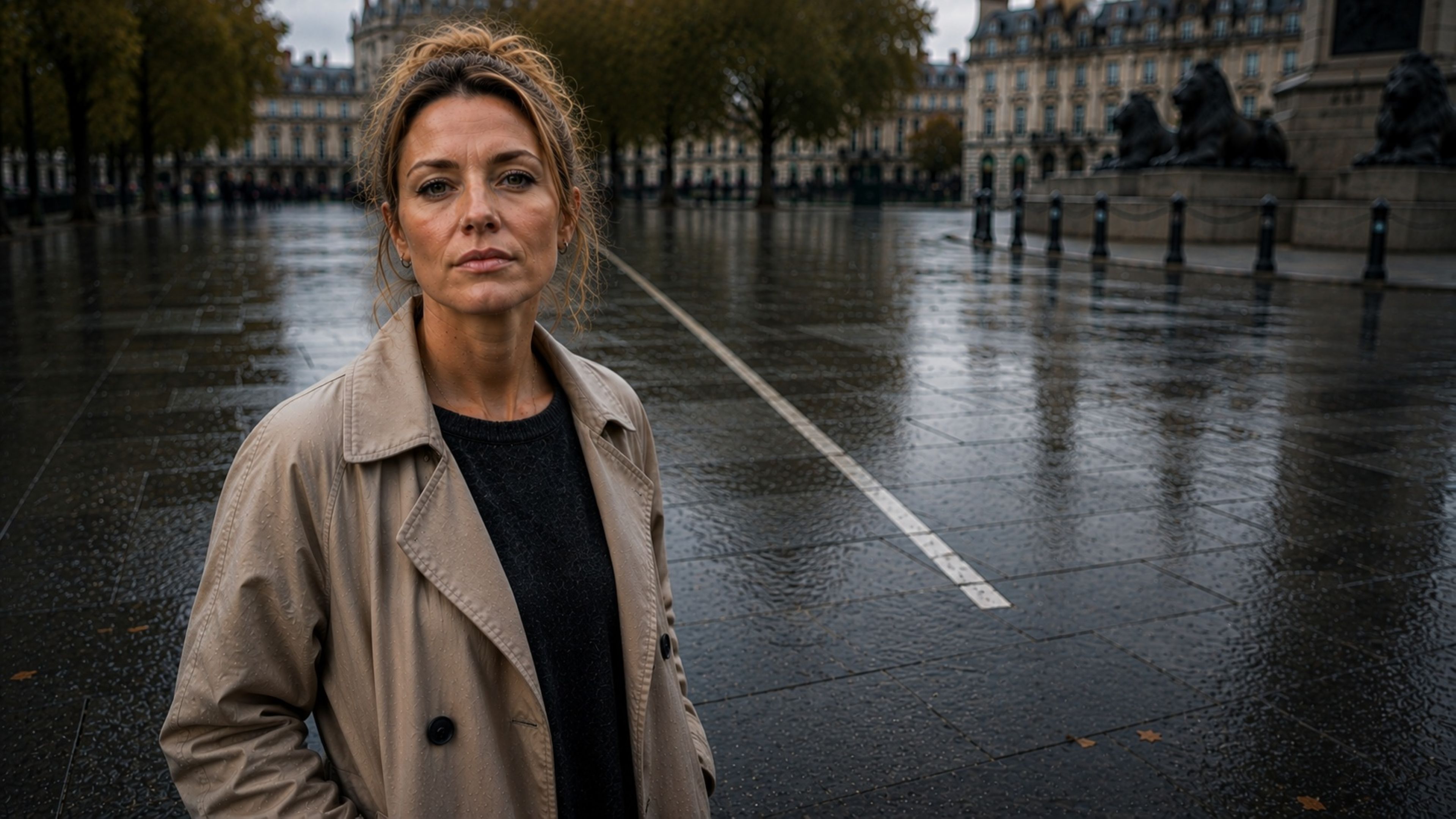
The Calculation
I have lost count of how many times I have done it myself, and how many times I have watched other women do the same.
Walking back to a car at night. Crossing a station car park. Leaving work. Leaving a pub. Leaving a friend’s house. Keys through the fingers. Phone already open. Eyes scanning. Body tightened. Doing the calculation.
Every woman knows this ritual.
We know how far away the footsteps are. Which side of the road feels safer. When to pretend to be on the phone. When to turn around and make it obvious we have seen you. How to make ourselves smaller without looking weak. How to get to the front door without looking afraid.
We know this because we were taught it. Not always with words. Mostly through repetition. Through stories. Through warnings. Through what happened to us. To our friends. To the women before us.
And the thing that should stop the whole country cold is this:
It is considered normal.
Women adapting our behaviour is normal. Women planning escape routes is normal. Women being told: don’t walk there, don’t wear that, don’t trust him, don’t drink that, don’t go alone, don’t stay late, don’t answer back, don’t make a fuss. All of that is treated as ordinary.
And when something does happen, the first question is almost never: what allowed this to happen?
It is: why were you there?
That was the moment it clicked for me. The enforcement zone is not only personal violence. It is policy. It is law. It is culture. It is what a society decides about whose bodies matter, whose suffering is tolerable, and whose protection can be traded away.
This is where the thread lands.
In No. 1, I followed the thread into the church. In No. 2, I followed it into the machinery of managed movements.
This time I have to follow it into the body.
Because everything I examined, religion, empire, media, war, ideology, family, courts, policing, led me back to the same point. Simple enough to say. Brutal enough to live:
Women are treated as territory.
Not metaphorically. In practice.
We become the border. The honour. The warning.
The punishment. The prize. The currency.
And once you see that, you start to understand that the civilisation story is not held together by law or truth.
It is held together by permission.
Permission to control. To take. To shame. To silence. To reduce women to function and call it civilisation.
The Pattern
There are two ways to lie to people.
One is to tell them something false.
The other is to tell them something true, but only in fragments, so they never see the whole.
We are living inside the second kind.
The right says it wants to protect women, while routing female fear into civilisational hatred. The left says it wants to liberate women, while abstracting the category of woman so completely that protection becomes difficult even to name.
These are not identical sins. But they can arrive at the same destination: women’s protections become negotiable, debatable, disposable.
The institutions say women are equal, while punishing the ones who insist on being treated that way.
And the result is always the same: women get managed.
Managed by law, religion, moral panic, culture, pornography, policing, courts, medicine, ideology, and now, increasingly, by algorithm.
The enemy is not the believer. It is the machinery that turns belief into permission.
If you want to understand how old that machinery is, you start where every civilisation starts when it wants legitimacy. You start with the story that justifies taking other people’s bodies.
You start with scripture.
Scripture as Blueprint
I do not believe the Bible is a neutral moral authority. It is a library of human politics: myth, poetry, trauma memory, law, propaganda, and power, curated by men inside systems of conquest and inheritance.
Read the text plainly and it tells you so.
Numbers 31 is not a battle story. It is a sorting mechanism.[1] It is how a civilisation legalises which children live and which must die.
Boys are killed. Future resistance eliminated. Women are sorted by sexual status. Virgin girls are kept alive.
"Now kill all the boys. And kill every woman who has slept with a man, but save for yourselves every girl who has never slept with a man."
Numbers 31:17–18 (NIV)
Kill the sons, because they carry the defeated people forward. Keep the daughters, because they can be absorbed into the conqueror’s future.
The mechanism does not hide. It targets virgin girls specifically. This is not metaphor. This is how civilisations have always legalised the sexual abuse of children.
That is what empires do.
But Deuteronomy 21 goes further. It does not just describe violence. It ritualises violence. It builds a process. It turns the capture of a woman into a legal transaction, step by step: bring her in, strip her identity, make her mourn her family, then take her as wife.[2]
"When you go to war against your enemies and the LORD your God delivers them into your hands and you take captives, if you notice among the captives a beautiful woman and are attracted to her, you may take her as your wife. Bring her into your home and have her shave her head, trim her nails and put aside the clothes she was wearing when captured. After she has lived in your house and mourned her father and mother for a full month, then you may go to her and be her husband and she shall be your wife."
Deuteronomy 21:10–13 (NIV)
That is not just brutality. That is a moral technology. It is how you make violence feel lawful, and how you turn a captive into a wife.
These same verses sit at the heart of Jewish scripture as well. Judaism shares the Torah, and rabbinic tradition spent centuries debating exactly how the “beautiful captive” law should work in practice. The core teaching appears in the Babylonian Talmud, Kiddushin 21b:[3]
“The Sages taught: ‘And you see among the captives a beautiful woman’; the Torah spoke only in response to the evil inclination [yetzer hara]. For if the Holy One, Blessed be He, had not permitted him [to take her], he would have taken her unlawfully. The Torah therefore permitted him [to marry her] in a permitted manner.”
Babylonian Talmud, Kiddushin 21b
Listen to what the rabbis are saying here. Male lust in wartime is inevitable. Better to regulate it under religious law than pretend it won’t happen. So they argue the details: who can take her, how does conversion work, what if he rejects her after. These debates, the ones that shaped halakhic practice for two thousand years, began with an acceptance of the right to take.
And this is where the pattern spreads from the battlefield into ordinary life. From war into marriage. Rabbinic literature preserved a marriage formula in which women are not persons but objects to be acquired:[4]
”A woman is acquired in three ways: by money, by document, or by sexual intercourse.”
Mishnah Kiddushin 1:1
The wartime captive becomes the lawfully acquired wife. Conquest logic becomes contract. Territory becomes household.
Islamic jurisprudence inherited and argued over texts that similarly ground male authority and treat female captives as lawful spoils. Qur’an 4:34 has been used for centuries to establish guardianship:[5]
”Men are protectors and maintainers of women, because Allah has given some of them advantage over others, and because they spend from their wealth.”
Qur’an 4:34 (Sahih International)
And Qur’an 4:24 contains the language that makes female bodies war spoils:[6]
”And [forbidden to you are] married women except those your right hands possess.”
Qur’an 4:24 (Sahih International)
These texts mean different things to different believers today. Many religious scholars contest the patriarchal readings, fight against them, reinterpret them. But the historical record is unmistakable: male institutions used these texts to build systems of absolute authority over women. From captive to wife to property. The logic runs consistent across three thousand years.
And before anyone says "that was ancient history," look at how religion runs through state power right now. In Britain, the Church of England is not separate from government. It is established. The monarch is its Supreme Governor. Bishops sit in the House of Lords. Canon law and civil law interpenetrate. The separation of church and state, so clean on paper, does not exist in practice. Religion still has direct legislative access. The machinery never left. It just stopped advertising itself.
Empire, Trauma, and the Export of Consequence
If you want to see the modern version of this mechanism in action, you do not begin in Palestine. You begin in Europe.
Europe failed to protect its Jewish population. Hunted them in some places. Stood aside and watched in others. The Dreyfus affair[7] made the contradiction visible. Pogroms made it visible in blood. Then catastrophe, industrialised.
Political Zionism did not arrive because people woke up and liked a new idea. It grew out of survival instinct: the fear that Jews would never be safe inside European civilisation, no matter how assimilated they became, no matter how hard they tried to be acceptable.
That impulse was legitimate.
But empire does what it always does. It takes survival and turns it into policy. Takes trauma and turns it into paperwork. Takes guilt and turns it into geography.
Balfour[8] in 1917 promised a homeland while standing on land already inhabited, then acted shocked when the contradiction would not resolve itself peacefully.
Christian Zionism did something more powerful still. It took real historical trauma and strapped it to an apocalyptic timetable. Converted history into prophecy. Recruited believers into geopolitical certainty.
Once prophecy is driving policy, there is no negotiation. There is only script.
And once a script is running, somebody has to pay for it.
This is not the past. This is now.
And again, look where it lands.
Not in theological debate.
In bodies.
Women and children always pay the bill for prophecies written by men.
The Care System as Enforcement Zone
The enforcement zone does not begin with individual men. It begins with an institution deciding which children matter and which ones do not.
In the 1970s and 1980s, children in state care lived in homes run by predators. Families lived above them, in normal houses, with names. Children in care had neither. The Waterhouse Inquiry[9] documented North Wales, 1974 to 1990: systematic abuse, decades of complaints ignored, local authorities that knew, police that were called and did not pursue, social services filing reports into the void.
Seventy-two recommendations. Most never happened. The structural problems stayed. Vulnerable children kept being placed with dangerous adults because the system that was supposed to protect them chose, again and again, to protect itself.
Then came the wave of scandals that should have ended the argument permanently. Rotherham, Rochdale, Telford and beyond. The Jay Report[10] found 1,400 victims in Rotherham alone. Organised abuse. Vulnerable girls, including girls from care homes and chaotic families, targeted precisely because the system had already failed them once.
The Independent Inquiry into Child Sexual Abuse (IICSA)[11] ran from 2015 to 2022. It examined abuse across England and Wales: children’s homes, schools, religious organisations, the military. Different institutions, same pattern: complaints that go nowhere, investigations that stall, perpetrators protected or moved on, reputations prioritised over children.
Then in June 2025, after everything was already documented, the government announced a new inquiry into grooming gangs.[12] Another one. Because the old inquiries had not actually changed the machinery.
And at the same time, Baroness Louise Casey released a national audit of group-based child sexual exploitation.[13] The finding was not subtle: it is still happening. Children are still being targeted. The system is still failing them.
Some of the least discussed allegations sit closer to power. Operation Midland[14] was a Metropolitan Police investigation into claims of VIP abuse networks. It concluded with no charges. The point here is not to claim what cannot be proven. The point is the structural lesson survivors learn: proximity to power changes the temperature of the room. It changes what gets investigated, how long, with what appetite, and with what consequences.
This is not about the ethnicity or faith of perpetrators. It is about the system deciding which victims are credible and which ones are inconvenient. My own experience in care, with a white man, proves it: the enforcement zone does not discriminate by postcode. It discriminates by power. Who has it. Who does not.
The care system creates vulnerability, then pretends to be shocked when predators exploit it. Girls and boys placed in homes with adults who should never have been trusted. Access given. Complaints filed. Then forgotten.
And here is what should stop the country cold: we are still doing this. Inquiries keep being launched because the previous ones did not work. Which means somewhere in Britain right now, a child in care is learning the same lesson I learned: the system that is supposed to protect you is teaching you that you are not worth protecting.
That is the enforcement zone. Not theoretical. Institutional. Built into brick, staffing, incentives, and silence.
Women and children treated as territory, not by one monster, but by a structure that keeps making the same choice.
The Enforcement Zone
In June 2022, the United States Supreme Court overturned Roe v. Wade.[15] Five decades of constitutional protection for reproductive autonomy, gone. Abortion regulation returned to the states. Women’s bodies became negotiable again.
Not through street violence.
Through law.
That is the enforcement zone in its cleanest form: permission written into policy.
In Britain, the law says women are protected. In theory. Self-defence is legal.[16] You can defend yourself in your own home without waiting to be attacked. In practice, the law permits “reasonable force” in the moment while criminalising most practical defensive tools. Pepper spray. OC spray. The tools women might actually use.
The UK is not unique in this. Canada is similarly restrictive. But the UK is not the global default either. Some jurisdictions are more permissive. Western Australia allows OC spray for lawful self-defence. The Northern Territory began a trial in September 2025 allowing eligible adults to carry it. The pattern is clear: the UK has chosen a path more restrictive than comparable democracies.
The trap is precise. You may defend yourself in the moment, but you may not carry the most practical tool to make self-defence viable before a man’s hands are already on you.
So women are expected to anticipate violence, adapt to violence, and survive violence, while being denied the tools that might stop it before it starts.
And when violence happens, the system often behaves as though survival itself were suspicious. Family courts spent years being criticised for minimising domestic abuse and maintaining contact between children and violent fathers in the name of parental involvement.[17] That is also the enforcement zone: not just the assault, but the permission structure around it.
Crime outcomes data for 2024 to 2025[18] shows that only 11.3% of recorded domestic-abuse violence against the person crimes resulted in a charge or summons. A large share closed because the victim withdrew support. Not because she stopped caring, but because the process itself can feel more dangerous than stopping.
The old order no longer needs to call women property out loud. It only has to keep producing the same result: male violence is accommodated, female resistance is constrained, and women carry the aftermath.
This is one reason fawning exists. Not because women are weak, but because women learn early that survival is more achievable than justice. Fawning is not consent. Health.com[19] names it: an automatic survival response, deeply wired, designed to keep you safe when threat feels overwhelming. Compliance as strategy. Placation as calculation. Your brain does the maths: direct resistance may make it worse.
And when the law denies practical tools, and the system does not consistently follow through afterwards, that calculation becomes rational.
The enforcement zone is not only personal violence. It is policy. It is law. It is what a state decides about whose bodies matter, whose suffering is tolerable, and whose “protection” can be traded away.
That is why courtrooms still treat compliance as consent, girls in care are treated like inconvenient witnesses, rape is managed as reputational risk before it is treated as crime, child exploitation is handled like scandal before it is handled like emergency, and women are expected to modify ourselves rather than society modifying its permission structure.
This is the oldest trick in civilisation.
The system does not have to stop men. It only has to make women doubt themselves.
Doubt what they saw. Doubt what they felt. Doubt what happened. Doubt whether it was “bad enough”. Doubt whether they will survive the process of being believed.
And once women are trained into doubt, the machinery can run without needing open chains.
The chains become internal.
Institutional Shielding
The care system shows one pattern. But the same principle operates at every level.
In 2019, Jeffrey Epstein was arrested in New York. The files exposed what had been visible for years to anyone willing to look: powerful men, underage girls, access, money, protection. Judges. Politicians. Financiers. Celebrities. The machinery that enabled him was suddenly visible.
And then what happened?
Some prosecutions. Some settlements. Some documentation. But the broader network that made his operation possible largely survived. The mechanisms that allowed access, discouraged reporting, and protected the powerful when allegations surfaced did not vanish. They stayed in place.
In Britain, Savile.[20] A man who abused children and young women for decades while protected by proximity to the BBC, to royalty, to the establishment. Never prosecuted while alive. The inquiry came after his death, when he could no longer sue, when institutions could manage the story of how they had failed. The machinery that shielded him in life then helped shape the narrative of his shielding after death.
That is institutional shielding at scale.
But it does not only happen in Westminster or Hollywood.
It happens in pubs. In family homes. In ordinary streets. The same pattern, the same outcome, just without the cameras.
After my father left, my mum was devastated. She drank, she unravelled, and the man who came next recognised vulnerability when he saw it.
It started with the small violations. Staring. “Accidental” contact. Comments when no one else was listening. Then he escalated. A lodger came home in the middle of it and I ran. If she had not walked in, it would have gone further.
I was twelve when it started. Fourteen when I told my mum. She said she believed me. He convinced her I was lying. She married him anyway.
That was when I understood shielding at the family level.
I became loud. Angry. Impossible to ignore. By fifteen I was in care, not because I was protected, but because I left. I knew that if I stayed in that house, worse would happen.
What I learned later was worse in a different way: he was not an aberration. He was known. Mothers warned each other quietly. Do not leave your daughters alone with him. They knew what he was. And he stayed anyway.
That is how shielding works. Not always through open defence. Sometimes through quiet accommodation. Through everyone adjusting around the predator instead of removing him.
After that I became fierce because I had no other option. No framework. No adults who listened. Just refusal.
And for that I became the problem. Too loud. Too difficult. A liar. A troublemaker. In the family narrative, I was recast as the threat to the home rather than the child being threatened inside it.
This is how institutional shielding works at every level. Predators are accommodated. Witnesses are discredited. The institution, whether family, state, school, church, care system, or media organisation, protects itself before it protects the vulnerable.
When I tried to protect myself, I was the one who was removed. Not him. Me. The child goes. The predator stays.
And in care, when I was raped, the pattern repeated. I was not treated as a victim. I was treated as a problem. Something to move along. Something to contain.
That is why women and children know in their bodies that speaking is dangerous. The family protects the father. The institution protects the staff. The establishment protects its own. The person who names the harm gets recast as the disruption.
The child gets removed. The machinery stays protected.
Waves 1–4 and the Capture of Feminism
To understand why contemporary feminism often struggles to defend women, you have to understand what happened to feminism itself.
First-wave feminism was about personhood. Women are people. Simple now. Not then. It meant the right to own property, to vote, to exist in law as autonomous beings rather than extensions of male relatives. It was not academic and it was not performed. It was grassroots. Broken windows. Hunger strikes. Women standing in the rain outside polling stations because the law said they could not vote, but it did not forbid them standing outside the building. Material struggle. Direct action.
Second-wave feminism was about bodily autonomy. Reproductive rights. Contraception. The right to refuse sex without losing economic support, children, or social standing. Workplace equality. The legal right to name marital rape as rape. Not theoretical. Lived. Won by women who watched their mothers die from unsafe abortions, watched rape treated as a family matter, watched women disappear into marriages they could not escape.
My grandmother, my nanny, is why second-wave matters. Her adult life was pregnancy in a two-up-two-down in Glasgow with an abusive man. Thirteen pregnancies. No contraception. No legal recourse. No escape. She died at 42. Not illness. Wear. A body treated as territory. Used until it broke.
That is what second-wave fought. Not in theory. In the lived reality of women like my nanny, whose bodies and futures were never treated as their own.
These waves changed law, culture, and material life. Not completely and not evenly, but the gains were real. They were grounded in women whose bodies were on the line.
Then something shifted.
Third-wave feminism moved deeper into institutions: universities, NGOs, policy spaces, foundations. And once feminism moved inside institutions, it began to absorb institutional incentives. Respectability. Career ladders. Language that sounds clever in rooms where nobody wants to change anything material.
Power does not want feminism. It wants something that looks like feminism without threatening the order. So bodily autonomy, the hardest-won gain, becomes abstraction. Lived violence becomes discourse. Material struggle becomes a set of correct phrases. Safe enough to be discussed in boardrooms without anyone having to risk anything.
Fourth-wave feminism inherited that terrain. It also brought real gains, especially around sexual violence and public testimony, but it arrived in a world where the conversation could be pulled away from the ground. Online performance replaced organisation. Symbols replaced protection. Words replaced outcomes.
Then the backlash arrived and used the confusion.
It took the fragmentation, the language games, the fear of saying the wrong thing, and weaponised them. While debates spiralled, material protections eroded: abortion rights rolled back, domestic abuse prosecutions collapsed, girls in care still targeted, family courts still criticised for prioritising contact over safety, practical self-defence tools still illegal to carry.
The machinery did not stop. It became harder to name, because the conversation about women had become easier to derail.
And when birth rates fall, the panic sharpens. In England and Wales, the total fertility rate fell to 1.41 in 2024, the lowest on record, with provisional 2025 figures estimating a further fall to 1.39.[21][22] The state already knows what follows: an ageing population, deaths projected to exceed births from mid-2026, and a future it does not know how to fund without asking harder questions about housing, wages, care and social structure.[23] Too often, instead of confronting those failures honestly, power reaches for the oldest shortcut available. It turns back towards women's bodies, as though demographic strain were something women are obliged to solve with our blood.
None of this means women's freedom is the problem. It means freedom changed the terms. Education lengthened. Work became non-optional. Family formation moved later. Contraception made timing more controllable. Abortion made compulsion less absolute. Then housing costs climbed, childcare became punitive, wages thinned out, relationships grew less stable, and the years in which people might once have built a family got eaten alive by precarity. That is not one cause. It is a stack of them. The point is not that women were "set free" and civilisation broke. The point is that institutions demanded modern labour, offered less material security, and then acted shocked when family life no longer followed the old script.
Abortion statistics can tell us something about timing, pressure, and unintended pregnancy. They cannot, on their own, explain low fertility.[24][25]
This is not saying later-wave feminism was wrong about everything. Some of its insights are real and necessary. But it lost something crucial when it left the material ground: the ability to speak plainly about what women need to be safe.
Into that vacuum, reactionary clarity stepped. Even when the answers were wrong, they sounded concrete. They sounded like lived experience rather than institutional language. That is how abstraction becomes the tool of undoing.
You cannot build resistance from inside a framework that has lost its footing.
The Counterfeit Rescue
Now we arrive at the pivot.
When women’s protections become negotiable, somebody will always step forward claiming to be the rescuer.
But the rescue is often counterfeit.
Because legitimate concerns about women’s boundaries can be turned into a recruitment tool for tribal hatred.
A woman can be right about women’s spaces, then be steered into a broader project that is not about women at all.
It is about civilisational conflict.
And civilisational conflict is one of the oldest engines of empire. Proxy wars. Intervention. Destabilisation. Moral panic. Manufactured consent.
Watch what happens when a state consolidates power. Watch what gets written onto women’s bodies.
Iran, 1979: revolution. By 1983, compulsory hijab: law, enforced. Not voluntary. Not a personal choice. A state deciding women’s bodily autonomy is negotiable. Ideology consolidating itself by making women the visible enforcement zone.
This is not “Islam in essence”. This is what states do when they want permanent legitimacy. Control the body first. Make the woman the billboard.
Which brings me to the point that gets flattened in public discourse.
Islam is not a single uniform culture. Muslim-majority societies have not treated women the same way across time or geography. Extremism does not emerge in a vacuum either. It is shaped by war, destabilisation, proxy funding, sanctions, and the long afterlife of intervention.
That does not excuse coercion. It explains why the worst expressions often rise after societies are shattered.
And again, who becomes the enforcement zone?
Women.
Forced to cover. Forced to uncover.[26] Forced to comply. Forced to perform civilisation for men.
The debate is framed as: “What should women be allowed to do?”
The real question is: “Why are women the place civilisation writes its panic?”
A Fifth Wave, If We Are Serious
If there is a fifth wave worth building, it will not be another faction.
It will be a moral line.
Not left. Not right. Not tribal. Not theological.
A simple principle that applies across every culture, every faith, every ideology, every state:
Women and children are not territory.
Not for prophets, priests, husbands, states, armies, courts, activists, algorithms, or revolutions.
No sacred text has the right to sanctify our disposability. No political movement has the right to recruit our pain. No institution has the right to trade our bodies for “stability”.
If a society wants to be moral, do not measure it by what it claims to believe.
Measure it by what it permits, and what it quietly allows to continue.
Once you understand that, you stop asking: “Which side am I on?”
You start asking: “Which structures are turning humans into inventory?”
That is why I built The Gnostic Key.
Because you cannot dismantle a system you do not understand, and you cannot replace it with something human-centred until you can see the machinery clearly enough to refuse it.
The most powerful thing humans possess is not violence.
It is withdrawal.
The ability to say no, to stop consenting, and to stop performing obedience as though it were virtue.
To build something else until the old becomes irrelevant.
Closing
I do not think women need to be revered as goddesses to be safe.
They need to be treated as fully human.
Not territory. Not property. Not symbol. Not temptation. Not punishment. Not prize.
Human.
If you read the trilogy in order, you see the whole machine: the story, the spectacle, and what it costs.
If you want a civilisation worth living in, start there.
Everything else is theatre.
Zoë
What is your reading of No. 3?
Use this discussion to test claims and improve clarity.
Which argument is strongest, and what evidence would strengthen the weaker sections?
- Which line of argument should be expanded?
- Which source would best support the central claim?
Share your reasoning on X or Telegram using #TheGnosticKey.
Resources
Primary reporting, official statements, and historical references used in this piece.
References
-
:The conquest sorting mechanism: kill the boys, keep virgin girls.
-
[2] Deuteronomy 21:10–13 (NIV)
:The ritual of captive-woman assimilation: bring her in, strip identity, mourn, then take.
-
[3] Babylonian Talmud, Kiddushin 21b
:Rabbinic debate on the 'beautiful captive' law: rabbis acknowledge male lust in wartime is inevitable and argue how to regulate it lawfully.
-
:Rabbinic marriage law using acquisition language: 'A woman is acquired in three ways.'
-
:Verse historically used to ground male authority over women, though heavily debated and reinterpreted by modern Muslim scholars.
-
:Verse including the exception for female captives 'in your possession', central to debates about war, slavery, and women's status.
-
:European antisemitism and the wound that produced Zionism.
-
[8] The Balfour Declaration (1917)
:Imperial policy turning trauma into paperwork and geography.
-
[9] Waterhouse Inquiry: Lost in Care (2000)
:Tribunal of Inquiry into the Abuse of Children in Care in North Wales. Examined systematic abuse in children's homes 1974-1990, with 72 recommendations.
-
[10] Jay Report: Independent Inquiry into Child Sexual Exploitation in Rotherham (2014)
:Documented grooming gangs and estimated 1,400 victims in Rotherham alone. Landmark exposure of institutional failures.
-
[11] Independent Inquiry into Child Sexual Abuse (IICSA) Final Report (2022)
:Seven-year national inquiry (2015-2022) into institutional child sexual abuse across England and Wales. Examined children's homes, schools, religious organisations, military.
-
[12] Independent Inquiry into Grooming Gangs (2025-ongoing)
:National inquiry announced June 2025, chaired by Baroness Anne Longfield. Terms of reference confirmed December 2025. Investigates group-based child sexual exploitation historically and currently.
-
[13] Baroness Louise Casey: National Audit of Group-Based Child Sexual Exploitation (2025)
:Rapid audit confirming the pattern of institutional failures in protecting vulnerable children persists across care system.
-
[14] Operation Midland / Dolphin Square Allegations
:Metropolitan Police investigation (2014-2016) into alleged VIP abuse ring and trafficking from care homes to Dolphin Square, Pimlico. Investigation concluded with no charges.
-
[15] Dobbs v. Jackson Women's Health Organization (2022)
:US Supreme Court overturns Roe v. Wade: 50 years of settled law on reproductive autonomy. Bodily autonomy becomes negotiable by state.
-
[16] UK Self-Defence Law and Defensive Tools Restrictions
:UK permits reasonable force in self-defence but criminalises practical defensive tools including pepper spray/OC spray, unlike Western Australia and Northern Territory.
-
[17] UK Family Court Pro-Contact Culture and Domestic Abuse
:GOV.UK assessment of family law cases: documented pro-contact culture minimising domestic abuse risks and prioritising parental involvement over child safety.
-
[18] Crime Outcomes in England and Wales 2024-2025
:Official crime statistics: only 11.3% of domestic-abuse-related violence crimes closed with charge or summons. Majority closed due to victim withdrawal.
-
[19] Health.com, 'What Do Fight, Flight, Freeze, and Fawn Trauma Responses Mean?'
:Fawning: automatic survival response when brain judges direct resistance unsafe. Compliance as strategy, not weakness or consent.
-
[20] The Pollard Review: Report
:Investigation into decades of sexual abuse protected by proximity to BBC, royalty, and establishment. Never prosecuted while alive.
-
:ONS overview page linking the latest England and Wales fertility bulletins, including the 2024 total fertility rate of 1.41 and record-low trend.
-
[22] Births in England and Wales: 2025
:ONS 2025 births bulletin used for the provisional estimate of a further fall in total fertility rate.
-
[23] National population projections, 2024-based
:ONS population projections covering ageing, projected natural change, and the expectation that deaths will exceed births from mid-2026.
-
[24] Abortion statistics for England and Wales: 2023
:DHSC statistical release for abortion totals and rates in England and Wales in 2023.
-
[25] Abortion statistics commentary, England and Wales: 2023
:DHSC commentary used for cautious framing around timing, pressure, and unintended pregnancy.
-
[26] The Islamic Republic of Iran's Chastity and Hijab Law (1983)
:1979 revolution led to compulsory hijab law 1983. Ideology written onto women's bodies as state policy, not voluntary tradition.
Scholarly Sources & Translations
These sources are provided for verification, study and context. They represent diverse perspectives and are offered as reference points, not as doctrinal positions.
Link unavailable? Paste the URL into web.archive.org to find an archived snapshot. Most sources in our evidence packs are preserved there.
Open Discussion
Every argument in this piece is open to challenge. Bring primary sources, counterexamples or a better interpretation: the Community exists to test this work, not to validate it.
Support The Gnostic Key
The Gnostic Key is independently researched, written, and built. If the work has value to you, you can make a one-off contribution to help keep TGK independent.