
🏦 The recognition switch
Recognition is usually presented as diplomatic signalling. A symbolic gesture between governments. Polite fiction.
In practice, it operates as a legal switch. On or off. Audible or mute. Authorised or locked out.
The Venezuelan gold case makes this visible. Two competing boards both claimed authority to act for the Venezuelan central bank, including in respect of gold reserves of about US$1.95 billion held by the Bank of England. [2] One board was appointed by Nicolás Maduro, who controls the territory, the institutions, and the day-to-day governance of Venezuela. The other was appointed by Juan Guaidó, who was recognised by the UK government as interim President but controlled none of these things inside the country.
Read that again. In de facto terms, Maduro governs Venezuela's territory and institutions. Guaidó did not exercise that same internal control. But because the UK recognised Guaidó, his board gets to speak in UK courts about Venezuelan gold. The Maduro board, the one actually operating the central bank inside Venezuela, faces a preliminary obstacle: under UK law, they are speaking for an authority the UK has chosen not to recognise. [3]
The UK Supreme Court framed the first preliminary issue as the "recognition issue." [2] That framing is the key. Before the court could consider who was right, who had legitimate authority, or what justice required, it first had to determine who the UK executive recognised. And on that question, courts do not decide. They accept.
Under UK law, this is framed through the One Voice Principle. The state speaks with a single voice on recognition, and that voice belongs to the executive, not the judiciary. [2] [3] Courts do not second-guess. They do not weigh evidence about who actually governs. They accept the classification and apply it.
One classification. Made by ministers. Without vote or trial. And US$1.95 billion in gold becomes unreachable.
Recognition is the first gate. But it is not the only one.
“One diplomatic classification, and billions locked in place.”
⛓ The permission system
Sanction's are usually framed as punishment. You did something wrong, so we cut you off.
That framing obscures how they actually work.
Operationally, sanction's function as permission systems. The default condition is prohibition. Everything is locked. Movement occurs only inside licensed corridors, and the corridors open only when regulators say so. OFAC (the US Office of Foreign Assets Control) administers the architecture. They run the gates.
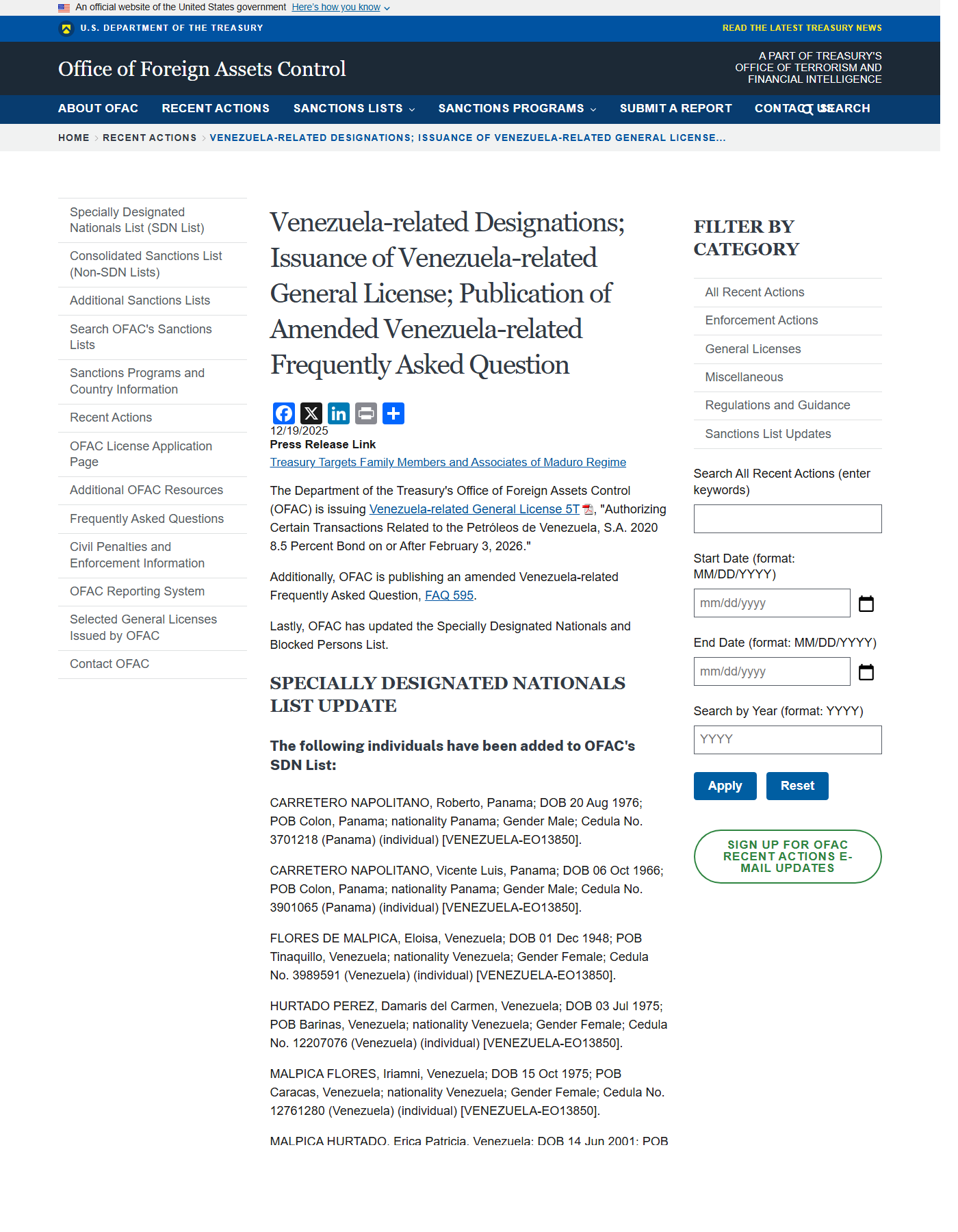
Their FAQ 595 states it plainly: between 24 October 2019 and 3 February 2026, there was no authorisation in effect for transactions related to the sale or transfer of CITGO shares in connection with the PdVSA 2020 bond. [4] CITGO is Venezuela's US-based refining and retail subsidiary. PdVSA (Petróleos de Venezuela) is the state oil company that owns it. The 2020 bond is a debt instrument with CITGO shares pledged as collateral. Unless OFAC specifically authorised it, the transaction was prohibited.
The authorisation date has been extended repeatedly. General License 5T specified effectiveness "on or after February 3, 2026." [5]
Subsequent OFAC notices. [6] continued to control the timing and conditions of movement. Each notice is published, timestamped, and binding. Nothing dramatic happens. The corridor simply stays controlled. The pressure accumulates.
This is the point. The power of a sanctions regime is not only in the prohibition. It is in the pacing. Delayed authorisation functions as leverage without requiring overt confiscation. Nothing is "seized" in the theatrical sense. The paperwork simply remains incomplete. The asset remains frozen. The regulator controls the timing.
To see what this looks like in practice, consider the gold sitting in London.
🧱 The vault that cannot be opened
Picture US$1.95 billion in gold bars. They sit in a vault at the Bank of England. They belong to Venezuela's central bank. They have not moved. They have not been sold. They have not been formally "seized."
And yet Venezuela cannot access them.
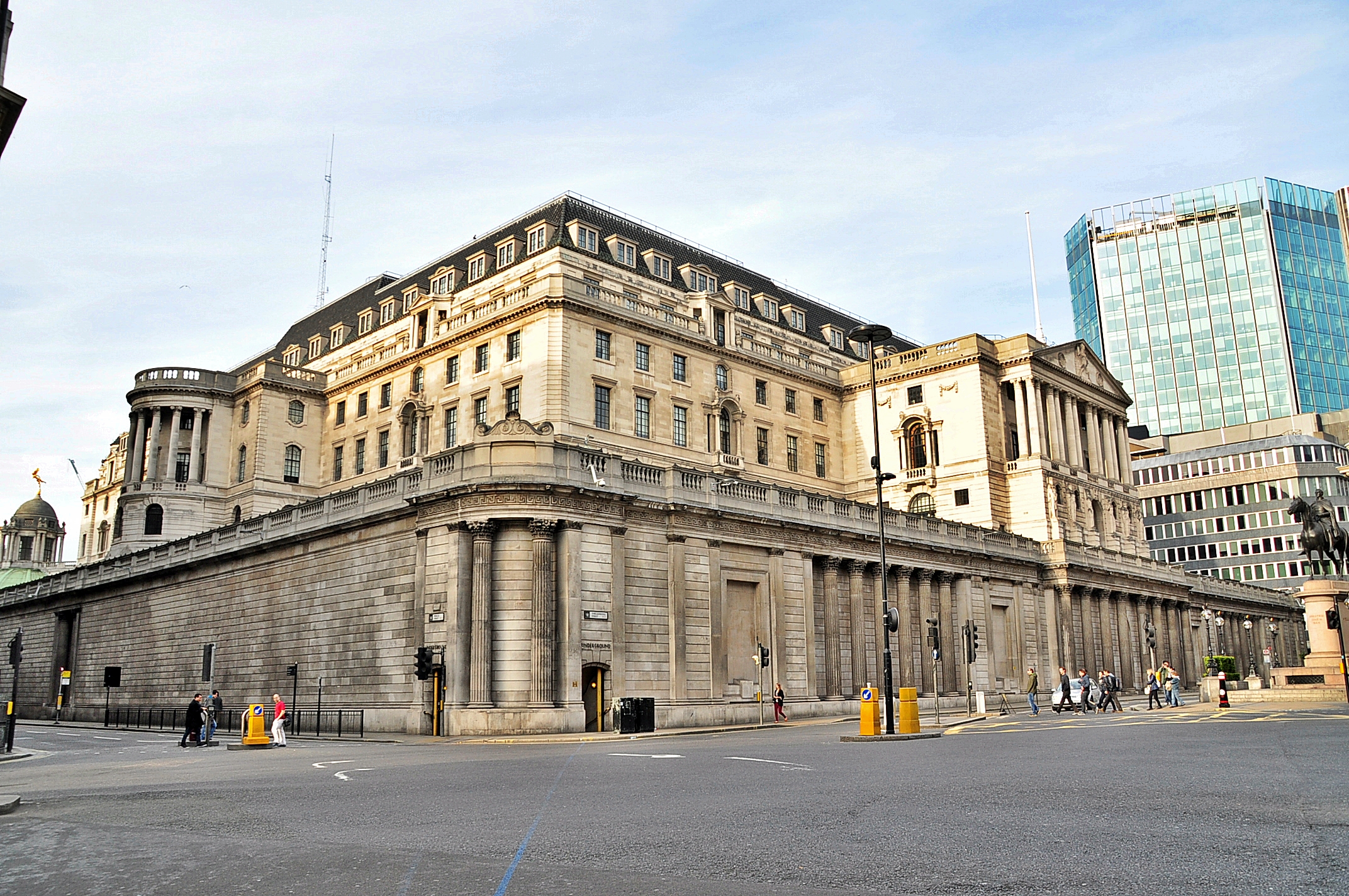
The UK Supreme Court press summary frames the dispute: two competing boards, each claiming to be exclusively authorised to act for the Venezuelan central bank, each claiming the right to issue instructions about the gold. [2] The central issue, as the court sees it, is not who governs Venezuela. It is who can lawfully issue instructions under English law.
Think about that. The question is not "who runs Venezuela?" The question is "who does the UK say runs Venezuela?" And those are different questions with different answers.
Because the UK executive recognised Guaidó, the Guaidó-appointed board could appear in court. The Maduro-appointed board (the one actually operating Venezuela's central bank inside the country) faced a preliminary obstacle: under the one voice principle, they were speaking for an authority the UK had chosen not to recognise. [3]
No bars are loaded onto trucks. No dramatic footage. No invasion. The gold simply becomes unreachable, because the authority that controls it inside Venezuela cannot instruct the bank that holds it outside Venezuela.
One interpretation is theft by procedure. The gold case is one asset. But the same architecture can be applied to corporate structures, share certificates, and entire subsidiaries.
That is where the courts come in.
⚖ The execution engine
Once recognition determines who may appear and sanction's determine what may move, courts can become something other than arbiters of justice in the everyday sense. They become process managers. Supervising the mechanics of transfer according to procedural rules. Not weighing who deserves what. Just running the machinery.
The District of Delaware provides the clearest example. Court records show an enforcement pathway aimed at PDV Holding, Inc., the US-incorporated company that sits between PdVSA and CITGO. A writ of attachment was authorised against shares owned by PdVSA, allowing creditors to seize and sell those shares to satisfy judgments. [7] In US practice, that enforcement toolkit can include writs like fieri facias (a court order directing enforcement against a debtor's property) as part of the execution pathway.
A later memorandum order sets out a supervised sale process: objections windows, response deadlines, court rulings on procedure. [8] The structure is familiar from bankruptcy auctions and creditor enforcement. The difference is the target: a strategic national asset, routed through the same procedural machinery as a foreclosed house.
The target is not a battlefield. It is a corporate structure. A share certificate. A court timetable. The question is not whether the process is legal (it is) but whether legality has become the instrument rather than the constraint.
Process takes time. And in this architecture, time is not neutral.
🛢 Scheduled seizure
Strategic assets rarely vanish overnight. They are repositioned through litigation, regulatory delay, and procedural inevitability. In practice, the slowness functions as a feature, not a bug. It reduces public shock. Lowers political cost. Produces an appearance of neutral administration. By the time the asset changes hands, the seizure looks like paperwork.
OFAC's handling of the CITGO-related authorisation window illustrates how delay functions as leverage. FAQ 595 describes the prohibition during the delayed period. [4] GL 5T sets the effective date. [5]
Then GL 5U supersedes it, pushing the date further. [6] Each extension is published, timestamped, and binding. Nothing dramatic happens. The corridor simply stays closed. The pressure accumulates.
Meanwhile, the Delaware sale process order shows a stepwise procedure: objections windows, response deadlines, supervised execution. [8] A stalking horse bid (an initial bid selected to set a baseline for an auction) can structure the sale. The result can be scheduled seizure. Regulators control when activity is permitted. Courts supervise how it proceeds. The outcome arrives dressed as market resolution.
This is an asset funnel. A pathway that channels strategic assets into a controlled process where value is redirected by law. No gunboats required.
But the machinery does require reach. And that reach extends beyond courtrooms.
🌍 Enforcement without war
Enforcement no longer requires declarations of hostilities. It travels through forfeiture, interdiction, and compliance obligations. Paperwork can reach ships, cargoes, and counterparties across borders. The language is always legal rather than military.
In August 2020, the US Department of Justice announced the disruption of a fuel shipment bound for Venezuela, describing it as the largest US seizure of fuel shipments from Iran. The cargo was confiscated through a civil forfeiture pathway (where the state seizes property by alleging it is connected to unlawful conduct, often without a criminal conviction). [9]
More recently, Reuters reported that the United States seized a sanctioned oil tanker off Venezuela's coast on 11 December 2025. Venezuelan officials described the action as theft and piracy. [10]

Both actions were presented as compliance with a legal regime. Both interrupted a sovereign supply line. The framing is enforcement. The effect is coercion. Call it what you want, but when you seize another country's oil shipments in international waters, the distinction between "sanction's enforcement" and "piracy" starts to look like vocabulary.
But coercion, even when dressed in legal process, has limits. And the system is beginning to show signs of adjustment.
🔄 Tactical recalibration
The sanction's architecture is not static. When coercion hits limits, regulators can recalibrate without dismantling the framework.
On 29 January 2026, OFAC issued General License 46, authorising certain activities involving Venezuelan-origin oil. [11] On 3 February 2026, OFAC issued General License 47, authorising the sale of US-origin diluents (light hydrocarbons blended with Venezuela's heavy crude to make it thin enough for pipeline transport and export) to Venezuela. [12] Both licences sit within the same Venezuela sanction's Regulations that produced the prohibitions documented above.
This is tactical retreat within the same architecture. The prohibition framework remains. The licensing corridor widens. The regulator retains control. Nothing has been conceded at the structural level, but the operational posture has shifted.
The timing may matter.
Remember the trains. Land-based energy corridors are expanding. Russian pipelines. Iranian routes. Central Asian networks. Alternative settlement rails are also part of the pressure picture. Maritime chokepoints (Suez, Panama, the Red Sea) face disruption, and UNCTAD reports that rerouting away from these chokepoints increased global vessel demand by 3% and container ship demand by 12% by mid-2024. [13]
The window in which maritime leverage and dollar-denominated sanctions remain maximally effective may be narrowing. The Rasht-Astara rail link remains the missing western segment of the INSTC, with Russian officials later pointing to 2028 as a completion target. [14] Red Sea disruption has also pressured maritime chokepoints since late 2023. [15] This does not prove cause and effect. The narrower reading is that GL 46 and GL 47 suggest a system adjusting as coercion becomes costlier.
The framework remains. The posture shifts. The question is who absorbs the costs while the recalibration plays out.
Updated 19 March 2026: sentence added linking GL 46/47 timing to the Rasht-Astara and Red Sea disruption cycle.
🏠 The permission system turns inward
Here is what should concentrate the mind.
The instruments documented in this episode (recognition doctrine, designation power, contractor exclusion, market access coercion) were built and refined on foreign states. Venezuela. Iran. Russia. Countries that could be framed as adversaries, making the tools feel distant from domestic life.
The linked live dossier records a domestic analogue involving Anthropic, a US-incorporated AI company.
In late February 2026, reporting described a dispute between Anthropic and the Pentagon over military access to AI systems, including safeguards around autonomous weapons and mass domestic surveillance. In March 2026, Anthropic was formally designated a supply-chain risk and brought legal challenges against the designation.
If that record is confirmed in the final source pass, the mechanism is closely parallel to what this episode documented in the Venezuelan case. Recognition determines who can instruct the custodian. Designation determines who can transact. Contractor exclusion removes market access. The target changes. The instrument does not.
The same period also saw OpenAI announce an agreement with the Department of War, publicly stating that its technology would not be used for mass domestic surveillance, autonomous weapons direction, or high-stakes automated decision systems. That claim matters, but so does the structure around it: government access, approved terms, controlled usage categories, and market access through compliance.
One interpretive line carries this forward. The same kind of legal routing that controls Venezuelan oil access can also shape which AI companies receive state contracts, which models are permitted inside government systems, and which firms are treated as acceptable suppliers. The permission architecture is not only geopolitical. It is a system that can be deployed against any actor who refuses compliance, regardless of nationality. A foreign state. A domestic corporation. The instrument is similar. The target moves.
Live tracking of these developments is in The Empire Codes: Ep0: Fortress of Fear, available through The Gnostic Key.
🧮 The bill comes due
The legal machinery
Two mechanisms do most of the work. Recognition changes who can instruct the Bank of England about US$1.95 billion in gold, without any court finding that the unrecognised government lacks de facto control inside Venezuela. The switch is diplomatic. The consequence is legal. No domestic Venezuelan court ruling is required. [2] [3]
sanction's licensing creates an administratively controlled corridor. OFAC frames certain CITGO-related transactions as prohibited unless specifically authorised. The corridor opens and closes at the regulator's discretion. [4] [5]
Where the cost lands
US$1.95 billion in gold sits in the Bank of England, functionally immobilised. [2] Venezuela's merchandise imports fell from an estimated US$39.0 billion (2010) and US$33.3 billion (2015) to an estimated US$14.9 billion (2024). [16] That is not a statistical abstraction. That is medicine, food, and spare parts that did not arrive.

Reuters reported on 15 January 2026 that Venezuela would have access to about US$4.9 billion in SDRs (Special Drawing Rights, the IMF's reserve asset used for international liquidity) if IMF ties were restored, but IMF engagement has been suspended since 2019, with restoration contingent on recognition outcomes among major shareholders. [17]
This is the Who Pays pattern. When reserves are immobilised, permissions are delayed, and external liquidity is blocked, the pressure concentrates on currency stability, import capacity, and public provisioning. Decision-makers in Caracas, Washington, and London remain insulated. Households absorb the shock. Public systems absorb the shock. The people who made the decisions do not absorb the shock.
This pattern (mechanism visible, cost displaced) is what carries forward into the next episode.
🧿 Where this goes
Carry-forward code: Theft, with paperwork.
This episode documented how recognition doctrine, sanction's licensing, and court-supervised execution can displace sovereignty over external assets without invasion, occupation, or declared hostility. The machinery is visible. The paperwork is published. The framing is always legal. The costs land on populations, not decision-makers.
The same architecture scales. What works on gold bars and share certificates can be applied to export markets, technology access, and entire supply chains. The target shifts from an asset to an economic sector. The mechanism remains: permission systems, procedural gates, and administrative control over what may move and when.
And the target need not be foreign. The Anthropic sequence, if confirmed in the final source pass, would show a similar instrument deployed against a domestic American company. The permission system does not require an enemy. It requires non-compliance.
But remember the context. The trains keep running. The land corridors keep expanding. The bypass infrastructure keeps being built. GL 46 and GL 47 are early signals that the coercion window may be narrowing. The extraction dynamic continues, but the architecture appears to be feeling the limits of its reach.
Episode III follows the machinery as it scales. The subject is tariffs, export controls, and the weaponisation of trade relationships. If Episode II showed the heist, Episode III shows the hostage.
Keep a permanent offline copy of this part, with the full text and the complete formatted edition ready to download.Own This Part
Members and Founding Members pay £2.49, applied automatically at checkout when signed in.
When does legality become theft?
This episode documents law used as a weapon.
At what point does recognition replace justice?
- Who declares legality?
- Who benefits materially?
- Who loses protection?
Share your insights with #TheGnosticKey.
Resources
References
-
[1] UK recognises Juan Guaidó as interim President of Venezuela (GOV.UK)
:Recognition statement used as the documentary anchor for UK executive posture.
-
[2] UK Supreme Court press summary, UKSC 2020/0195 (Venezuela gold dispute)
:One voice principal framing and gold dispute synopsis.
-
[3] Court of Appeal judgment, [2020] EWCA Civ 1249 (Maduro Board v Guaidó Board)
:Application of the one voice doctrine in the recognition dispute.
-
[4] OFAC FAQ 595 (CITGO shares and PdVSA 2020 bond restrictions)
:States prohibition unless specifically authorised and describes the authorisation gap.
-
[5] OFAC General License 5T (effective authorisation date)
:Sets effective authorisation on or after 3 February 2026.
-
[6] OFAC Recent Actions notice (GL 5T issuance and FAQ update)
:Links GL 5T and FAQ amendment as a coordinated administrative action.
-
[7] District of Delaware opinion and order (attachment pathway), PDVH/PDVSA context
:Court record describing an attachment and enforcement pathway against PDV Holding-related interests.
-
[8] District of Delaware order, Sale Process and Litigation (1:23-mc-00608-LPS, Doc 59)
:Court supervised sale process mechanics for PDVH shares.
-
[9] DOJ press release: largest US seizure of Iranian fuel from four tankers
:Demonstrates extraterritorial enforcement via forfeiture and seizure tied to Venezuela bound shipments.
-
[10] Reuters report on US seizure of a sanctioned oil tanker off Venezuela's coast (11 Dec 2025)
:Recent illustration of sanction's-linked enforcement action reported by Reuters.
-
[11] OFAC Recent Actions: Issuance of Venezuela-related General License 46 (29 Jan 2026)
:OFAC notice issuing GL 46, authorising certain activities involving Venezuelan-origin oil.
-
[12] OFAC Recent Actions: Issuance of Venezuela-related General License 47 (3 Feb 2026)
:OFAC notice issuing GL 47, authorising sale of US-origin diluents to Venezuela.
-
[13] UNCTAD news release: Suez and Panama Canal disruptions threaten global trade and development
:Quantified disruption effects: rerouting increased global vessel demand by 3% and container ship demand by 12%.
-
[14] Interfax (2023): Rasht-Astara railway completion expected by 2028
:Rasht-Astara rail link agreement and completion-target context.
-
[15] Reuters (18 Dec 2023): Red Sea attacks force rerouting of vessels
:Houthi attacks and maritime chokepoint disruption context.
-
[16] UNCTAD country profile, Venezuela (trade totals and imports)
:Trade totals and import values used to ground the 'Who Pays' box.
-
[17] Reuters report on IMF ties and SDR access contingent on recognition (15 Jan 2026)
:Reports IMF position on engagement and the scale of SDR access discussed.
This episode reflects public documents and reporting as of January 2026, with later live-dossier material clearly marked where it appears. The evidence pack prioritises primary sources, court records, government statements, regulator notices, and official enforcement releases. Interpretation is explicitly marked and constrained to what the cited record supports.
These sources are provided for verification, study and context. They represent diverse perspectives and are offered as reference points, not as doctrinal positions.
Link unavailable? Paste the URL into web.archive.org to find an archived snapshot. Most sources in our evidence packs are preserved there.
Read Alongside
-
The Empire Codes:
-
The Empire Codes:
Episode I: The Panic Room at the Top of the World
-
The Empire Codes:
Episode III: The Tariff Guillotine
Continue the Conversation
All discussions are publicly readable. Posting and replies require Membership.
Support The Gnostic Key
The Gnostic Key is independently researched, written, and built. If the work has value to you, you can make a one-off contribution to help keep TGK independent.