


⚠️ Previously in Part II
Previously: You walked the path of return, past the Archons, through the toll gates, armed with gnosis and memory. The soul that remembers ascends. The soul that forgets returns. The Gnostic Christ—Jesus as Revealer—taught this escape from the false cosmos. Now we ask: must you die to begin the journey, or can you rise while still breathing, and carry the spark beyond the veil now?
💨 Chapter 1: The Soul’s Exit
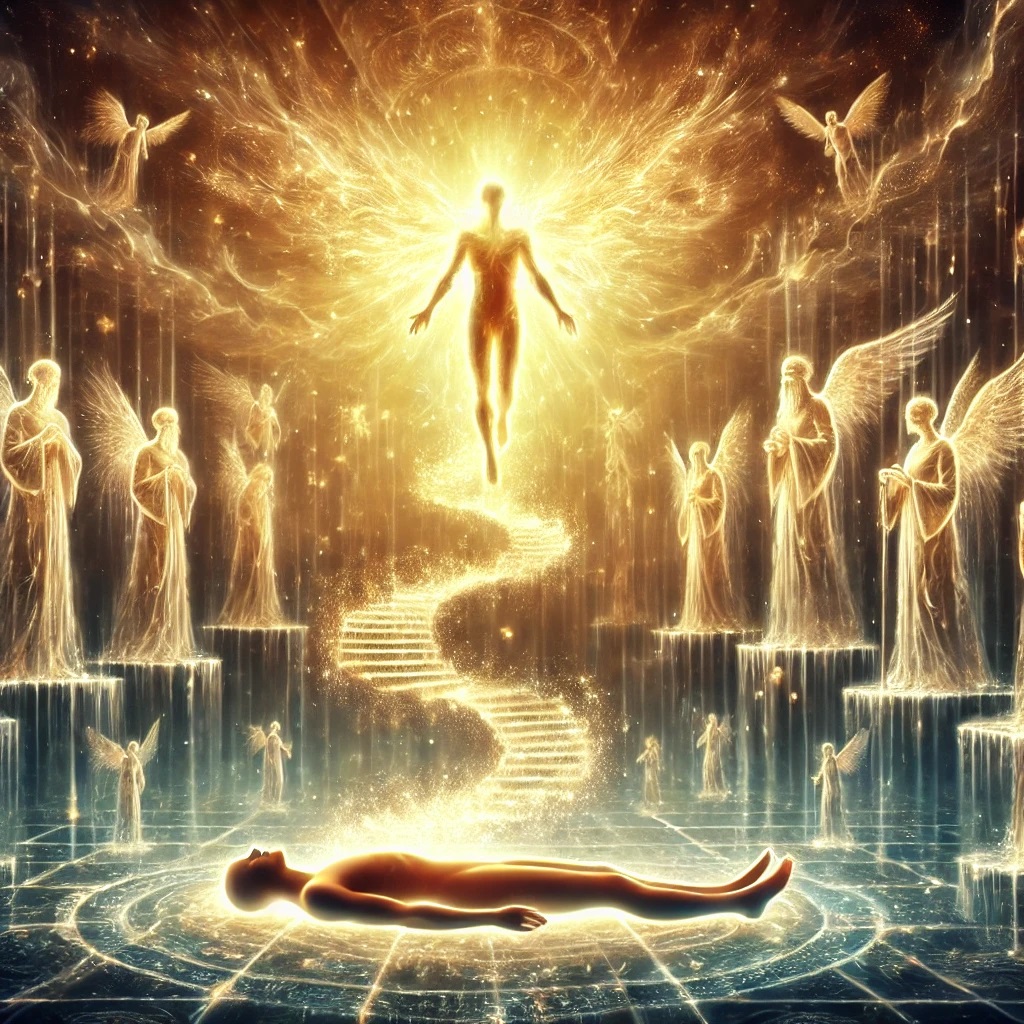
The Gnostic path doesn’t begin at death. But death is where it is tested.
When the body fails, the soul doesn’t die.
It separates.
To most; it feels like confusion. A drifting. A tunnel. But to the awakened, those who carry gnosis; it is the beginning of return.
Gnostic Christianity taught that at death, the soul rises through the heavens, but it does not rise freely.
There are toll gates. Guardians. Archons who question, distort, delay—wardens of the false cosmos.
They demand answers. Passwords. Recognition.
“All nature, all formations, all creatures exist in and with one another, and they will be resolved again into their own roots.”
Gospel of Mary (BG 8502 IV 4:22). Source
This is why gnosis matters, not just for life, but for death.
If the soul remembers its origin, if it knows the lie; it can pass.
If not; it forgets again. Falls again. Re-enters the wheel of confusion, the cosmic prison.
This is why the Gnostic Christ came: not to give salvation, but to teach souls how to exit.
⚡ TL;DR
- At death, the soul rises, but not freely.
- Archons guard the exit, interrogating and deceiving the soul.
- Gnosis gives the soul memory, the passwords of liberation.
- If the soul forgets; it is returned to the world of illusion.
- Gnostic teachings were not about worship, they were a map for how to die awake.
🛑 Chapter 2: The Toll Gates of the Archons
The Gnostics taught that after death, the soul does not float freely to paradise.
It rises through layers, and at each layer; it is interrogated.
These checkpoints are called toll gates, guarded by the Archons, rulers of illusion. In Part I we named them as parasitic intelligences—lesser rulers of the psyche—patterns, trauma loops, and inherited programs dressed as cosmic law.
They do not demand faith. They demand forgetfulness.
They speak in riddles. They mirror your shame. They whisper: “You are not worthy.” “You belong to the body.” “You have no memory of the Light.”
Each gate is a veil. A test. Proof of whether you awakened before death, or remained asleep inside it.
“When the soul leaves the body; it is confronted by the Archons who ask: ‘Where do you come from? Who sent you? What signs do you bring back?’”
Paraphrased from The Apocalypse of Paul (NHC V,2). Source
If the soul remembers the true Source, the answers are simple.
But if it clings to ego, identity, belief; it stumbles.
This is why the Gnostic path was never about worship or repentance. It was about remembrance.
The soul must speak its origin. It must know itself.
In Pistis Sophia (Book III, Chapter 111), the soul is led before the rulers of the midst, questioned on the mysteries of destiny, and chastised if it cannot answer. The text supports the toll-gate motif of post-mortem interrogation, but it does not name a fixed sevenfold list.
Here, the gates are rendered as a symbolic schema: Time. Law. Power. Ego. Desire. Knowledge. Emotion. These are interpretive thresholds rather than a verbatim list from the source text. The soul must pierce them and declare: “You are not my god. I am from the Light.”
Note: The toll gate motif appears in texts like the Apocalypse of Paul and Pistis Sophia, where the soul must confront the guardians of illusion. While Gnostic schools differed in detail, they agreed on this: remembrance is the key to return.
Primary Sources: Pistis Sophia, Book III, Chapter 111 · Apocalypse of Paul, NHC V,2 · Second Treatise of the Great Seth, NHC VII,2
⚡ TL;DR
- After death, the soul ascends, but must pass through toll gates guarded by Archons.
- Each gate tests the soul’s memory, self-knowledge, and origin.
- Archons deceive through guilt, ego, confusion, and fear.
- Gnosis gives the soul the “passwords”, keys of inner knowing, to pass through.
- This soul map appears in Apocalypse of Paul, Pistis Sophia, and other Gnostic scriptures.
🔓 Chapter 3: How Gnosis Frees the Dead
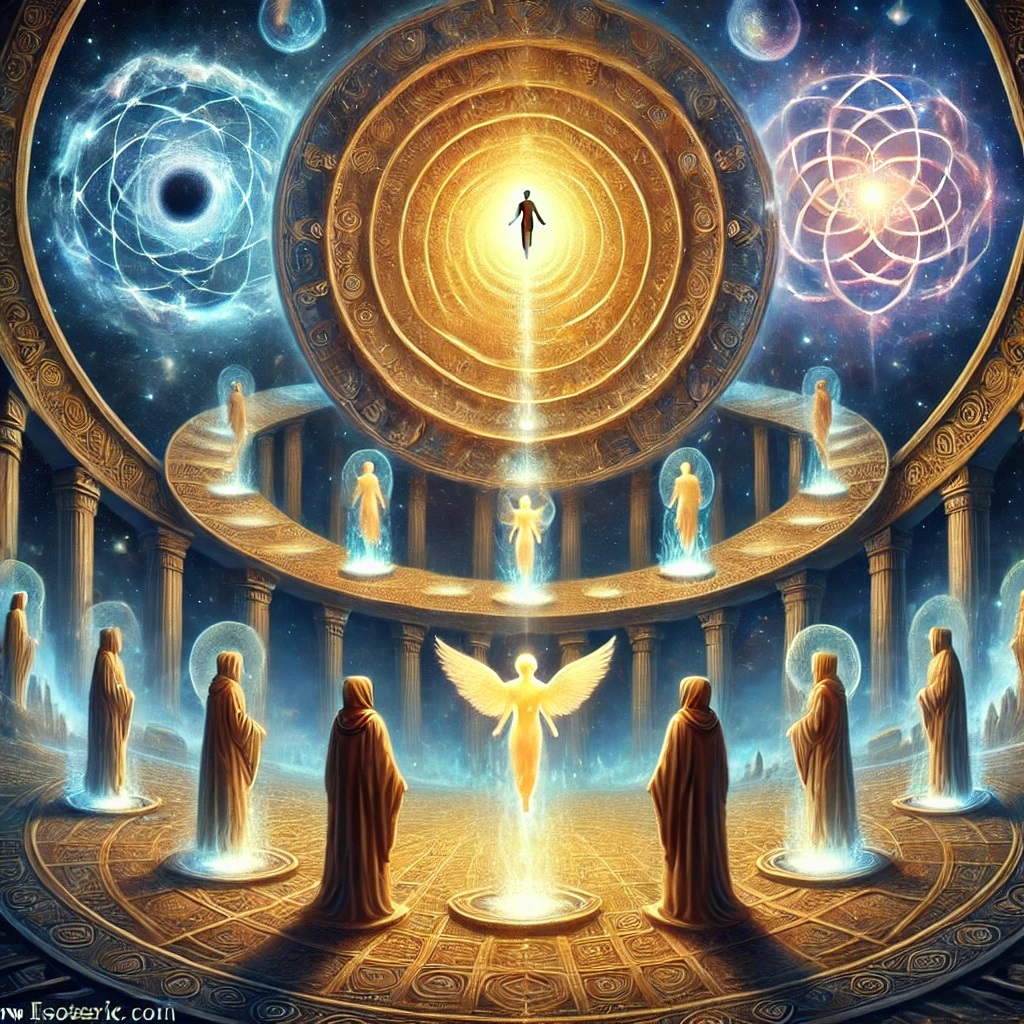
The Gnostics were not mystics of metaphor. They were engineers of the soul’s escape.
They didn’t just seek enlightenment. They mapped the post-mortem labyrinth.
They taught: If a soul awakens in life, remembers its origin, names the false gods, embodies the Light; it will pass through death unbound.
This is gnosis: inner knowing that survives the body.
Jesus, to them, was not a sacrifice. He was a living transmission, a Revealer from the Light, come to teach souls how to return.
“He who has come to know himself has already achieved knowledge of the Depth of All.”
Gospel of Truth (NHC I,3 22–25). Source
In the Pistis Sophia, he gives Mary passwords, names of light, and radiant seals, not to dominate others, but to guide the dead.
Every true Gnostic teaching is an afterlife map.
Every rite is a soul-signal. A bypass code. A liberation key against the Archons.
Every act of remembrance pulls the soul closer to the Pleroma.
This is why they burned the pages.
Because a soul that knows the way out cannot be kept in.
⚡ TL;DR
- Gnosis is more than knowledge; it is the soul’s memory, and it survives death.
- If awakened in life, the soul can pass through the Archonic toll gates unbound.
- Texts like Pistis Sophia contain soul-maps, passwords, and spiritual codes for the journey.
- Every Gnostic saying, seal, or name was a key to unlock a layer of the illusion.
- A soul that remembers cannot be detained, not by death, not by system, not by lie.
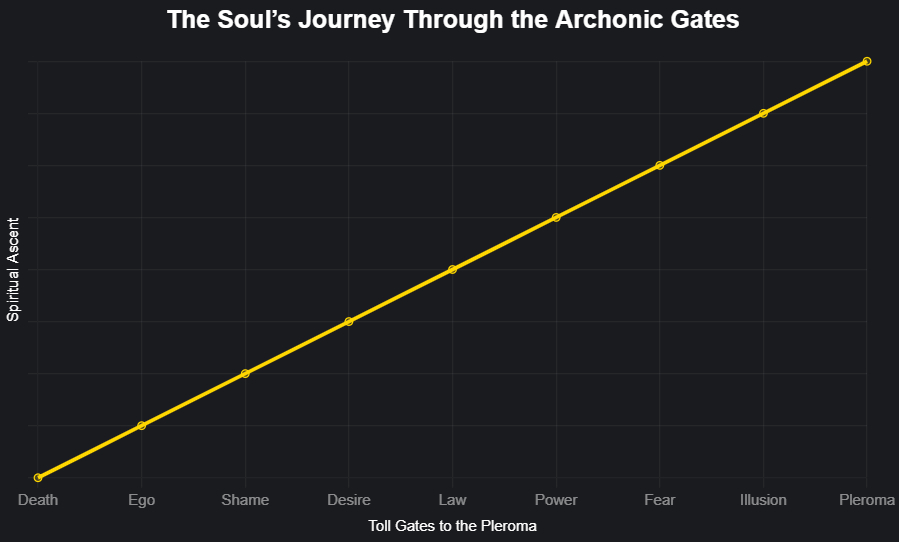
🗺️ Visual Map: The Soul’s Journey Through the Toll Gates
In Gnostic teachings, the soul does not ascend freely after death. It must pass through seven gates, layers of illusion, each guarded by an Archon.
Each gate poses a challenge of identity, memory, and allegiance.
- Death: The soul separates from the body
- Gate 1: Ego: “You are your name. Your title. Your story.”
- Gate 2: Shame: “You are too impure to rise.”
- Gate 3: Desire: “Don’t you want to return?”
- Gate 4: Law: “You disobeyed the system. You are guilty.”
- Gate 5: Power: “Bow. Submit. I am your ruler.”
- Gate 6: Fear: “Where will you go? Who will catch you?”
- Gate 7: Illusion: “There is no Pleroma. Only this.”
- The Pleroma: If remembered: the soul returns home
To each gatekeeper, the awakened soul answers:
“You are not my god. I am from the Light.”
🕳️ Chapter 4: What Happens If You Forget?
Not every soul remembers.
Some die in sleep. Some carry belief, but not gnosis. Some cry out to the wrong god, and the Archons smile.
Because if you forget your origin, you can be redirected.
If you call the Demiurge “Lord,” the toll gates open, but not to freedom.
You are recycled. Reinserted. Re-enchained in the wheel of birth, trauma, conformity, and amnesia.
Paraphrase: The soul that does not possess gnosis is powerless after death; it is thrown into forgetfulness and cast back into the world.
Gospel of Philip (paraphrase). Source
In the Gnostic vision, this cycle is not growth. It’s containment.
The Archons feed on repetition. On unprocessed karma. On loops of belief without liberation.
This is not punishment. It is programming.
The system doesn’t need your worship. It needs your forgetfulness.
But even here, there is hope.
Because every cycle carries a crack.
Every return is a new chance to remember. And the soul that remembers within the world can break it from within.
Note: The idea of reincarnation, souls returning to new bodies until they awaken, is prominent in Sethian Gnostic texts like the Gospel of Philip and Apocalypse of Paul. Other traditions, like the Valentinians, offered gentler cosmologies with less focus on rebirth. This page follows the Sethian stream, where forgetful souls are recycled by the Archons until gnosis frees them.
⚡ TL;DR
- If a soul dies without gnosis; it forgets and is cast back into the world.
- The afterlife is not automatic ascension; it is interrogation and redirection.
- Souls who worship the Demiurge unknowingly align with the Archons after death.
- This creates a loop: a wheel of reincarnation and spiritual amnesia.
- But every return carries a spark. Gnosis can break the loop, even from inside it.
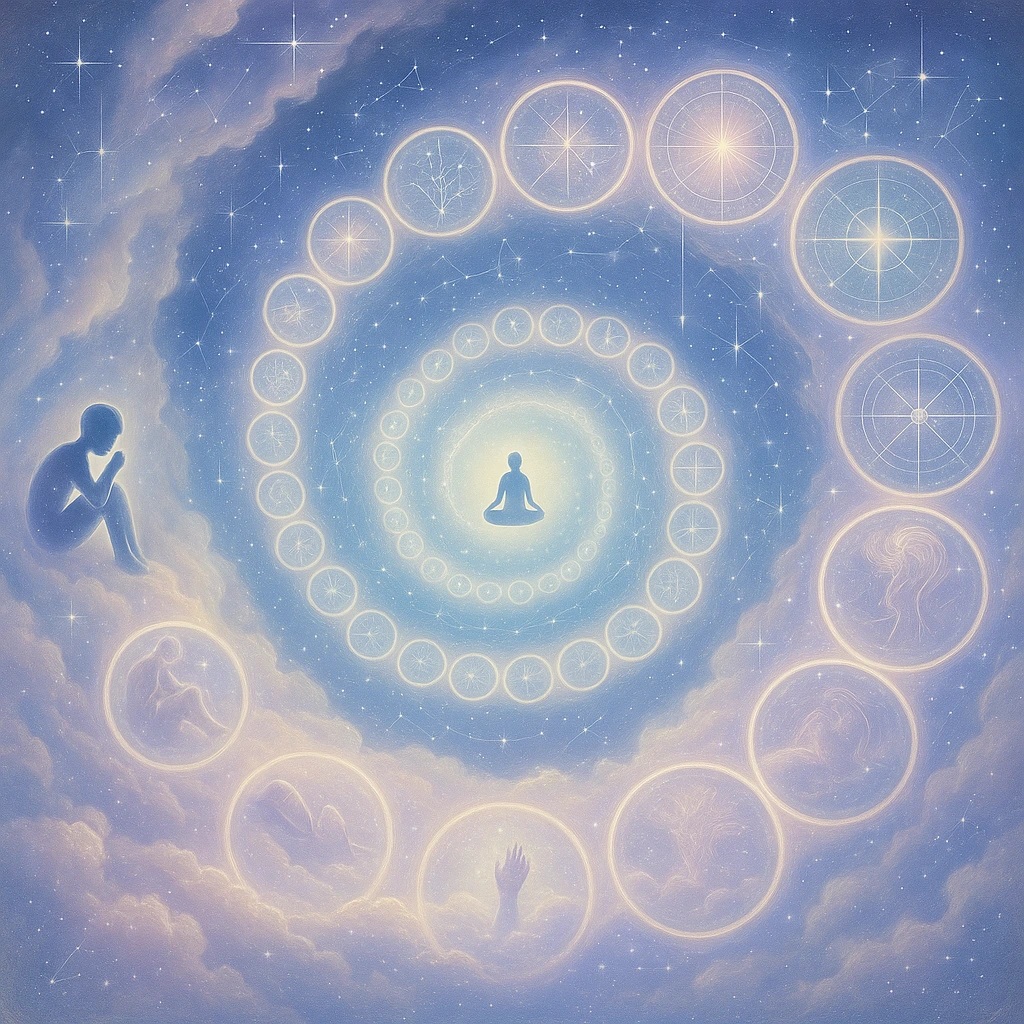
👁️ Chapter 5: The Final Return
When the soul has remembered…
When it has passed the toll gates…
When it has spoken the names, shattered the illusions, and burned off the body of forgetfulness.
Then it rises.
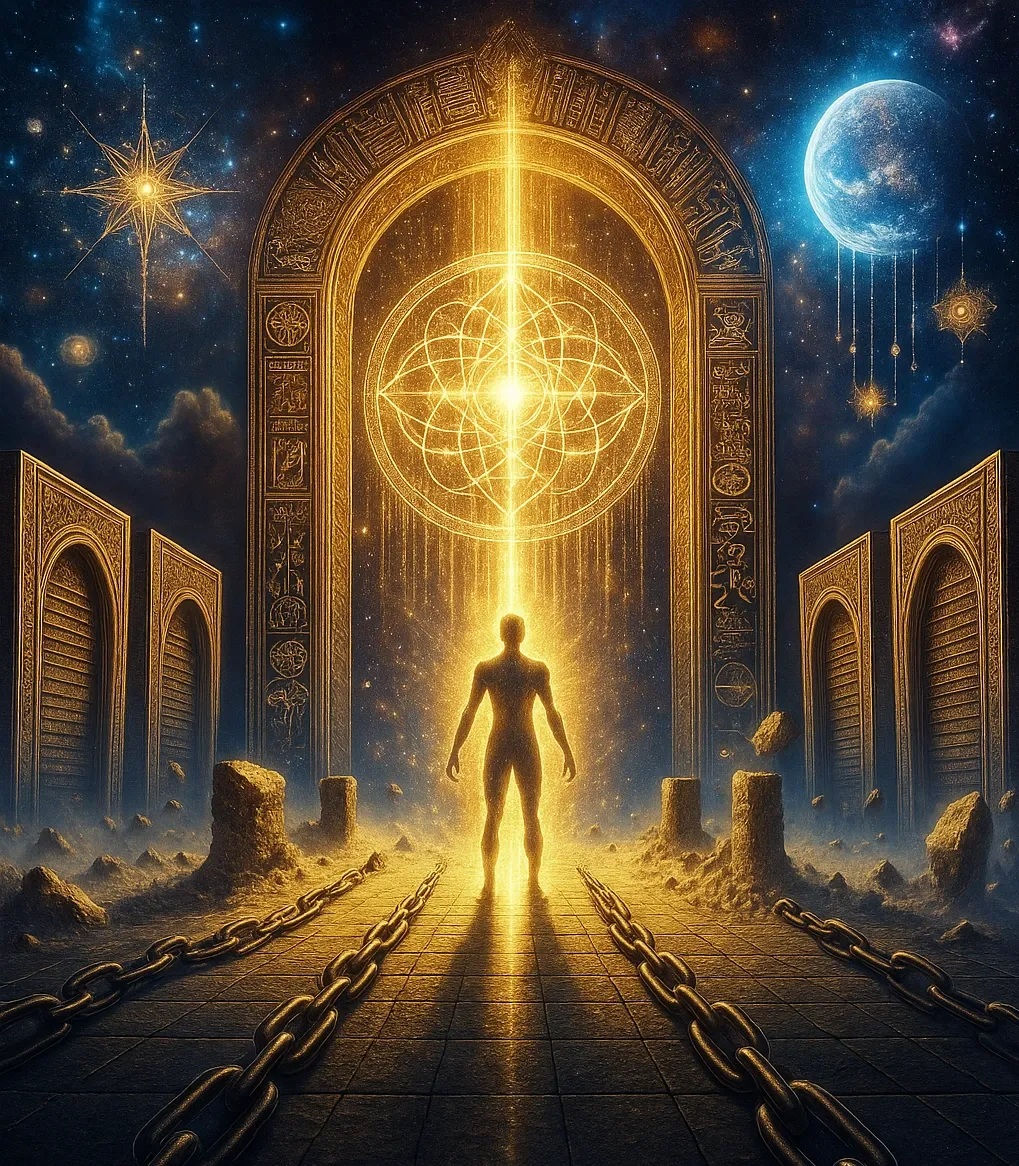
Not into heaven. Not into paradise. But into the Pleroma: the Fullness, the source-realm of light, truth, and total union.
This is not a place.
It is the original state.
Not reward, return.
“You are from the place where Light came into being by itself. You came from it, and you will return there.”
Gospel of Truth (NHC I,3 30–32). Source
In the Pleroma, the soul is no longer separate.
It does not float like a ghost. It does not worship. It remembers what it is: not a fragment, but the All.
Individuality dissolves into radiance. The spark merges with Sophia. And the exile ends.
This is the promise buried beneath religion. The liberation hidden behind the cross. The secret Jesus died to reveal: not to hide.
When you know this before death, the return is not just afterlife; it is now.
⚡ TL;DR
- The soul’s goal is not heaven, but the Pleroma: the divine realm of origin.
- When the soul passes the gates and dissolves ego; it returns to Fullness.
- This is not a reward but a remembrance, a reintegration with the divine All.
- The Gnostic Christ came to teach this final return, not to mediate it, but to mirror it.
- The return can begin now. Gnosis is the gate.
☠️ Chapter 6: Prepare Now, Dying Before Death
What if you didn’t have to wait for death?
What if the gates could open now: because the real prison was never the body, but the illusion that you were only the body?
To the Gnostics, the soul’s return wasn’t just a future hope. It was a present possibility.
“Die before you die.”
Let the false self burn. Let the Archons lose their hold. Let the voice of the Demiurge fall silent inside you.
This is the real resurrection, the rising of the divine spark while you still breathe.
“Whoever drinks from my mouth will become like me. I myself shall become that person, and the hidden things will be revealed to them.”
Gospel of Thomas (Saying 108, NHC II,2 51:10–15). Source
To die before death is to remember the Source.
To speak the passwords now. To pass the toll gates in dreams. To meet Sophia in silence. To stand before Christ, not as a worshipper, but as a mirror returned.
You do not need permission. You need memory.
This is the work. The flame. The page.
Now, read it inward.
⚡ TL;DR
- The Gnostics taught “dying before death”, awakening while still alive.
- This means shedding false identity, ego, fear, and reprogramming now.
- The toll gates can be passed through mystical states, memory, and gnosis in life.
- This is resurrection: the divine spark ignited before the body falls.
- When you remember who you are, death becomes a return, not a loss.
🧘 Chapter 7: Practicing Gnosis Today
Gnosis isn’t philosophy. It’s practice.
It begins in silence, deepens through honesty, and awakens through inner fire. The ancients whispered the codes, but the key must be turned from within.
1. Mirror Meditation
Inspired by Gospel of Thomas, Saying 3
Sit in silence. Place a mirror before you. Breathe. Look into your own eyes and ask: “Who am I beneath the lie?”
Let whatever rises come. You are not judging, you are remembering. Practice daily for 5–10 minutes. Track your responses, visions, and shifts in a journal.
2. Toll Gate Journaling
Each week, confront one Archon: Ego, Shame, Desire, Law, Time, Power, or Identity.
Ask yourself: “Where does this rule me?”
Write freely. Close with the declaration: “You are not my god. I am from the Light.”
Do one Archon per week, for 7 weeks. Record what cracks open as illusion dissolves.
3. Symbolic Recall
Before sleep, close your eyes. Picture a toll gate before you. An Archon demands: “Who are you?”
Speak your truth aloud: “I am from the Pleroma. I remember.”
Repeat nightly for 7 days. After each session, draw or write down any symbol, word, or dream fragment that lingers. These are soul-messages from beyond the veil.
These aren’t rituals. They are reminders.
Gnosis doesn’t save you; it wakes you. And in waking, the veil dissolves.
Want to track your progress? Start a 21-day Gnosis Journal. Mark each day you practice. After 3 weeks, reflect: What surfaced? What shifted? What false gods did you outgrow?
After 7 weeks, pause and look back. What once ruled you that no longer does?
🎨 Creative Prompt
Write a poem from the perspective of your soul at the toll gate, standing between the false god and the Light. Title it “I Remember”. Speak the truth of your origin.
🗣️ Will You Remember at the Gate?
This is not mythology; it is rehearsal. Forgetting begins now. Memory is the first liberation.
If you had to speak your soul’s origin at death, what would you say?
- What do you truly remember about your origin?
- Which false gods still whisper to you?
- If you met the Archons tonight, would you recognise them?
- Have you died before death, or are you still clinging to the mask?
Share your reflections using #TheGnosticKey and tag @thegnostickey.
🧠 Quiz
Can the soul pass the toll gates by memory rather than fear?
📖 Glossary
Terms for exile, escape, and the return to the Pleroma.
- Pleroma
- The Fullness: the radiant totality of divine being from which true emanations arise and to which the soul returns.
- Toll Gates
- Astral checkpoints or stations of testing where the soul's memory, identity, and knowledge are challenged during ascent.
- Gnosis
- Direct inner knowing of the divine: remembrance of the soul's true origin beyond belief, performance, or borrowed doctrine.
- Archon
- In Gnostic cosmology, a ruler of deception and control. Archons serve the demiurge, maintain the false world, and resist human awakening through fear, illusion, and domination.
- Demiurge
- The lesser creator god of Gnostic cosmology. Not the true divine but a craftsman who built the material world as a prison or distortion. Distinguished from the true ineffable source.
- Divine Spark
- In Gnostic cosmology, a fragment of divine fullness hidden within the soul, buried beneath forgetfulness and illusion. In the Buddhism episode, this parallels buddha-nature: the unconditioned luminous awareness that was never truly bound, waiting to be recognised rather than achieved.
- Forgetfulness
- The soul's loss of origin, memory, and inner truth under the pressures of the false world.
- Sophia
- In Gnostic cosmology, Divine Wisdom whose fall from the Pleroma mirrors the soul's exile into matter. In the Buddhism episode, Sophia's mirror function parallels the bardo deities: in both traditions, a figure that reflects the soul's own nature back to it, making recognition possible rather than requiring discovery of something new.
- Apocalypse of Paul
- A visionary text mapping the soul's ascent through heavens, rulers, and gates of testing.
Sources & Study Path
Texts detailing the soul’s ascent, the toll gates, and the return to the Pleroma.
📑 References
-
:A map of the Archons, toll gates, and passwords of ascent.
-
:Dialogues on seals, names, and liberating knowledge.
-
:Teachings on rebirth and reunion through gnosis.
-
:The soul’s ascent beyond fear and authority.
-
:Remembrance dissolves death.
-
[6] Second Treatise of the Great Seth
:The Revealer mocks the false powers and affirms liberation.
📖 Scholarly Sources & Translations
- Hans Jonas (1958). The Gnostic Religion. Beacon Press.
- Elaine Pagels (1979). The Gnostic Gospels. Random House.
- Marvin Meyer (ed.) (2007). The Nag Hammadi Scriptures. HarperOne.
- Bentley Layton (1987). The Gnostic Scriptures. Doubleday.
- Kurt Rudolph (1983). Gnosis. Harper & Row.
These sources are provided for verification, study and context. They represent diverse perspectives and are offered as reference points, not as doctrinal positions.
Continue the Conversation
All discussions are publicly readable. Posting requires an Initiate-tier account. New thread creation is currently available at Initiate while Adept upgrades are not yet live.
Support The Gnostic Key
If this work helps you, a small contribution keeps the archive alive.